

Summer Sandals and Plantar Fasciitis: Why "Cushy" Flip-Flops Make It Worse
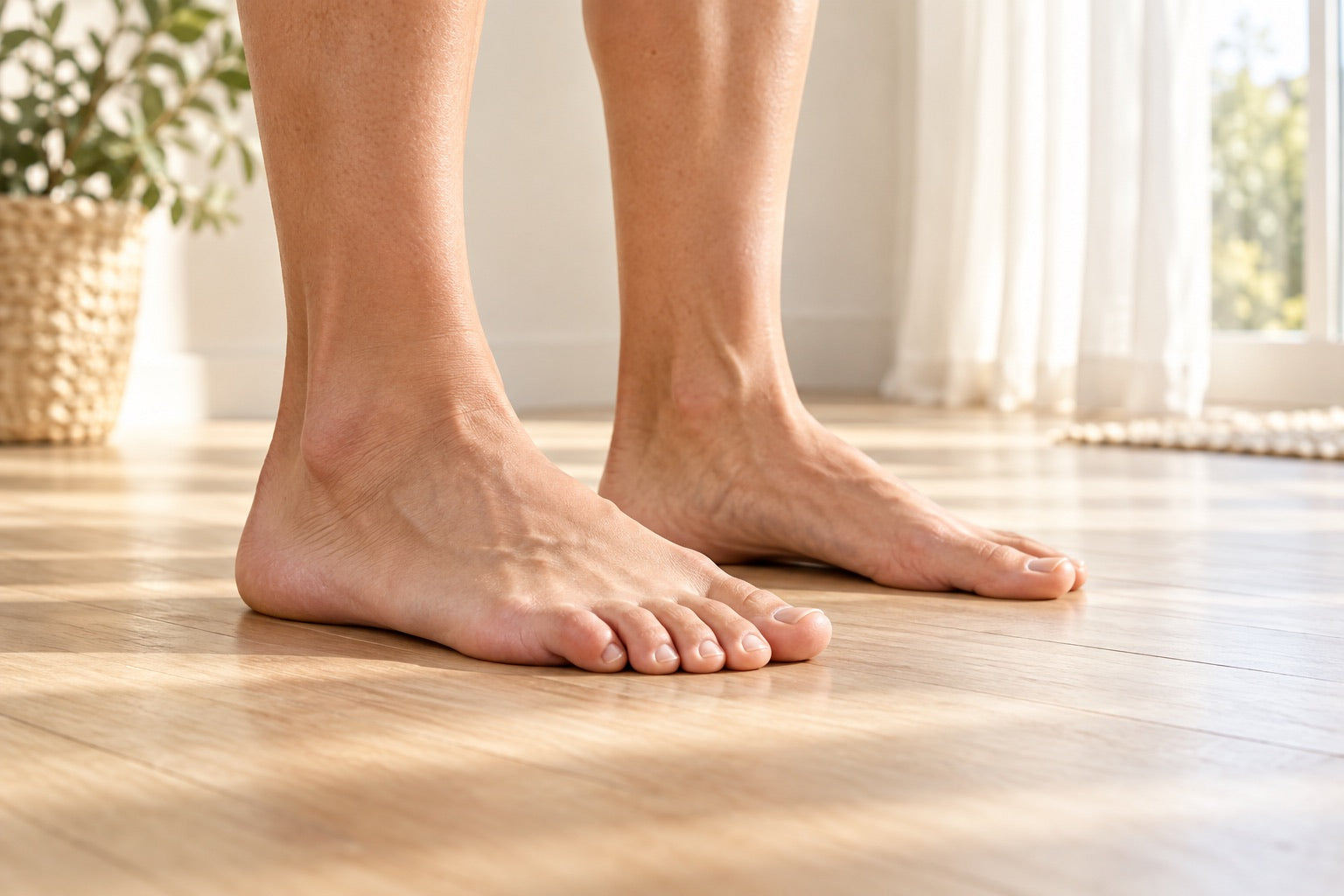
The first 75-degree day rolls around, the flip-flops come out of the closet, and within a week the morning heel pain is back with a vengeance. If that pattern sounds familiar, it isn't a coincidence — and it isn't because your feet have suddenly gotten "weaker" over the winter. It's because the footwear you reach for the moment the weather turns is doing something measurable, and measurably bad, to the soft tissue under your arch.
Plantar fasciitis is the most common cause of heel pain in adults, affecting roughly one in ten people at some point in their lives. It also has a strong seasonal pattern: podiatry clinics see a notable spike in new plantar fasciitis cases between May and August every year. Patients almost always blame "doing more outside." The footwear they're doing it in deserves at least equal blame.
Here's the part most people get wrong: the problem isn't that flip-flops are flat, or that they're cheap, or that they're "not real shoes." Plenty of properly designed sandals are excellent for foot health. The problem is that the standard summer flip-flop — the soft, cushy, $12 foam pair you grab at the drugstore — forces your foot into a specific compensatory pattern that loads the plantar fascia in exactly the way it shouldn't be loaded. And the cushier the foam, the worse this gets.
The biomechanics problem nobody tells you about
Walking in flip-flops is not the same as walking in shoes. It is also not the same as walking barefoot. It is its own gait pattern — and a measurably altered one.
A foundational 2008 biomechanical study by Shroyer and Weimar at Auburn University compared the gait of college-aged adults walking in flip-flops versus athletic shoes and found that flip-flop wearers took shorter steps and exhibited less vertical force at heel strike. On its surface that sounds protective. It isn't. The reason the steps got shorter wasn't because the wearer was being gentle with the heel. It was because the wearers were unconsciously curling their toes to keep the shoe on their foot, which shortens the available stride and changes how force travels up the chain.
A follow-up study published in the Journal of Foot and Ankle Research by Price and colleagues confirmed and extended these findings. Compared to sneakers, flip-flop wearers showed a shorter stride, a larger ankle angle at the beginning of double support and during swing phase, a smaller braking impulse, and a shorter stance time. The authors specifically attributed the increased ankle plantarflexion during swing to "contraction of the toe flexors to keep the flip-flop on the foot due to the lack of a heel-strap or full upper."
Translation: every step in a flip-flop, your toes clench the shoe to keep it on. If you walk 7,500 steps at a Saturday farmer's market, that's 7,500 extra toe-flexor contractions.
Why toe-gripping is a plantar fascia problem
Your plantar fascia isn't a random strip of tissue. It's the bottom rope of a structural mechanism called the windlass mechanism — the system that lets your foot transition from a soft, shock-absorbing surface at heel strike into a rigid lever for push-off.
The windlass mechanism works like this: as the toes — especially the big toe — extend at the end of the stance phase, the plantar fascia winds around the metatarsal heads, tightens, and pulls the heel and forefoot closer together. That tightening shortens the foot, raises the arch, and turns the whole structure into a stiff platform you can push off of. It is one of the most elegant pieces of human anatomy.
What happens when you wear a flip-flop? You override the windlass mechanism on the wrong end. Instead of the toes extending at push-off, the toes are flexing — gripping — to keep the shoe attached. The plantar fascia ends up under tension during the wrong phase of gait, repeatedly, for thousands of cycles per day. That repetitive maladaptive loading is exactly the mechanical pattern that produces microtears at the plantar fascia's insertion at the medial calcaneal tuberosity. That's the textbook origin of heel-pain plantar fasciitis.
The 2018 revision of the American Physical Therapy Association's clinical practice guidelines for heel pain explicitly identifies "footwear with limited support" and "prolonged weight-bearing in unsupportive footwear" as modifiable risk factors for plantar heel pain. The 2023 international revision of those guidelines kept that designation. It is the only category of footwear singled out by name in those guidelines.
Why "cushy" makes it worse, not better
This is the part that surprises most people, because it runs against the entire marketing logic of the summer footwear aisle. If your foot hurts, the instinct is to grab the softest, squishiest pair on the rack. "Pillowy footbed." "Cloud-like comfort." "Memory foam contour."
Those words describe a footbed that is, biomechanically, a problem. Here's why: a soft foam footbed compresses unevenly under load. Under your heel — the heaviest single contact point of the foot — the foam compresses the most. Under the longitudinal arch, where there's an air gap between your foot and the ground in most arch types, the foam barely compresses at all. So as the foam ages, your heel sinks into a crater while your arch is left supporting your bodyweight against an essentially unresponsive surface.
What does that do? Three specific things, each of which makes plantar fasciitis worse:
1. It deepens the calcaneal landing angle. When your heel drops into a soft, worn footbed, your rearfoot effectively lands in a tilted position. That increases the eversion moment at the subtalar joint, which is a fancy way of saying your arch collapses inward more aggressively at heel strike. More collapse means more strain on the plantar fascia.
2. It removes proprioceptive feedback. Your foot has roughly 200,000 sensory nerve endings on the plantar surface, and most of them respond to firm contact and pressure gradient. A pillowy footbed muffles all of that input. Your nervous system stops getting clean signals about where your foot is in space, and the small intrinsic foot muscles that should be co-contracting to stabilize the arch never fire correctly. The job gets dumped onto the plantar fascia, which is a passive structure not designed to do active stabilizing work.
3. It pairs zero arch contour with zero rearfoot control. Most cheap flip-flops are dead flat from heel to toe. The plantar fascia evolved to be supported by the bony arch, but if the arch is unsupported and the heel is unstabilized, the fascia is on its own. A soft, flat foam slab is essentially a guarantee of overuse loading on every step.
Who's most at risk this summer
Not everyone who wears flip-flops gets plantar fasciitis. But certain groups are dramatically more likely to develop it, and the seasonal switch from supportive winter footwear to summer slip-ons is often what tips them over the threshold.
The high-risk groups, based on the clinical literature, are:
People over 40. The plantar fascia loses water content and elasticity with age, and the heel fat pad — the natural cushion under your calcaneus — thins by roughly 25% between ages 30 and 60. Both changes mean less margin for error in your footwear choices.
People with flat feet or fallen arches. A 2025 study in Biomechanics examining how foot arch type affects gait in plantar fasciitis patients found that pes planus (flat-footed) individuals demonstrated excessive pronation throughout stance, while pes cavus (high-arched) individuals showed limited ankle dorsiflexion. Both deviations are amplified, not corrected, by an unstructured flip-flop.
People who recently increased activity. The classic Memorial Day weekend pattern: ten thousand steps at a barbecue, six thousand at a cookout, twelve thousand at the beach — all in flip-flops, after a winter of mostly sitting. The plantar fascia is a tendon-like structure, and tendons hate sudden volume changes.
People who stand on hard surfaces for work. Nurses, teachers, line cooks, retail staff. If you're going to summer-mode footwear and your day involves six-plus hours of standing, you're stacking risk factors.
Runners in the spring ramp. Mileage is going up. Cross-training between runs is happening in flip-flops. The fascia never gets a recovery window.
What to actually wear (and how to fix what you've already got)
The good news is that you do not have to give up open footwear for the summer. You have to give up unsupportive open footwear. Those are not the same thing.
Three real options, ranked by clinical evidence:
Option 1: Switch to a structured sandal with a contoured footbed and a heel cup. Sandals with a defined arch contour, a deep heel cup, and a firm midsole density behave more like a shoe than a flip-flop. The brands that get this right tend to charge $80 to $130 for a pair. They are worth the money if you're prone to heel pain.
Option 2: Add an insert to the closed-toe shoes you wear most of the day, and treat flip-flops as short-distance only. A 2024 randomized sham-controlled trial published in Clinical Rehabilitation by Fagundes and colleagues compared inserts adapted for daily-wear footwear against a sham control in 56 patients with persistent plantar heel pain. The insert group showed clinically meaningful improvements in pain and function at 12 weeks. The mechanism is straightforward: a properly designed insert restores the arch support and rearfoot control that everyday footwear strips away. The features that matter, per the literature, are a firm-but-pliable medial arch contour, a deep heel cup that re-centers the calcaneus, and a structural shell that doesn't compress flat by August. Slip a quality pair into your work shoes, your sneakers, your hiking shoes, and your closed-toe walking shoes — and save the summer slides for the pool deck.
Option 3: If you must wear flip-flops, wear ones designed by clinicians. A 2016 randomized controlled trial published in BMC Musculoskeletal Disorders by Chard and colleagues evaluated flip-flop footwear with a moulded, contoured foot-bed against unsupportive flip-flops in adults with foot pain. The contoured footwear group showed reduced foot pain over 12 weeks. The takeaway isn't that all flip-flops are fine; it's that contour and arch shape are the variables that matter, not openness or material. A 2025 study presented at the International Physical Therapy Research Symposium reinforced this finding, showing that physical therapy combined with arch-supportive flip-flops outperformed physical therapy alone over 8 weeks of intervention.
A few practical rules from the research: limit unsupportive flip-flops to under 30 minutes of continuous wear; never run errands in foam flip-flops (errands stack steps fast); replace any flip-flop where the footbed has a visible heel imprint deeper than 3–4 mm; and if you already have heel pain, stop the flip-flops entirely for two weeks while you address the inflammation, then re-introduce only contoured options.
The bottom line
Plantar fasciitis is not a punishment for wearing flip-flops. It's a predictable response to a specific pattern of mechanical loading — toe-gripping, unsupported arches, and flat foam footbeds — repeated over thousands of steps a day, for months at a time, on top of an already-vulnerable tissue.
The fix is not to suffer through summer in winter shoes. The fix is to be honest about what your "comfortable" flip-flops are actually asking your feet to do. A $12 foam slab marketed on softness is not a footwear choice; it's a load-management problem with a price tag.
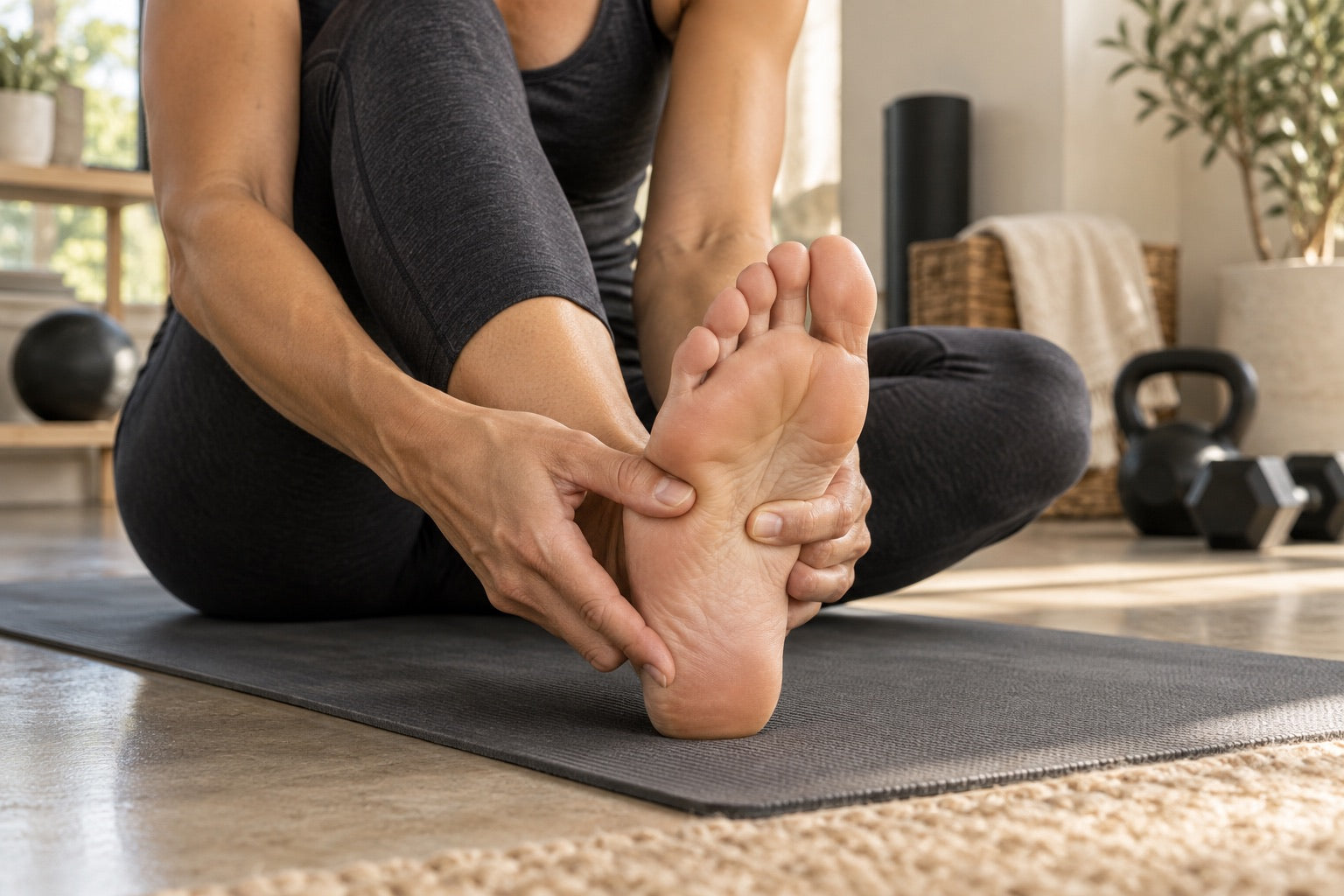
If you're already feeling that first-step morning pain, that telltale sharpness on the medial heel, or a dull ache after a long day in unsupportive sandals, the cheapest, fastest, most evidence-supported intervention you can make is to add structured arch and heel support to the footwear you wear most of the day. That alone, for most people, is enough to break the seasonal cycle and keep summer from becoming the season your feet stop working.
Your plantar fascia has done a lot for you. Give it something to lean on.
Related reading

Sources
- Shroyer JF, Weimar WH. Comparative analysis of human gait while wearing thong-style flip-flops versus sneakers. J Am Podiatr Med Assoc. 2010;100(4):251–257.
- Price C, Andrejevas V, Findlow AH, et al. Does flip-flop style footwear modify ankle biomechanics and foot loading patterns? J Foot Ankle Res. 2014;7:40.
- Chard A, Greene A, Hunt A, Vanwanseele B, Smith R. Flip-flop footwear with a moulded foot-bed for the treatment of foot pain: a randomised controlled trial. BMC Musculoskelet Disord. 2016;17:204.
- Fagundes MG, Mendes AAMT, Bezerra VF, et al. Effects of inserts adapted in flip-flop sandals in patients with persistent plantar heel pain: a sham-controlled randomised trial. Clin Rehabil. 2024;38(11):1471–1483.
- Koc TA Jr, Bise CG, Neville C, et al. Heel Pain — Plantar Fasciitis: Revision 2023. Clinical Practice Guidelines from the Academy of Orthopaedic Physical Therapy and the American Academy of Sports Physical Therapy. J Orthop Sports Phys Ther. 2023.
Medical disclaimer: This article is for educational purposes only and does not constitute medical advice. If you have persistent foot pain, severe heel pain, swelling, numbness, or any condition that is not improving with conservative measures, consult a qualified healthcare provider — typically a podiatrist, orthopedist, or physical therapist — for evaluation and individualized treatment.
Sources
- Price C, Andrejevas V, Findlow AH, Graham-Smith P, Jones R. Does flip-flop style footwear modify ankle biomechanics and foot loading patterns? Journal of Foot and Ankle Research, 2014; 7(1):40. DOI: 10.1186/s13047-014-0040-y
- Sharpe T, Malone A, French H, Kiernan D, O'Brien T. Effect of flip-flops on lower limb kinematics during walking: a cross-sectional study using three-dimensional gait analysis. Irish Journal of Medical Science, 2016; 185(2):493-501. DOI: 10.1007/s11845-016-1421-y
Frequently Asked Questions
Why summer footwear can quietly worsen plantar fasciitis.
Are flip-flops really that bad for plantar fasciitis?
Most flip-flops are flat, unstructured, and force the toes to grip the sole to keep the sandal on — which loads the plantar fascia continuously. For someone with active plantar fasciitis or a history of it, flip-flops can be a significant aggravating factor.
Are 'cushioned' sandals safer than flat flip-flops?
Cushioning alone doesn't add the arch support that's missing. Most marketed 'comfort' sandals provide a soft footbed but no structural arch — which can feel better at first but doesn't reduce the underlying strain on the plantar fascia.
What kind of summer footwear is plantar-fasciitis-friendly?
Look for sandals with a contoured arch (not just a soft footbed), a deep heel cup, and a strap system that doesn't require the toes to grip. Some brands sell sandals with a built-in orthotic-style footbed — those are typically a safer choice for people with current or recurring plantar fasciitis.
The WYATT takeaway
Softness is only part of the footwear decision. Look at the support you are relying on throughout the day, including the shoes you wear when sandals come off.
Sources
- Shroyer JF, Weimar WH. (2010). Comparative analysis of human gait while wearing thong-style flip-flops versus sneakers. Journal of the American Podiatric Medical Association, 100(4). PubMed
- Carl TJ, Barrett SL. (2008). Computerized analysis of plantar pressure variation in flip-flops, athletic shoes, and bare feet. Journal of the American Podiatric Medical Association, 98(5). PubMed
- Zhang X, Paquette MR, Zhang S. (2013). A comparison of gait biomechanics of flip-flops, sandals, barefoot and shoes. Journal of Foot and Ankle Research, 6(1). PubMed
- Koc TA Jr, Bise CG, Neville C, et al. (2023). Heel Pain — Plantar Fasciitis: Revision 2023. Journal of Orthopaedic & Sports Physical Therapy, 53(12). JOSPT
This article is for informational purposes only and is not medical advice. Consult a qualified healthcare provider before starting any treatment program.