

Why Your Recovery Sandals Aren't Doing What You Think They Are
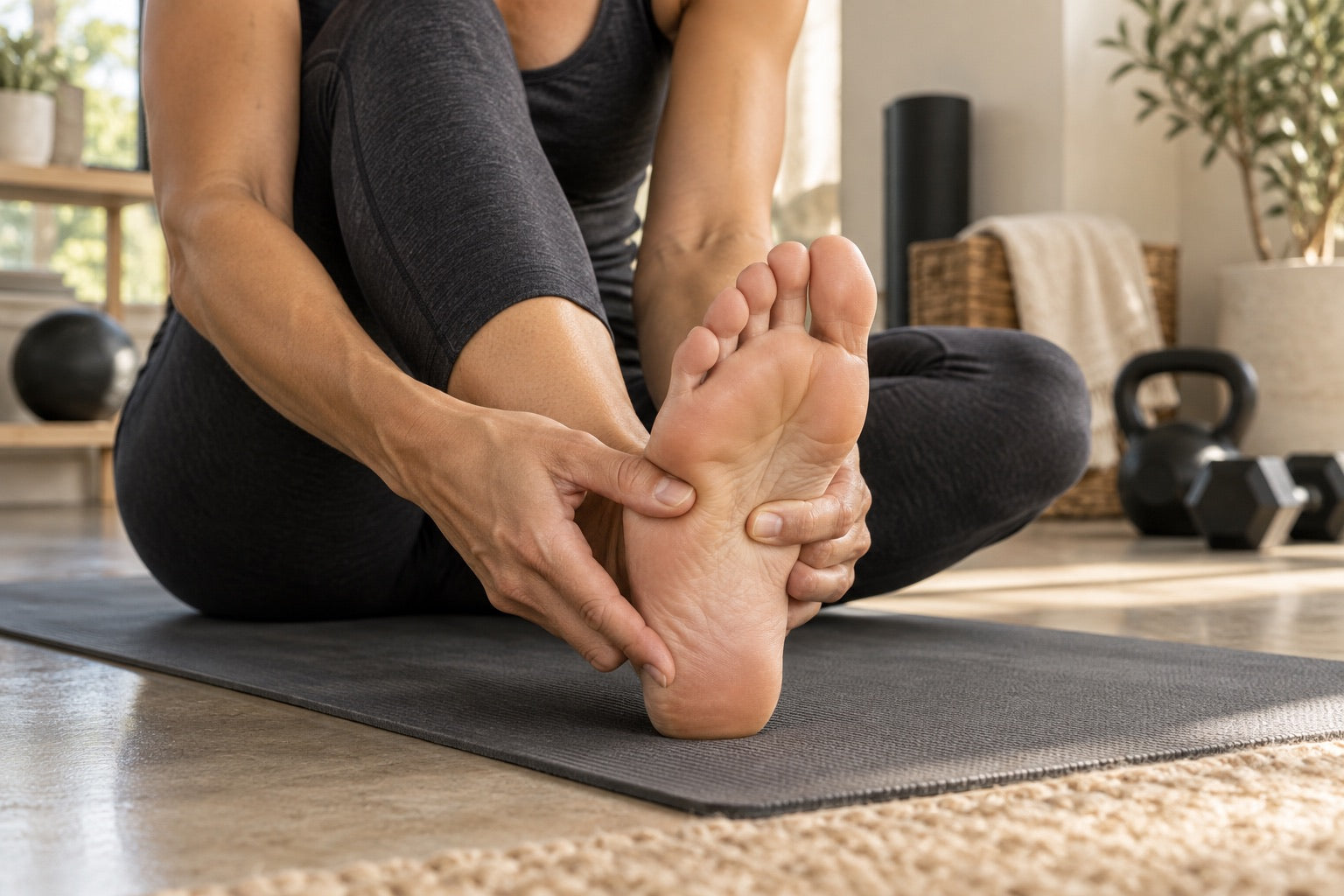
You finish a long shift, or a long run, or a long flight. You peel off the shoes you've been imprisoned in for ten hours. You slide your feet into the cushioned slip-on that has somehow become a uniform — the OOfos, the Hoka Ora, the Crocs LiteRide, the Hey Dude knockoff. The relief is immediate. The foam swallows your heel. Your forefoot stops aching. The first 30 seconds feel like proof that the shoe is doing something.
The relief is real. But the relief is not the same as recovery, and treating one as the other is how a category that began as a brief post-workout reset became the all-day footwear of nurses, teachers, runners, retail workers, and parents — many of whom develop new foot pain a few months in and assume the sandals just stopped working.
The sandals didn't stop working. They were never doing what most people think they were doing in the first place.
What "recovery sandals" actually are
The category is roughly five years old in mass-market terms, and its product platform is simple: a slip-on slide or sandal with a thick, soft midsole — usually a proprietary EVA-derivative foam (Oofos's "OOfoam," Hoka's plush midsole, Crocs's LiteRide) — and a vaguely contoured footbed. Marketing copy is built around three claims: high impact absorption, "natural foot posture," and arch cradling.
The category leader advertises that its foam absorbs "37% more impact than traditional EVA foam." That figure comes from internal lab testing, not a peer-reviewed clinical trial. "Absorbs more impact in a lab compression test" is not the same statement as "reduces injury risk in a real human walking around all day."
The APMA Seal of Acceptance — which appears on most of the major recovery sandal brands — is also worth understanding. It signals that a product meets baseline foot-health standards and has been reviewed by a panel of podiatrists. It is not a clinical trial outcome. A product can carry the seal and still be inappropriate for daily, all-day, long-term wear in the way millions of people now use it.
The wrong belief: "soft equals recovery"
The dominant assumption built into recovery-sandal culture is that softness, in itself, is therapeutic — that if a shoe feels like a cloud, it must be helping. The premise is intuitive: hard surfaces make my feet hurt, soft surfaces make my feet feel better, therefore softer is better.
This belief is partially true in a narrow window, and almost entirely wrong as a general principle. It conflates three different things: subjective comfort, impact attenuation, and therapeutic outcome. Subjective comfort is what your nervous system reports about pressure. Impact attenuation is what foam does to a force curve in a lab. Therapeutic outcome is whether the underlying tissue actually heals or strengthens. The three correlate, but they are not the same. A surface that maximally reduces felt pressure may also reduce muscular demand on the foot enough to weaken it over time. A surface that absorbs lab impact may let the foot collapse in ways that load the wrong tissue.
This is the reason "softer is gentler" never produced the clean injury-prevention story footwear marketing spent two decades promising.
What the cushioning research actually says
The most carefully studied cushioning question in footwear — running shoe midsole hardness — has been investigated in large randomized trials. In the Malisoux et al. 2020 study, 848 recreational runners were randomized to soft or hard versions of the same shoe and tracked over several months (Malisoux et al., 2020). The soft-cushioning group did show a lower running-related injury risk overall — but the protective effect was concentrated in lighter runners and largely absent in heavier ones. The relationship between perceived cushioning and injury risk turned out to be modulated heavily by individual biomechanics and body mass.
Even in the cleanest experimental conditions, cushioning is not a clean win. It interacts with bodyweight, gait, the structural elements of the shoe around it, and the surface the person is moving on. "More foam" is not a strategy.
Recovery sandals are doing something narrower than running shoes. They offer cushion. They do not offer heel counter rigidity, midfoot torsional control, lacing-based fit, or any meaningful arch geometry. The cushion is the entire intervention. If cushioning research on running shoes — where the rest of the shoe is engineered around the foot — produces a hedged, conditional answer, the cushion-only answer in a slip-on sandal is going to be hedged at best.
Mechanism #1: the passive bridge problem
Modern footwear, including recovery sandals, has a structural choice to make: passively support the arch (carry the load for the foot, like a bridge spanning a gap), or actively engage the arch (load the small muscles of the foot so they keep doing their job).
The foot is not a static structure. The plantar fascia, the long arch ligaments, and a layer of small intrinsic muscles work together as what researchers have called the "foot core" — a system of local stabilizers analogous to the deep core musculature of the trunk (McKeon et al., 2015). Like any muscular system, it adapts to the load it's given. Constantly load it and it stays strong. Repeatedly take its job away and it weakens — the same use-it-or-lose-it logic that governs every other muscle group in the body.
This is the quiet problem with the kind of footwear that "supports" the foot by lifting the load entirely off it. A pillow under your arch isn't training your arch. Over weeks and months of all-day wear, the small stabilizers that should be doing the work get smaller and weaker. Then, on the day you walk barefoot across a tile floor or jog half a mile in real shoes, the structures that should be holding your arch up have less capacity than they did before. People often interpret this — incorrectly — as the recovery sandals having "stopped working."
Recovery sandals are squarely in the passive-bridge camp. The cushion sits under the foot. The foot doesn't have to do anything. That's exactly why they feel so good in the first 60 seconds, and exactly why they're not a long-term answer.
Mechanism #2: no heel counter, no pronation control
Look at the back of a slip-on recovery sandal. No rigid heel cup. No medial post. The heel sits on a foam pillow, free to rotate in any direction the moving leg pulls it. For someone with a neutral gait and well-conditioned feet, that's fine. For the large portion of adults who overpronate — whose arches collapse medially under load — it's a problem.
Overpronation isn't just a foot phenomenon. It's a chain reaction. When the rearfoot rolls inward without resistance, the tibia rotates, the knee tracks medially, the hip drops on the swing side, and the lumbar spine compensates. Bonanno et al.'s 2018 trial in British Journal of Sports Medicine found that foot orthoses, which provide structural correction rather than only cushioning, can reduce overuse injury risk in athletic populations (Bonanno et al., 2018). The mechanism the orthoses are working on is exactly the mechanism a cushion-only sandal leaves untouched.
If you have flat feet, posterior tibial tendinopathy, plantar fasciitis with a pronation component, or chronic medial knee pain, a recovery sandal is not neutral for you. It is permission for the same biomechanical pattern that produced the pain in the first place to keep happening — but with a foam pillow softening the ground signal so you don't notice as quickly.
Mechanism #3: the all-day-wear drift
The recovery sandal began as a 30-minute post-workout reset. That use case is defensible. After a long run, the calf complex is fatigued, the plantar fascia has been loaded thousands of times, and the small muscles of the foot are tired. Decompressing that system in a soft, unstructured slide for half an hour is a reasonable cool-down strategy.
The problem is that the category drifted. People started wearing them to dinner. Then to the grocery store. Then to walk the dog. Then to standing 10-hour shifts on a hospital floor. A 30-minute decompression is fine. Twelve hours of weight-bearing on a surface that provides no structure is not a decompression — it's an extended experiment in passive support. The category was designed for the first use; it is being used for the second.
The cleanest test of whether you've drifted into all-day-wear territory: how many of your weight-bearing hours per week are spent in recovery sandals? If the number is more than a few hours total, you're not using them as recovery. You're using them as primary footwear — and the framework you should use to evaluate them is the framework for any primary footwear: structure, fit, and whether they engage your foot, not just how soft they feel in the first minute.
What the foot pain literature actually recommends
For the conditions recovery sandals are most often used to manage — plantar fasciitis, heel pain, generalized "tired feet" — the clinical literature converges on something different from cushion-only solutions.
For plantar fasciitis specifically, randomized trials have repeatedly shown foot orthoses to be effective, with prefabricated and custom devices producing comparable outcomes (Landorf et al., 2006; Hawke et al., 2008). The 2023 JOSPT guidance for plantar heel pain recommends foot orthoses as a first-line intervention alongside stretching and progressive loading (JOSPT, 2023). The mechanism is not "more cushion" — it's structural support that controls how the foot loads, paired with active conditioning.
The orthotic literature isn't competing with the cushion literature. Cushion is one variable. Geometry is another. Engagement of the small muscles is a third. The interventions that produce durable improvement in plantar heel pain or arch pain or runner's overuse injury are the ones that address geometry and engagement, not the ones that only soften the ground.
Where recovery sandals legitimately help
Recovery sandals are not useless. The honest case for them: the post-run cool-down is real — letting a tired plantar fascia and Achilles complex decompress in a soft, unstructured shoe for 20–60 minutes is a reasonable use of the category. The post-shift decompression is real. After eight or ten hours in stiff work footwear, switching into something soft for the evening is fine. Walking from couch to kitchen is not the kind of activity that demands biomechanical correction.
What recovery sandals are not designed to do, and what their construction can't do: resolve plantar fasciitis, correct overpronation, strengthen weak feet, replace a shoe with structure for a 12-hour shift, or substitute for a properly contoured insert in a properly fitted shoe.
The framework most people should use: recovery sandals are an evening shoe. Inserts and supportive shoes are the working tools.
The right mental model: cushion the moment, engage the structure
The most useful frame for thinking about footwear and foot health is to separate acute decompression from chronic conditioning. Acute decompression is what you want when a tissue is fatigued and needs to reduce its load briefly — a recovery sandal is fine for that. Chronic conditioning is what you want for the rest of your life: footwear and inserts that engage your foot rather than carry its load for it.
What conditioning footwear looks like in practice: a shoe that fits, with a structured heel counter, paired with an insert whose contour wakes up the small muscles of the foot rather than letting them sleep through the workday. The contoured geometry doesn't just soften pressure; it changes which muscles are firing, how the foot sequences through stance phase, and how load is distributed from heel strike through toe-off. Done well, the foot does more work in this kind of footwear, not less — but the work is the right work, and the system gets stronger over time rather than weaker.
This is the design philosophy behind FCSS Pro, the patented insert system that has been refined through decades of pedorthic patient feedback. It isn't a foam pillow. It's a contoured insert whose geometry engages the foot's intrinsic stabilizers under load — an active conditioning surface, not a passive bridge. The result is what you want from anything load-bearing in the body: the structure does its share of the work, and the muscles around it stay strong because they're being used.
What to do this week
If you've been living in recovery sandals and you've noticed your feet getting worse instead of better, the move is not to throw them out. Right-size their role. Use them for what they're good at — the evening reset, the post-workout cool-down, the 20 minutes around the house — and put structured footwear with a real insert back in the rotation for the hours that demand it.
If your daily footwear is currently a slip-on slide and a pair of work sneakers with the factory sock liner still in them, the single highest-leverage change you can make in the next 30 days is probably the insert. Not the sandal. The thing under your foot during the eight hours that matter most.
Related reading

Sources
- Malisoux L, Delattre N, Urhausen A, Theisen D. (2020). Effect of shoe cushioning on landing impact forces and spatiotemporal parameters during running: results from a randomized trial including 800+ recreational runners. European Journal of Sport Science. PubMed
- McKeon PO, Hertel J, Bramble D, Davis I. (2015). The foot core system: a new paradigm for understanding intrinsic foot muscle function. British Journal of Sports Medicine, 49(5):290. BJSM
- Bonanno DR, Murley GS, Munteanu SE, Landorf KB, Menz HB. (2018). Effectiveness of foot orthoses for the prevention of lower limb overuse injuries in naval recruits: a randomised controlled trial. British Journal of Sports Medicine, 52(5):298–302. BJSM
- Landorf KB, Keenan A-M, Herbert RD. (2006). Effectiveness of Foot Orthoses to Treat Plantar Fasciitis: A Randomized Trial. Archives of Internal Medicine, 166(12):1305–10. PubMed
- Hawke F, Burns J, Radford JA, du Toit V. (2008). Custom-made foot orthoses for the treatment of foot pain. Cochrane Database Syst Rev. Cochrane
- Koc TA, Bise CG, Neville C, Carreira D, Martin RL, McDonough CM. (2023). Heel Pain – Plantar Fasciitis: Revision 2023. Journal of Orthopaedic & Sports Physical Therapy, 53(12):CPG1–CPG39. JOSPT
This article is for informational purposes only and is not medical advice. Consult a qualified healthcare provider before starting any treatment program.
Frequently Asked Questions
What recovery sandals actually do (and don't do) for foot recovery.
Do recovery sandals really help recovery, or is that marketing?
Recovery sandals provide a soft, contoured footbed that feels good after a hard workout — that part's real. What's overstated is the claim that they actively heal tissue or restore foot mechanics. They're a comfort tool, not a therapeutic intervention.
Are recovery sandals a substitute for orthotic inserts?
No. Recovery sandals are designed for short post-activity wear and lack the structural support needed for hours of standing or walking. If you're using recovery sandals as your daily footwear, you're likely under-supporting your foot during the hours that matter most.
Can recovery sandals make foot pain worse?
If they're too soft and you wear them all day, they can fail to support arch mechanics and contribute to plantar fascia strain or posterior tibial overload. Use them for what they're made for: 30–60 minutes of decompression after activity.
Buying for everyday shoes rather than an open slide?
Start with what you are buying: a complete sandal, a soft replacement liner or a separate structural insert. These are different constructions, and the word “recovery” does not tell you whether an item belongs in your everyday shoes.
Check the shoe before choosing the insert
A separate insert needs a suitably fitting shoe that encloses and retains it. It is not an accessory to place loose in an open recovery slide. Check the shoe’s interior space, its existing liner and the insert’s fit instructions before buying.
Compare construction, not just softness
FCSS™ Pro is a firm, three-quarter-length polypropylene insert with a deep heel cup. A soft full-length liner covers a different area and has a different construction. Compare the material, length and shape with what you intend to put inside your shoes; these differences alone do not establish which product will address your pain.
For the terminology behind those choices, read our comparison of insoles and inserts. If you are shopping because of plantar fasciitis, use our plantar fasciitis insert buying questions to organize the practical checks before purchasing.
The WYATT takeaway
Judge recovery footwear by what it does underfoot, not just how soft it feels when you first put it on. That distinction is central to WYATT's approach to support.