
Your Watch Counts Steps, Not Load: What 2026's #1 Fitness Trend (Wearables) Misses About Your Feet
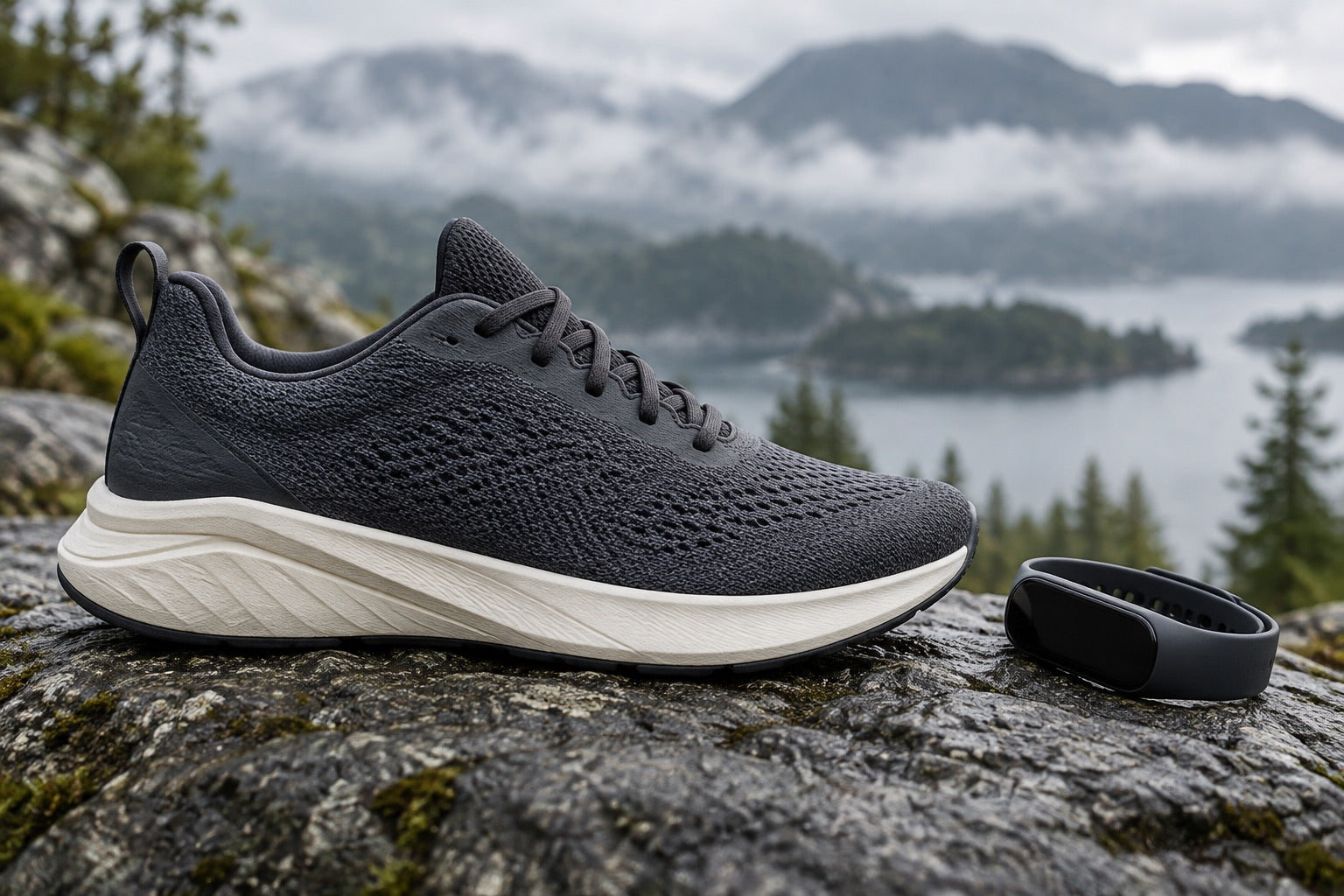
If you strap on a smartwatch before a walk or run, you are already ahead of most people. The instinct to measure your activity — to see your steps climb, your heart rate settle into a zone, your sleep and recovery trend in the right direction — is one of the healthiest habits the last decade of fitness culture has produced. It is no accident that wearable technology just topped the American College of Sports Medicine's 2026 worldwide fitness trends survey for the third straight year, a spot it has now held more times than any other trend in the survey's history.[1] Tracking works because what gets measured gets managed, and a wrist device that nudges you to move, hydrate, and rest is a genuinely good thing for your health.
So let's be clear up front: your watch is not the problem. The problem is a quiet gap between what it measures and what actually determines whether your feet hold up. Your device is superb at counting the events of movement — steps, minutes, beats, floors climbed. What it cannot see is the mechanical load each of those events drives through your arch and heel. And when your feet start aching in the middle of a training block that your watch says is going perfectly, that blind spot is usually where the answer is hiding.
What Your Wearable Genuinely Gets Right
Give the technology its due, because it has earned it. A modern wrist wearable is a remarkable piece of engineering. It tracks heart rate continuously and accurately enough to guide training intensity. It counts steps and estimates distance well enough to keep you honest about your weekly volume. It monitors sleep stages, resting heart rate, and heart-rate variability — real physiological signals that reflect how well you're recovering. Newer devices layer on skin temperature, blood-oxygen readings, and even glucose trends. For managing the systemic side of fitness — cardiovascular fitness, recovery status, consistency — a good wearable is one of the best coaching tools money can buy.
This matters because the systemic signals are real and worth acting on. If your watch shows your resting heart rate creeping up and your sleep fragmenting, that is meaningful data about accumulated fatigue. If it shows you've been sedentary for six hours, the reminder to stand and move is doing you a favor. None of that is in dispute. The device is telling you the truth about the variables it was built to sense. The trouble only starts when we assume it's sensing a variable it was never designed to touch.
The One Thing It Doesn't Measure: Load
Here's the gap. Your wearable counts a step as a step. To the accelerometer on your wrist, a slow stroll on carpet and a hard heel-strike on summer asphalt at the end of a long run both register as "one step, +1 to the daily total." But your foot experiences those two events on completely different scales. With every running stride, the ground pushes back on your body with a force of roughly two-and-a-half to three times your body weight — and that force gets absorbed, redistributed, and channeled through the small structures of your foot before anything else in the chain gets a say.
Step count is a tally of how often your foot hits the ground. Load is a measure of how hard, and the two are not the same number. Ten thousand easy steps on a soft trail and ten thousand steps that include a fast tempo block on concrete can produce wildly different amounts of tissue stress at the plantar fascia — yet your watch records them as the same round, satisfying five-figure achievement. That's the mismatch. The metric you're optimizing (steps) is a proxy for the thing that actually injures feet (cumulative mechanical load), and it's a looser proxy than most people realize.
The Research Wearable Makers Don't Put on the Box
This isn't a hunch — it's a known limitation that biomechanics researchers have measured directly. In a widely cited study, scientists set out to test whether the force signals a wearable can capture actually track the load that internal structures endure. Their finding, published in PLOS ONE, was blunt enough that they put the implication right in the title: ground reaction force metrics are not strongly correlated with tibial bone load when running across speeds and slopes — with explicit "implications for science, sport and wearable tech."[2] In plain language, the external forces a device can estimate are a poor stand-in for the internal load your tissues are actually managing. The number on your screen and the strain inside your foot are two different quantities.
Why the disconnect? Because the largest forces acting on your skeleton during a stride don't come from the impact of your foot smacking the ground — they come from your own muscles contracting to control that impact and propel you forward. The relationship shifts with speed, with slope, and with how you land. Related work analyzing runners with tibial stress injuries has shown that impact loading and ground reaction force waveforms differ meaningfully between injured and healthy runners in ways a simple step tally can never surface.[3] A wrist accelerometer sampling your arm's motion is several links removed from any of this. It is guessing at load from the wrong end of the body.
The load story also isn't just about a single hard step — it's about accumulation. The clearest framework in the sports-science literature is simple: injury happens when cumulative training load outpaces the tissue's capacity to absorb it.[4] Bone, fascia, and tendon all adapt to load, but only when the dose and the recovery are matched. A step counter tracks the dose in the crudest possible unit and says nothing about capacity, about the rate of loading, or about whether last week's spike left your tissues under-recovered going into this week. That's the information your feet actually run on, and it's precisely the information your watch doesn't have.
Why Load, Not Steps, Is What Irritates the Fascia
To understand why this gap matters so much for your feet specifically, it helps to know what the plantar fascia does. That thick band of tissue running from your heel to the base of your toes acts like a spring and a shock absorber. Every time you load the foot, the arch lowers slightly and the fascia stretches to store energy; as you push off, it recoils to help launch you forward. It's an elegant system, and it's built to handle a lot of load — as long as the load stays inside its capacity and gets enough recovery to adapt.
Plantar fasciitis is, at its core, a load-management failure. The tissue is asked to absorb more cumulative stress than it can repair between sessions, and it becomes irritated at the point of highest strain, usually right where the fascia anchors to the heel. Notice that this is a story about load and recovery, not about step count. You can develop it walking if the surfaces are hard, the volume spikes, and support is absent. You can develop it running while hitting a "perfect" weekly step goal, if too many of those steps were high-load and too few were easy. The metric that predicts trouble is how much strain the fascia absorbed and whether it had time to bounce back — neither of which lives on your wrist.
This is also why the surfaces and shoes you move on quietly rewrite the math. A day of city walking on concrete, a barefoot stretch on hardwood, a tempo run on hot asphalt — each pours more load into the same step. Your watch sees identical step totals; your fascia sees a heavier bill. If you've ever wondered why a lighter-mileage week left your heels more sore than a bigger one, the answer usually isn't in the step count. It's in the load per step, which is the one column your tracker leaves blank.
How to Close the Tracking Gap
The point isn't to distrust your watch — it's to fill in what it can't tell you. A few principles turn a step-obsessed routine into one that actually protects your feet.
Read load, not just laps. Get in the habit of mentally weighting your steps by how hard they were. A hilly run on pavement, a long day on your feet at a trade show, or a plyometric bootcamp class should count for far more in your internal ledger than the same step total accrued on a soft treadmill. Your watch won't do this weighting for you, so you have to. When you plan a hard-surface or high-intensity day, treat the next day as a recovery day regardless of what your step goal says.
Respect the ramp, not the milestone. Because injury tracks cumulative load against capacity, the fastest way to overrun your feet is to spike volume or intensity to chase a streak or a new personal best. The research on protecting against overuse is remarkably consistent: most of your easy volume should stay genuinely easy so the hard efforts don't compound into an injury. We broke down the runner data behind that ratio in our piece on why easy mileage protects your feet, and the principle applies whether you run, walk, or cross-train.
Don't confuse a scan or a stat with a solution. The wearable boom has a cousin in the at-home foot-scanning boom, and both share the same seductive flaw: they generate an authoritative-looking number that doesn't actually change what's happening under your foot. We covered that trap in our breakdown of what at-home 3D foot scans capture and miss. Data about your foot is useful; it is not the same as reducing the load your foot has to absorb.
Lower the load per step at the source. This is where support does its quiet work. A well-engineered orthotic insert reduces the peak strain the fascia has to absorb on each stride — structured arch contact spreads the load, and targeted cushioning blunts heel impact. That's not a metric on a screen; it's a mechanical change to the input. Clinical trials of prefabricated supports for plantar heel pain have found meaningful improvements in pain and function compared with no support.[5] Lowering load per step is exactly the lever your tracker can measure the effects of — steadier training, fewer flare-ups — but can never pull on its own.
The Bottom Line on Your Wrist Data
Wearable technology deserves its place at the top of the fitness world. It has made millions of people more active, more consistent, and more aware of their own recovery, and that is a real public-health win. Keep tracking. Keep chasing your streaks. Just understand what the numbers are and aren't telling you. Steps, heart rate, and sleep are honest signals about your activity and your systemic recovery — but they are silent about the mechanical load your feet quietly absorb on every one of those steps. That load is what irritates the plantar fascia, and it's the one variable your device leaves blank.
The fix isn't a better gadget. It's closing the gap the gadget can't: weight your steps by how hard they were, ramp your volume patiently, and reduce the load per step at the source so your feet can keep pace with the rest of you. Conservative measures — supportive footwear, quality inserts, calf and foot flexibility, and sensible progression — remain the first-line approach for the vast majority of heel pain.[6] Your watch will happily record the result: more good days on your feet, and fewer that end with your heels reminding you what the tracker forgot to count.
Frequently Asked Questions
Does my smartwatch or fitness tracker measure the impact on my feet?
No. Consumer wrist wearables count steps and estimate distance, heart rate, and calories, but they do not measure the mechanical load your feet actually absorb. Biomechanics research has shown that the external force signals a wearable can estimate are not strongly correlated with the internal load structures endure — the forces are several body-segments removed from what a wrist accelerometer senses. Your step count tells you how often your foot hit the ground, not how hard.
If my step count is normal, why do my feet still hurt?
Because step count doesn't capture load per step. Ten thousand steps on hard pavement, in unsupportive shoes, or including a fast or hilly effort deliver far more strain to the plantar fascia than ten thousand easy steps on a soft surface — yet your tracker records them identically. Plantar fasciitis is a load-management failure: it develops when cumulative stress on the fascia outruns its capacity to recover, which can happen even when your daily numbers look perfectly on target.
How do I actually manage foot load if my watch can't?
Weight your steps mentally by how hard they were and follow high-load days with genuine recovery; keep most of your easy volume truly easy so hard efforts don't compound; ramp volume gradually rather than spiking it to chase a goal; and reduce the load per step at the source with supportive footwear and quality orthotic inserts. Those steps lower the strain your fascia absorbs — the exact variable a step counter can't see.
The WYATT takeaway
Your wearable is coaching you off step counts, heart rate, and calories — all real metrics — but it never measures the mechanical load your feet absorb. So your training looks perfectly managed on screen while your arches quietly bank stress the device can't see.
When cumulative load on the plantar fascia outruns its capacity to recover, the tissue at the heel and arch becomes irritated and inflamed — the beginning of plantar fasciitis. By the time the pain shows up, the "load debt" has been accruing for weeks, invisible to a step tally.
The FCSS™ Pro is a removable engineering modification that reduces the peak load your fascia has to absorb on every one of those steps — structured arch support plus targeted heel cushioning — so you can keep chasing your rings and streaks without your feet paying the tab.
References
- American College of Sports Medicine. The Future of Fitness: ACSM Announces Top Trends for 2026 (wearable technology ranked #1). ACSM, 2025. acsm.org
- Matijevich ES, et al. Ground reaction force metrics are not strongly correlated with tibial bone load when running across speeds and slopes: Implications for science, sport and wearable tech. PLOS ONE, 2019. journals.plos.org
- Ground Reaction Forces and Impact Loading Among Runners with Different Acuity of Tibial Stress Injuries. PMC, 2024. pmc.ncbi.nlm.nih.gov
- Warden SJ, et al. Preventing Bone Stress Injuries in Runners with Optimal Workload. Current Osteoporosis Reports, 2021. pubmed.ncbi.nlm.nih.gov
- Landorf KB, Keenan AM, Herbert RD. Effectiveness of foot orthoses to treat plantar fasciitis: a randomized trial. Archives of Internal Medicine, 2006. pubmed.ncbi.nlm.nih.gov
- Cleveland Clinic. Plantar Fasciitis: Causes, Symptoms & Treatment. Cleveland Clinic. my.clevelandclinic.org
Reviewed and approved by the WYATT MVMT Podiatric Care Team — backing every step with 35+ years of custom orthotic engineering.