Heel Spurs vs. Plantar Fasciitis: The Complete Treatment Guide
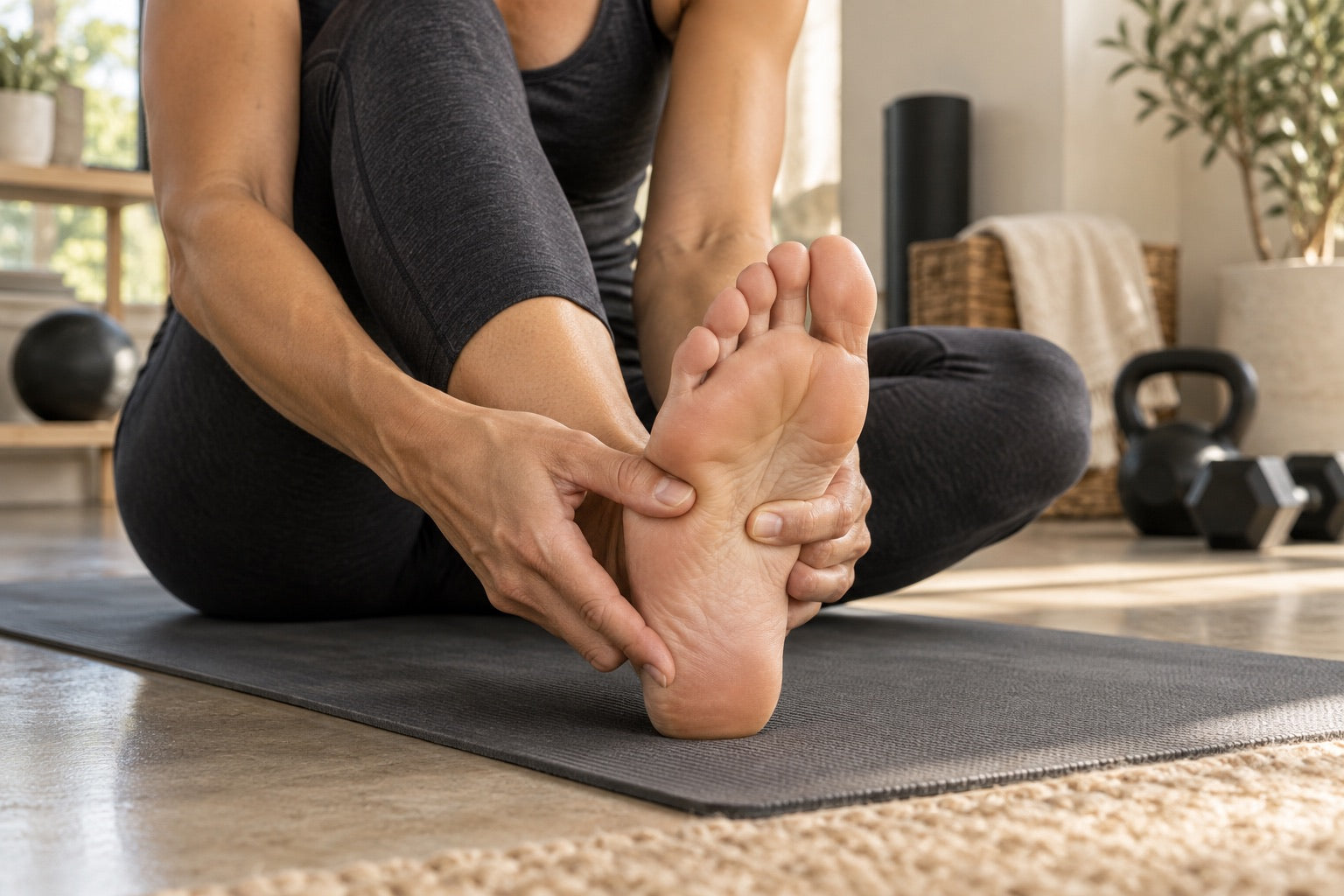
- Heel spurs and plantar fasciitis are related but not the same condition — the spur is a bone adaptation, the pain almost always comes from the soft tissue around it.
- Roughly half of people with a visible spur on X-ray have no pain at all.
- The 2023 JOSPT clinical practice guideline1 recommends structural orthotic inserts as first-line non-surgical treatment for both.
- Surgical spur removal is reserved for the small percentage who don't respond to 9-12 months of conservative care — and even then, outcomes are mixed.
- Most cases resolve in 6-12 weeks with proper structural support and load management.
Heel spurs are one of the most misunderstood diagnoses in foot medicine. The X-ray shows a bony growth on the heel, the doctor calls it a heel spur, and the patient walks out thinking the spur is the source of their pain — and that surgery is the answer.
Neither is usually true.
Heel Spur or Plantar Fasciitis? The Difference That Actually Matters
Clinicians, urgent-care doctors, and X-ray reports use "heel spur" and "plantar fasciitis" almost interchangeably. They're not the same thing, and the difference changes how you should treat the pain.
Plantar fasciitis is an overload injury of the plantar fascia — the thick band of connective tissue running from your heel bone to the base of your toes. Despite the "-itis" suffix, research going back over two decades shows the tissue is primarily degenerative, not acutely inflamed: a histological study of biopsies from chronic heel-pain patients found myxoid degeneration and collagen disarray rather than classic inflammation, which is why many clinicians now prefer plantar fasciosis or fasciopathy.8 It's common — roughly 10% lifetime incidence, and about one million U.S. physician visits a year.9
A heel spur (clinically, a calcaneal spur) is a small bony outgrowth — an osteophyte — that forms where the fascia attaches to the heel bone. It develops slowly, over months or years, as the body lays down extra calcium in response to chronic mechanical traction. On X-ray it looks alarming: a hook of bone projecting forward from the heel. It's rarely the actual source of pain.
Here's the part most people never hear: a case-control X-ray study found calcaneal spurs in 85% of plantar fasciitis patients — but also in 46% of people with no pain at all. The features that actually distinguished the painful cases from the pain-free ones were soft-tissue findings (fascia thickness, fat-pad changes), not the spur itself.10 The American Academy of Orthopaedic Surgeons is explicit on this point: spurs accompany plantar fasciitis often, but they don't cause the pain.11
The relationship runs in one direction: chronic plantar fascia overload → bone remodeling at the insertion point → heel spur. The spur is a downstream marker of the same mechanical problem that's causing your fasciitis, not an independent culprit. That's exactly why surgically removing a spur without fixing the underlying mechanics so often disappoints — it's like sanding down a callus without changing the shoes that caused it. The body just lays down new bone again.
What Actually Causes Both Conditions
The same mechanical drivers produce plantar fasciitis and, over time, the heel spur that can form alongside it:
- Excessive arch strain. A collapsing arch or a rigid high arch that fails to absorb shock both overload the fascia — overpronation and supination just load it from different directions.
- Tight calves and limited ankle dorsiflexion. The fascia is functionally continuous with the Achilles tendon through the heel bone. A matched case-control study found individuals with 0° or less of ankle dorsiflexion had an odds ratio of 23.3 for plantar fasciitis versus those with more than 10° — one of the strongest risk associations in the entire literature.7
- Sudden increases in load. A new training program, returning to running after a layoff, or a new job that has you on concrete all day can all trigger symptoms.
- Unsupportive footwear. Flat shoes and worn-out soles force the fascia and intrinsic foot muscles to do work the shoe should share.
- Body weight. The same case-control study found a BMI over 30 kg/m² carried an odds ratio of 5.6. It's mechanical, not moral — every extra pound adds fascia load with every step.
- Occupation. Teachers, nurses, retail workers, and anyone standing 8+ hours a day on hard floors develop plantar fasciitis at higher rates (odds ratio 3.6).7
What the Research Says About Treatment
The evidence on heel-spur and plantar-heel-pain treatment converges on a clear hierarchy. Conservative, structural interventions resolve the vast majority of cases. Surgery is the exception, not the rule.
What works (evidence-based, first-line)
The 2023 JOSPT guideline gives orthotic inserts an "A" recommendation — the strongest evidence rating. The Pfeffer 1999 trial showed prefabricated inserts4 perform comparably to custom orthotics at roughly a tenth of the cost — a finding a 2008 Cochrane review2 later confirmed.
The DiGiovanni 2003 protocol5 — pull toes back toward the shin, hold 10 seconds, 10 reps, several times daily — produces significant pain reduction at 8 weeks versus calf stretching alone.
Reduce high-impact activity (running, prolonged standing, jumping) for 2-4 weeks while inflammation calms. Low-impact alternatives like cycling and structured walking can usually continue.
What's secondary or selective
- Eccentric calf strengthening. Heel drops on a step, slow and controlled, build tendon and fascia resilience over several weeks.
- Night splints. Modest evidence; helpful for severe morning pain by keeping the fascia from tightening overnight.
- Extracorporeal shockwave therapy (ESWT). Reasonable for cases that haven't responded to 6+ months of conservative care.
- Corticosteroid injections. Provide short-term pain relief but carry risk of fascial rupture and fat-pad atrophy. Reserved for short-term flares, not a first-line option.
What's mostly a waste of money: soft gel drugstore cushions (they blunt impact but don't correct mechanics), topical anti-inflammatories applied to the spur itself (the spur isn't the issue), and long-term kinesio taping (fine for an acute flare, not a fix).
Heel Spur Surgery and Removal: What to Actually Expect
This is the question most people searching "heel spur" actually want answered, and most heel-spur content skips it. Here's the honest version.
Surgery is a last resort, not a middle-of-the-road option. The Buchbinder 2004 NEJM review6 and the literature since converge on the same threshold: surgical spur removal or plantar fasciotomy should be considered only after 9-12 months of consistent, correctly-executed conservative treatment — inserts, stretching, load management, and in some cases ESWT or injections — has failed to produce meaningful improvement. Most patients with a "heel spur" diagnosis never reach that conversation, because conservative care resolves the underlying load problem well before the 9-12 month mark.
When surgery does happen, it usually isn't simply "removing the spur." The procedure most often performed is a plantar fasciotomy — a partial release of the fascia to reduce tension — sometimes combined with excision of the bony spur itself if it's confirmed as a genuine mechanical source of pain on imaging and exam. Removing the spur alone, without addressing the fascia, is the older approach that fell out of favor precisely because it so often left patients pain-free on X-ray but not pain-free in real life.
Buchbinder's review is candid about outcomes: they're mixed. Some patients get meaningful relief; others don't, and a fasciotomy carries its own risks — arch instability, nerve irritation, and a recovery that runs 6-12 weeks before return to full activity, longer for return to high-impact sport. That's a real tradeoff against a conservative-care pathway that resolves the large majority of cases without it. It's why every major guideline treats surgery as the exception reserved for genuine treatment failures, not a shortcut around months of stretching and structural support.
Why Structural Support Specifically
The instinct when your heel hurts is to add cushion. Foam pads. Gel inserts. Thicker midsoles. The pain eases for a minute, then comes back. Here's why:
Within 4-6 weeks of regular wear, foam and gel break down. The temporary relief disappears. Cushion absorbs impact, but it doesn't change the side-to-side rocking of the heel, the collapse of the arch, or the tug on the fascia. Without correcting the mechanics, the tissue stress continues.
A rigid orthotic insert with a deep heel cup and triple-arch support physically holds the foot in a neutral position. It redistributes load away from the inflamed fascia and the spur attachment. It stops the gait pattern that caused the problem.
Our FCSS™ Pro orthotic inserts were built with exactly this mechanism in mind. The semi-rigid polypropylene shell controls arch mechanics, an 18mm deep heel cup cradles the fat pad and anchors the calcaneus, dual-density EVA foam protects the heel-strike zone without letting the arch collapse, and a built-in metatarsal pad offloads pressure from the ball of the foot. For the majority of people with a heel-spur diagnosis — whose pain is actually coming from the fascia around an incidental bone finding — that's the difference between dreading the first step out of bed and forgetting you ever had heel pain.
Recovery Timeline
Continued daily wear of structural inserts is the single most reliable way to prevent recurrence. The spur itself doesn't reactivate, but the gait patterns that caused it can drive new tissue stress if the underlying mechanics aren't corrected long-term.
If Your Symptoms Match Plantar Fasciitis
The majority of "heel spur pain" is plantar fasciitis with an incidental bony finding on X-ray. If the checks below describe your morning, you're in that majority — and the path forward is the conservative treatment outlined above, applied consistently.
- Sharp, first-step pain in the heel when you get out of bed or stand up after sitting for a while
- Tenderness when you press on the inside-front of your heel pad (the medial calcaneal tubercle)
- Pain or tightness along the arch when you pull your big toe back toward your shin
When to Escalate
See a podiatrist or sports medicine physician if:
- Pain persists at the same intensity after 8-12 weeks of consistent conservative treatment
- You develop numbness, tingling, or burning in the foot (suggests nerve involvement, not just a heel spur)
- You can't bear weight on the affected foot, or notice swelling, redness, or warmth around the heel
- The pain is at the back of the heel rather than the bottom (suggests Achilles or retrocalcaneal issues, not a plantar heel spur)
- You have a history of stress fractures, osteoporosis, or an inflammatory arthritis diagnosis
Frequently Asked Questions
Are heel spurs the same as plantar fasciitis?
No, but they almost always co-occur. Plantar fasciitis is degeneration and overload of the fascia — that's what hurts. A heel spur is a bony growth that forms in response to chronic stress on that fascia — it's a marker, not usually the source of pain. Treatment is the same for both.
Do I need surgery for a heel spur?
Almost never. Surgery is reserved for the small percentage of patients who don't respond to 9-12 months of consistent conservative care, and outcomes are mixed even then. The literature recommends exhausting structural support, stretching, and load management first — most people never reach the surgical conversation.
What does heel spur removal surgery actually involve?
Most often a plantar fasciotomy — a partial release of the fascia — sometimes combined with excising the bony spur if imaging confirms it's a genuine mechanical source of pain. Removing the spur alone, without addressing the fascia, is the older approach that fell out of favor because patients often ended up pain-free on X-ray but not pain-free in real life. Recovery runs roughly 6-12 weeks before return to full activity.
Will the spur ever go away on its own?
The bony growth itself doesn't typically dissolve, but in the large majority of cases the pain resolves with conservative treatment. The spur becomes asymptomatic — just like the roughly half of people with visible spurs who never had pain from it in the first place.
Are custom orthotics better than off-the-shelf inserts for heel spurs?
Research doesn't support the cost difference for most people. The Pfeffer 1999 trial and a subsequent Cochrane review both found high-quality prefabricated inserts perform comparably to custom orthoses for plantar heel pain, at a fraction of the price. Custom orthoses still make sense for significant anatomical asymmetry or complex biomechanical cases.
Can I keep running with a heel spur?
Most cases benefit from 2-4 weeks of reduced impact while inflammation calms, then a gradual return to running with proper structural support — no more than about a 10% weekly volume increase. Cycling and swimming are usually fine throughout.
Why does heel pain hurt worst first thing in the morning?
The plantar fascia shortens overnight while you sleep. Standing up rapidly re-stretches that tightened tissue under your full body weight, producing the classic "first-step" pain. A few minutes of gentle stretching before getting out of bed, and night splints for stubborn cases, can reduce it.
Are cortisone shots a good option for heel spur pain?
They reduce pain short-term but can weaken the fascia and raise rupture risk with repeated use. Reasonable for a severe, stubborn flare — not a first-line treatment, and not a substitute for fixing the underlying mechanics.
The WYATT takeaway
The useful question is what is causing the pain, not simply whether a heel spur appears on an image. Keep that distinction in mind when considering the support options discussed here.
Sources
- Koc TA Jr, Bise CG, Neville C, et al. "Heel Pain — Plantar Fasciitis: Revision 2023." Journal of Orthopaedic & Sports Physical Therapy. 2023. JOSPT 2023 CPG.
- Hawke F, Burns J, Radford JA, du Toit V. "Custom-made foot orthoses for the treatment of foot pain." Cochrane Database of Systematic Reviews. 2008. PMID: 18646168.
- Landorf KB, Keenan AM, Herbert RD. "Effectiveness of foot orthoses to treat plantar fasciitis: a randomized trial." Archives of Internal Medicine. 2006. PMID: 16801514.
- Pfeffer G, Bacchetti P, Deland J, et al. "Comparison of custom and prefabricated orthoses in the initial treatment of proximal plantar fasciitis." Foot & Ankle International. 1999. PMID: 10229276.
- DiGiovanni BF, Nawoczenski DA, Lintal ME, et al. "Tissue-specific plantar fascia-stretching exercise enhances outcomes in patients with chronic heel pain." Journal of Bone and Joint Surgery (Am). 2003. PMID: 12826724.
- Buchbinder R. "Plantar fasciitis." New England Journal of Medicine. 2004. PMID: 15152061.
- Riddle DL, Pulisic M, Pidcoe P, Johnson RE. "Risk factors for Plantar fasciitis: a matched case-control study." Journal of Bone and Joint Surgery (Am). 2003. PMID: 12728038.
- Lemont H, Ammirati KM, Usen N. "Plantar fasciitis: a degenerative process (fasciosis) without inflammation." Journal of the American Podiatric Medical Association. 2003. PMID: 12756315.
- Riddle DL, Schappert SM. "Volume of ambulatory care visits and patterns of care for patients diagnosed with plantar fasciitis." Foot & Ankle International. 2004. PMID: 24379471.
- Critical differences in lateral X-rays with and without a diagnosis of plantar fasciitis. Foot & Ankle International. PMID: 16697701.
- American Academy of Orthopaedic Surgeons. "Plantar Fasciitis and Bone Spurs." OrthoInfo.
For informational purposes only — not medical advice. See a licensed podiatrist or sports medicine physician for persistent or severe pain.