
Hot Pavement, Hot Feet: Why Summer Asphalt Aggravates Plantar Fasciitis (and How to Train Around It)
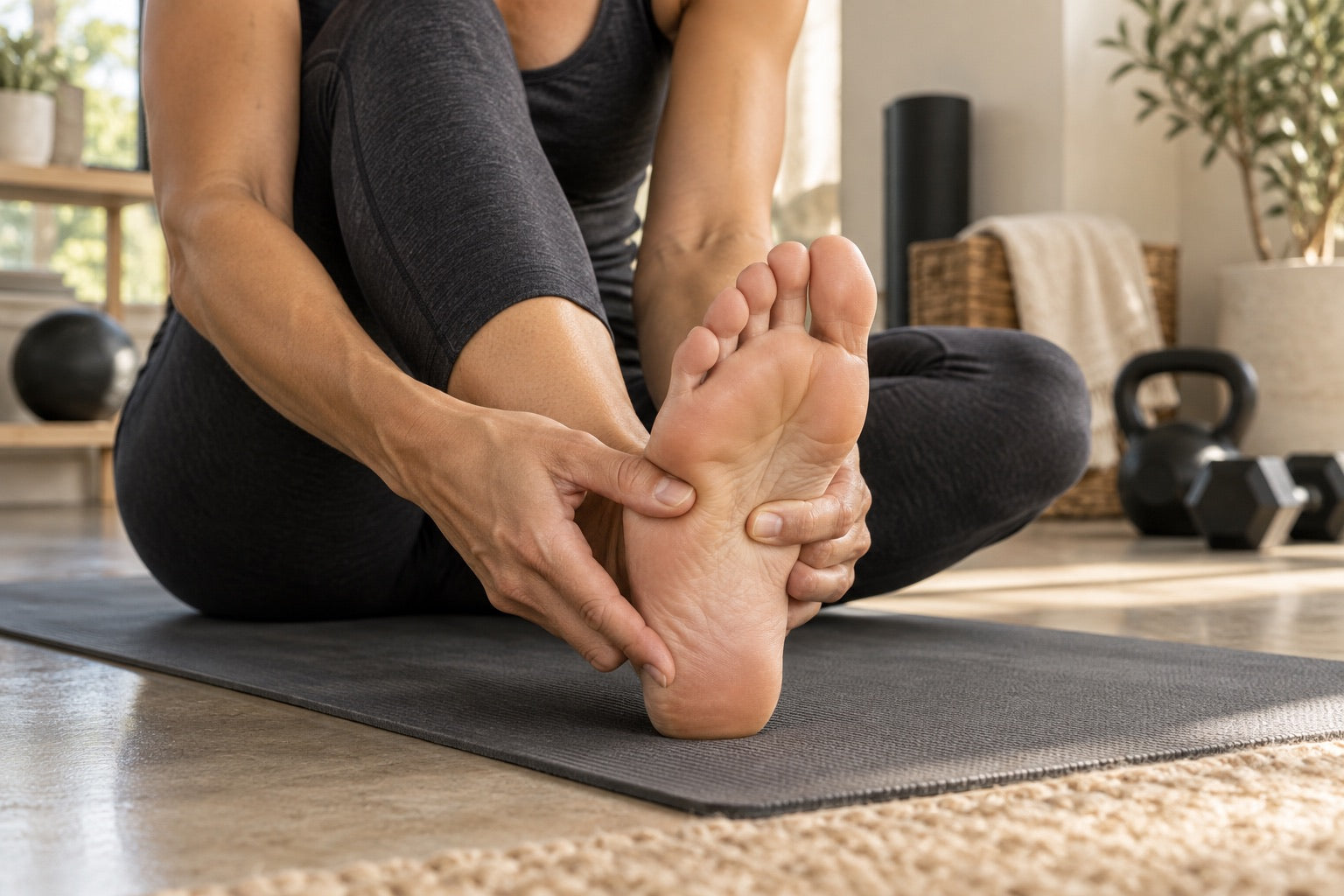
Summer foot pain isn't just about the miles you put in — it's about the surface those miles happen on. When the asphalt under your shoes climbs past 130°F, the rules of training change, and so does the risk profile of every step.
The Asphalt Math Most Runners Don't Know
On a 95°F summer afternoon, the air feels brutal. But the asphalt under your feet is a different problem entirely. Dark pavement absorbs solar radiation across the visible and near-infrared spectrum and re-radiates it as heat — and because asphalt is dense, it stores that heat through the afternoon and into the evening.
A widely cited study of pavement temperatures and contact burns[1] found that asphalt surface temperatures routinely measure 40–60°F hotter than ambient air. When the air reads 95°F, the asphalt itself can sit between 125°F and 140°F. Public-health agencies have issued similar warnings — pavement burns send thousands of people to emergency rooms each summer, and surface temps over 125°F can cause second-degree burns in under a minute of direct contact.
Most runners don't burn their feet, of course — shoes prevent that. But the heat doesn't disappear because there's a midsole between you and the ground. It transfers upward into your footwear, into the structural elements meant to support your arch, and into the soft tissue inside your foot. That's where the trouble starts for anyone managing plantar fasciitis. The temperature gradient between a shaded trail and a sun-baked road can exceed 40°F, which means two runners covering the same distance on the same afternoon can be subjecting their feet to completely different thermal loads depending only on the surface they chose.
Why Heat Is a Plantar Fascia Problem
The plantar fascia is a dense band of collagen-rich connective tissue that runs from your heel bone forward to the base of your toes. It's not muscle — it's a tendinous structure, more like a thick ligament. And like all collagen-based tissues, its mechanical behavior changes with temperature.
Classic biomechanics work on the mechanical properties of collagenous tissue[2] showed that elevated temperatures shift collagen's viscoelastic behavior — it becomes more pliable under load but also more susceptible to creep, meaning it deforms gradually under sustained stress and recovers more slowly. Subsequent work on creep and cyclic loading in tendon[3] has reinforced that connective tissue stiffness, recovery, and microdamage thresholds are all load- and condition-dependent.
Translated for the runner standing on hot pavement: a fascia that's already inflamed and gradually remodeling is now being asked to absorb load while running warmer than it would on cooler ground. Combine that with longer summer mileage, harder-baked shoe foam, and post-run swelling from heat-induced fluid retention, and you have a setup for symptom flares that arrive a day or two after the run — the classic delayed plantar fasciitis spike.
Your Shoes Are Also Cooking
The shoe industry has known about thermal degradation of EVA midsoles for decades. EVA (ethylene-vinyl acetate) — the dominant midsole foam material — is a thermoplastic. Its compressive stiffness, energy return, and rebound all shift downward as temperature rises. Research on the durability of EVA foam running-shoe midsoles[4] documented how repeated compression and thermal exposure progressively reduce a midsole's ability to resist load — the foam softens, recovers more slowly, and loses rebound as it warms and ages.
What does that mean for you? The cushioning you trained in during April is not mechanically the same cushioning you're running in during July. The midsole compresses more under heel strike, recovers more slowly, and offers less resistance to the medial collapse that drives plantar fascia overload. If your shoes were borderline already — a few hundred miles in, already softened — heat accelerates the failure curve.
For people managing plantar fasciitis, this matters more, because the heel cup and arch profile lose their structural shape exactly when your fascia is being asked to work harder. Soft cushioning is not structural support — and structural support is what prevents the calcaneus from rolling medially during midstance, the moment plantar fascia tension peaks.
The Three Things That Get Worse in Summer Heat
1. Tissue recovery slows. Heat-induced vasodilation pulls blood toward the skin to dump heat, reducing the deeper perfusion that drives microdamage repair. Combined with the dehydration most summer athletes run with anyway, the fascia gets less of what it needs to recover between sessions.
2. Inflammation amplifies. Plantar fasciopathy is a low-grade degenerative-inflammatory process, not just mechanical strain. Heat stress raises baseline physiological strain, and dehydration concentrates the chemical environment around the irritated tissue. A flare that would have settled overnight in March drags into the next day.
3. Stride mechanics quietly deteriorate. When you're hot, you fatigue earlier — and fatigue translates into subtle loss of pelvic stability, increased pronation, and a heel strike that lands harder than it would when fresh. Each of these adds load to the plantar fascia. Most runners don't notice the change in form. The fascia does.
Training Around the Heat: A Practical Framework
You don't have to stop running in summer. You do have to train smarter. Below is a framework drawn from American College of Sports Medicine heat-stress guidance[5] combined with practical adjustments for anyone managing plantar fasciitis.
Move Your Run to the Edge of the Day
Asphalt holds its heat for hours after the sun starts to drop. A run at 7pm in July is often still on 110°F+ pavement — the air has cooled but the road hasn't. The best windows are sunrise (the surface has been radiating heat all night and is at its coolest) and well after dark, when the surface has finally given back most of its stored heat. If you can't move your runs, shorten them.
Choose Surfaces Strategically
Concrete is brutally hard but reflects more heat than asphalt and runs roughly 10–20°F cooler in midday sun. Crushed-stone trails, hard-packed dirt, and shaded greenways are dramatically cooler — often 30–40°F below asphalt — and they let your shoes maintain their original structural shape because the foam isn't soaking heat from the surface. If your usual loop is exposed asphalt, swap two of your weekly runs to shaded surfaces during peak heat months.
Rotate Two Pairs of Shoes
EVA needs roughly 24–48 hours at room temperature to fully decompress after a hard run. In summer, with heat-softened foam, the recovery window is even more important. Running the same pair of shoes back-to-back on consecutive hot days means you're stacking compression sets on already-weakened cushioning. Two pairs of identical (or similar) shoes, rotated, dramatically reduces this effect — and it's one of the easiest interventions a plantar fasciitis-prone runner can make.
Hydrate for Tissue Health, Not Just Thirst
The standard ACSM guidance is to drink 16–20 oz of fluid 2–3 hours before exercise and another 8 oz 15 minutes before, with 7–10 oz every 20 minutes during.[5] For plantar fascia health specifically, dehydration matters because connective tissue depends on bound water to maintain its viscoelastic behavior. Chronically under-hydrated runners tend to have stiffer, more brittle fascia. It's not a dramatic effect, but on top of summer heat and increased mileage, it adds up.
Build Recovery Into the Daily Routine
Heat amplifies the importance of post-run care. Twenty minutes of feet-up against a wall, a frozen water bottle rolled under the arch for 8–10 minutes, and a short calf and intrinsic-foot mobility sequence in the evening will return more performance the next day than another junk mile would have. The plantar fascia recovers when the heel and calf are decompressed, not when they're loaded.
Why Structural Support Matters More in Summer
If you only fix one variable this summer, fix the support system inside your shoe. Here's why: every other intervention on this list is about minimizing the stress your fascia takes. Structural inserts change how the load reaches the fascia in the first place.
A semi-rigid orthotic insert with a deep heel cup does three things that matter during heat-stress training:
First, it controls calcaneal motion. The heel bone is the anchor point of the plantar fascia. When the heel rolls medially under load (which happens more as you fatigue, which happens faster in heat), the fascia is pulled into a stretch it wasn't designed to absorb at high frequency. A deep, structural heel cup keeps the calcaneus vertical through midstance. This is the single biggest mechanical lever for reducing plantar fascia load.
Second, it preserves arch geometry as your shoes degrade. The structural shape of a quality insert doesn't change with heat the way EVA does. Even as your shoe softens through summer mileage, the insert continues to deliver consistent arch and heel positioning — a real durability advantage in hot months.
Third, it redistributes pressure off the irritated medial heel. Plantar fasciitis pain typically localizes at the medial calcaneal tubercle, where the fascia inserts. Structural inserts off-load this point by transferring weight onto the arch and lateral heel surfaces. Less pressure on the inflamed insertion means faster overnight recovery and higher tolerance for the training load summer demands.
The FCSS™ Pro orthotic inserts were engineered around this principle of calcaneal stabilization rather than cushioning alone — which is why they don't degrade the way EVA-only solutions do as summer asphalt heats up. The structural shell holds its shape across the temperature ranges summer training exposes your feet to. If you want the deeper rationale for why structural support outperforms soft foam, our companion guide on why most plantar fasciitis inserts fail walks through the mechanics in detail.
Warning Signs to Take Seriously
Summer training tends to mask its own damage. Adrenaline, heat-induced fatigue, and the general fog of pushing through a hot run can hide symptoms that would otherwise prompt a rest day. Watch for these signs that hot-pavement training has crossed the line from tolerable to risky:
Morning pain that intensifies week over week. The classic plantar fasciitis presentation is a sharp first-step pain at the medial heel after sleep or prolonged sitting. If this pain is gradually worsening — not just present, but trending up — your training load is exceeding your recovery capacity. The JOSPT clinical practice guideline on heel pain and plantar fasciitis[6] treats progressive symptoms as a sign that conservative load management needs to be adjusted.
Pain that persists past the first 10 minutes of a run. Mild plantar fascia symptoms often warm up and fade in the first few minutes of activity. Pain that holds steady or worsens after the warm-up window is a clearer indication of active tissue irritation rather than baseline stiffness.
Pain that migrates to the arch or midfoot. When the medial insertion gets too irritated, compensatory load shifts into the arch belly and sometimes the posterior tibial tendon. Migration of symptoms is your nervous system telling you the original problem has cascaded.
Heel swelling, bruising, or visible thickening. Red flags for partial fascial tear or calcaneal stress reaction — both can present in athletes who pushed through a heat-driven training block. Stop and get imaging. This is not a "train through it" situation.
What an Honest Summer Plan Looks Like
You don't need a complete overhaul. You need a few small structural changes that compound. Here's a reasonable template for any plantar fasciitis-prone runner moving through July and August:
Train at the cool end of the day, two to three days per week on shaded or off-road surfaces, with no more than 10% week-over-week volume increases. Rotate two pairs of shoes with structural inserts in both. Hydrate to ACSM standards. Do 10 minutes of mobility and 10 minutes of arch off-loading every day you run. Take one full rest day. And if morning pain trends up for two weeks running, drop volume by 30% for a week and reassess. If you are early in your seasonal build, our breakdown of how to ramp up mileage without wrecking your feet pairs naturally with this heat plan.
The runners who get sidelined by summer plantar fasciitis are almost always the ones who treated heat as background noise. The ones who manage it well treat heat as a training variable — logged, planned for, and respected like distance, intensity, and elevation. Your fascia doesn't care about your goal pace. It cares about cumulative load, and hot pavement adds to that load whether you account for it or not. The good news: the same fascia that gets irritated in July can rebuild remarkably well when you give it support and recovery time. The fall season is built in the choices you make this month.
Frequently Asked Questions
Q: Why does running on hot asphalt make plantar fasciitis worse?
A: Asphalt that's 130°F+ transfers heat through shoe soles, softening the structural materials that normally provide arch support. As the support degrades during the run, more load shifts to the plantar fascia. The combination of heat stress on the tissue plus reduced shoe support during the workout is a textbook PF aggravation.
Q: What time of day is safest for summer running with PF?
A: Run early morning (before 9 AM) when asphalt is still cool, or after dusk once surfaces have started to release heat. Avoid the 11 AM – 4 PM window when surface temperatures peak. A surface that feels hot to a bare hand is too hot for an inflamed plantar fascia.
Q: Do I need different inserts for summer running?
A: Not necessarily different inserts — but you do need support that doesn't compress under heat. Foam-based products lose a meaningful share of their support properties as they warm. Structural orthotics with a semi-rigid shell maintain shape regardless of temperature, which is exactly why summer is when their advantage becomes most visible.
References
- Pavement temperatures and the incidence of contact burns in a desert climate. Journal of Burn Care & Research, 2012. pubmed.ncbi.nlm.nih.gov
- The mechanical properties of collagenous tissue (rat tail tendon). Journal of General Physiology, 1959. pubmed.ncbi.nlm.nih.gov
- Effects of creep and cyclic loading on the mechanical properties and failure of tendon. Journal of Orthopaedic Research, 2009. pubmed.ncbi.nlm.nih.gov
- Heel-shoe interactions and the durability of EVA foam running-shoe midsoles. Journal of Biomechanics, 2004. pubmed.ncbi.nlm.nih.gov
- American College of Sports Medicine. Exertional heat illness and fluid replacement guidance. acsm.org
- Heel pain — plantar fasciitis: clinical practice guideline, revision 2014. Journal of Orthopaedic & Sports Physical Therapy, 2014. jospt.org
Disclaimer: This article is for educational purposes and is not a substitute for medical advice. If you are experiencing persistent or severe foot pain, consult a podiatrist or sports-medicine physician.
The WYATT takeaway
You're logging summer miles on asphalt that sits 40–60°F hotter than the air, and that heat soaks straight through your midsole into the soft tissue of your foot.
Heat softens your EVA midsole and makes your collagen-based fascia creep under load — so the arch support fails and the calcaneus rolls medially exactly when plantar fascia tension peaks.
The FCSS™ Pro drops into your shoe as a removable semi-rigid shell that holds its heel-cup and arch geometry across the temperature range summer asphalt throws at you — so you keep training instead of shelving the season.