
Morning Foot Pain After Getting Out of Bed — What It Means and What to Do
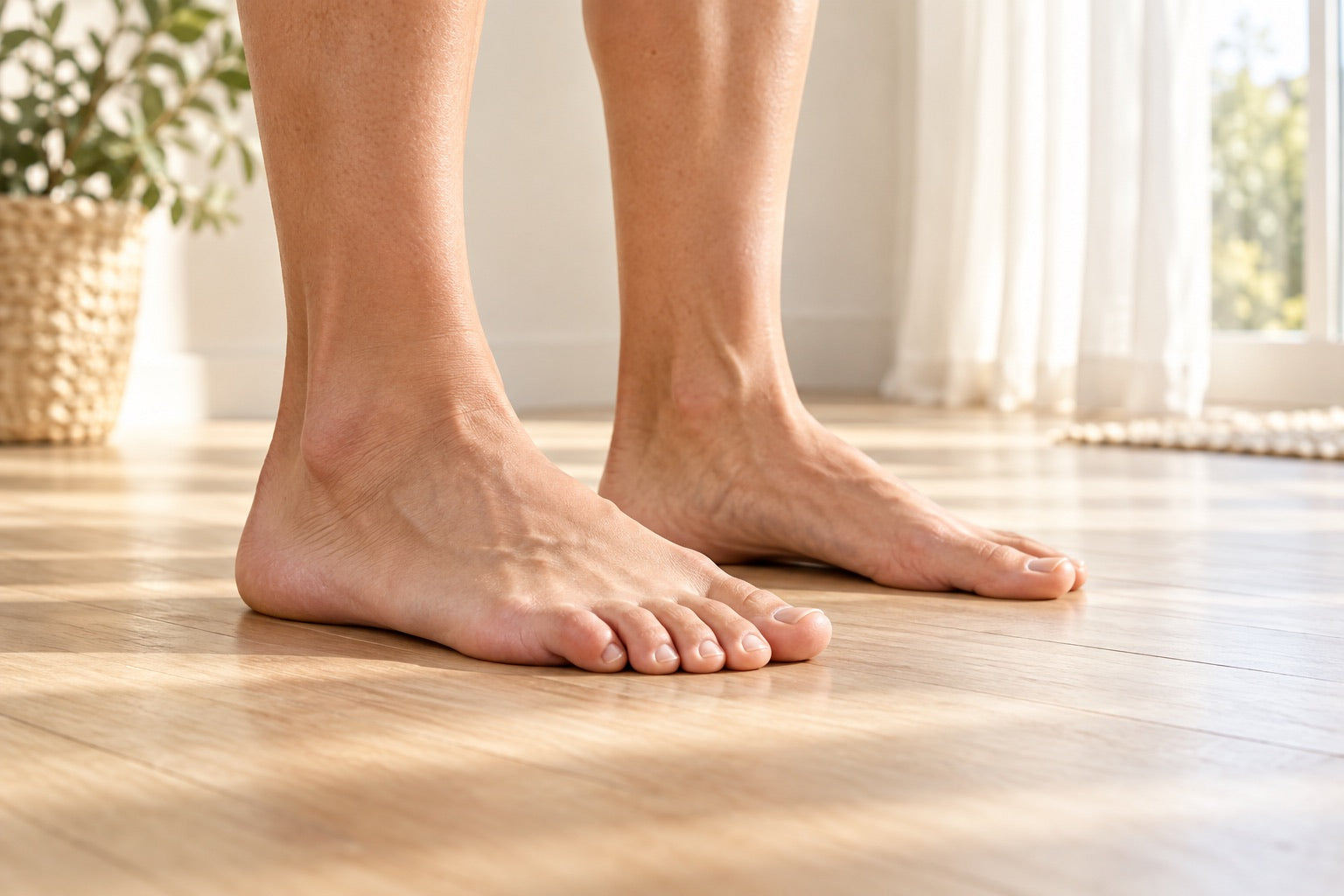
You swing your legs out of bed. Your feet hit the floor. The first three or four steps toward the bathroom feel like you're walking on a bruise — a sharp, focal ache through the heel, sometimes radiating into the arch. It eases as you move. By the time you're brushing your teeth it's mostly gone. By the time you're at your desk you've half-forgotten about it.
Then you stand up after lunch. The same pain comes back. Less intense, but unmistakable.
This pattern — sharp pain in the first few steps after rest, easing with movement, returning after sitting — is one of the most specific clinical findings in foot medicine. It has a name (post-static dyskinesia), a clear mechanism, and a fairly short list of probable causes. What it almost never is, despite what the internet sometimes implies, is "nothing" or "you just slept on it weird."
If you're getting it daily, your foot is telling you something specific. Here's what it's saying, why it happens, and what the evidence says actually changes the trajectory.
The pattern is the diagnosis
Clinicians who treat foot pain ask one question before almost any other: does it hurt the most when you first stand up in the morning, or after sitting for a while? The answer is so diagnostically loaded that the 2023 clinical practice guideline on heel pain — published in the Journal of Orthopaedic & Sports Physical Therapy, the most current evidence-graded document on the condition — uses first-step pain as a defining symptom of plantar fasciitis. Pain that is sharp at the start of weight-bearing, eases over a few minutes of activity, and returns after rest is the classic plantar-fasciitis presentation.
This isn't because plantar fasciitis is the only condition that hurts in the morning. It's because the pattern itself — the on/off behavior tied to rest and reload — points to a specific mechanical problem: a soft tissue in the foot that has shortened or stiffened overnight, and is being suddenly pulled to length when you stand on it.
The most common candidates for that tissue are the plantar fascia, the Achilles tendon and calf complex, the joint capsules in the rearfoot, and — in older patients — the heel fat pad itself. All four can produce the same general pattern. Distinguishing between them is mostly a matter of where the pain sits.
Where the pain sits — and what it likely means
Pain concentrated at the medial heel — the inside edge, just where the heel meets the arch — is the signature of plantar fasciitis. Pressing the spot reproduces the pain. The fascia attaches to a small footprint on the calcaneus, and that attachment point bears the tensile load every time the foot loads.
Pain that radiates up the back of the heel into the Achilles tendon, and is worst on the first few steps in the morning, more often points to insertional Achilles tendinopathy — a related but distinct condition. The tendon and the fascia share continuous fascial connections through the heel, which is part of why calf tightness shows up so reliably in plantar fasciitis exams.
Pain that sits directly under the heel, feels bruise-like rather than sharp, and gets worse on hard surfaces (tile, hardwood) is more consistent with heel fat pad atrophy or contusion. The fat pad — a specialized chambered cushion under the calcaneus — thins with age, with chronic high-impact loading, and with prolonged corticosteroid injections. When it thins enough, the calcaneus essentially loads bare against the floor.
Pain that's diffuse, achy, stiff, and accompanied by audible joint clicking or grinding is more typical of early osteoarthritic changes in the rearfoot, especially in adults over 50.
Most morning foot pain is plantar fasciitis. But "most" is not "all," and the location of the focal pain matters. Pain that doesn't fit the classic medial-heel pattern, or that doesn't ease with a few minutes of movement, deserves a clinical exam rather than a self-diagnosis.
Why the first step hurts so much
The mechanism behind first-step pain is mechanical and predictable. Three things happen overnight that converge into the morning ache.
First, the foot is in plantarflexion — toes pointed downward — for most of the night, because that's the position the foot relaxes into when you're not standing. Plantarflexion shortens the calf-Achilles-fascia chain. After several hours in that shortened position, the tissues lose elasticity. They stiffen.
Second, body temperature drops during sleep, particularly in the extremities. Cold connective tissue is stiffer than warm connective tissue. The fascia and the surrounding soft tissues are at their least pliable in the half hour after you wake.
Third, a damaged or chronically overloaded fascia attempts to remodel during periods of rest. The repair process produces a small amount of fibrotic stiffening — useful for healing in principle, painful when it gets pulled back out to length too quickly. The clinical literature has long described this as "post-static dyskinesia" — a non-specific term that simply means "movement dysfunction after rest."
The first three or four steps in the morning are, biomechanically, a sudden tensile load applied to the most shortened and least pliable version of a tissue that may already be inflamed or remodeling. Of course it hurts. The fact that it eases with movement is not a sign that nothing is wrong — it's a sign that warming and stretching the tissue restores enough pliability to tolerate normal load. The underlying problem hasn't gone away. It's just been temporarily brought back online.
This is the part most people get wrong about morning pain: the fact that it goes away with walking does not mean the day's loading has been good for the tissue. It often means the opposite. The tissue is being asked to perform the same job it was failing at yesterday, with the additional accumulated micro-damage of a long shift, run, or day on your feet. By bedtime tomorrow, the tissue stiffens around a slightly more inflamed baseline. The next morning's first step is, on average, a touch worse.
Left alone, this pattern tends not to self-correct. The clinical picture for plantar fasciitis without intervention is a slow chronic course measured in months to years rather than days, with a meaningful subset of patients still symptomatic at one year.
The morning protocol: what actually moves the needle
If first-step pain has been a daily fixture for more than a couple of weeks, the most useful thing you can do is treat the morning specifically — not as the worst symptom of a generalized foot problem, but as a discrete mechanical event that has its own short list of effective interventions.
Pre-load the tissue before you stand on it. Before your feet hit the floor, run through 30–60 seconds of gentle ankle range-of-motion work in bed: slow circles in both directions, alternating dorsiflexion and plantarflexion, and toe scrunches. Then, sitting on the edge of the bed, loop a towel around the ball of the foot and pull gently to bring the foot into dorsiflexion — hold 30 seconds per side. The point is not to "stretch out" the fascia in any meaningful long-term sense. The point is to warm the tissue and put it through a few cycles of length change before you ask it to bear your full bodyweight on a cold floor.
Calf-tightness work — but at the right time. A consistent finding across the plantar-fasciitis literature is that limited ankle dorsiflexion is one of the most reliable risk factors. Tight calves transmit load through the Achilles to the fascia. Wall-supported calf stretches — straight knee for the gastrocnemius, bent knee for the soleus, 30–45 seconds each, two to three times a day — are an unglamorous but evidence-supported intervention. The most useful sets are not first thing in the morning; they're after walking around for ten minutes, when the tissue is warm enough to lengthen.
Manage the first 30 minutes of standing. The window between getting out of bed and the morning activity that starts your day is when foot tissue is at its most vulnerable. Going from bed straight onto cold tile, in unsupportive slippers or barefoot, is the single most reliable way to set up a worse pain day. Supportive footwear from the moment your feet hit the floor matters more than the same footwear at any other point in the day.
The 2023 JOSPT clinical practice guideline lists three interventions with the strongest evidence base for plantar fasciitis: manual therapy, stretching protocols (especially calf and plantar fascia), and the use of foot orthoses. These are unranked; combined use produces better outcomes in most studies than any single intervention.
What the orthotic evidence actually says
The role of inserts in first-step pain is more specific than most people realize. The 2006 randomized trial published in Archives of Internal Medicine by Landorf, Keenan, and Herbert — still one of the cleanest pieces of evidence on prefab orthotics for plantar fasciitis — found that prefabricated foot orthoses produced statistically meaningful short-term improvement in plantar-fasciitis pain compared with sham inserts. The 2008 Cochrane review by Hawke and colleagues, looking at the broader category of foot orthoses for foot pain, found no consistent superiority of custom-made over prefabricated orthoses for most foot-pain presentations.
What inserts do mechanically — and why this matters specifically for first-step pain — is reduce the tensile load on the plantar fascia at the moment of heel strike and forefoot push-off. By cradling the rearfoot and supporting the medial longitudinal arch, a well-contoured insert shortens the effective lever arm of the windlass mechanism on the fascia. Less tension across the fascia per step means less cumulative micro-damage over the course of the day. Over weeks, that translates to a slightly less inflamed, slightly more pliable tissue every morning.
This is also why first-step pain often improves on inserts before people consciously notice the change. The morning pain is a downstream signal of the fascia's overnight state. Lower the day's load, and the next morning's stiffness shows up at a slightly lower baseline.
The McKeon and colleagues "foot core" framework, published in the British Journal of Sports Medicine in 2015, adds a useful nuance: the intrinsic muscles of the foot — the small muscles inside the arch — share the job of arch support with the plantar fascia. Footwear that under-recruits these muscles (overly cushioned, over-supportive, or unsupportive in the wrong ways) tends to leave the fascia carrying load it shouldn't. An insert that supports the arch and engages the intrinsic foot musculature — rather than passively bridging the arch and letting the muscles atrophy — is mechanically a better long-term fit for the morning-pain pattern.
What's worth ignoring
A lot of internet advice on morning foot pain is worse than useless.
"Roll your foot on a frozen water bottle" is not bad — cold and gentle compression after activity is reasonable inflammation management — but it's a recovery tool, not a cornerstone treatment.
"Get a night splint." Night splints have a real evidence base, but mostly for refractory cases that haven't responded to first-line care over several months. Not a first move.
"Just walk it off" is the most common and most damaging advice. Walking eases the morning pain in the short term and progressively loads a damaged fascia all day, ensuring tomorrow's first step is the same or worse. Pain that responds to warming is a signal of injury, not a cue to push through.
"It's just plantar fasciitis, it'll go away." It might. A meaningful percentage of cases do resolve in 6–18 months without specific treatment — but the average untreated patient pays for that resolution in months of accumulated overload, gait compensation, and secondary complaints in the knees, hips, and lower back.
When to escalate
Most morning foot pain is mechanical, reversible, and responsive to consistent first-line treatment over weeks to months. There are scenarios where the right move is a clinical exam rather than another blog post.
Pain that doesn't follow the classic warm-up pattern — pain that gets worse with activity rather than better, or pain that's worse at night than in the morning — is not classical plantar fasciitis and deserves a workup.
Pain that's accompanied by numbness, tingling, or burning — particularly along the inside of the heel and arch — can suggest tarsal tunnel syndrome rather than fasciitis.
Pain that fails to improve at all after 8–12 weeks of consistent first-line care (supportive footwear and inserts, calf and fascia stretching, load management) deserves imaging and a discussion of escalation: shockwave therapy, targeted physical therapy, in some cases a corticosteroid injection.
And in adults with diabetes or peripheral vascular disease, any new daily foot pain warrants a faster clinical evaluation, not a watch-and-wait.
Most morning pain doesn't end up in any of those categories. Most of it is a mechanical loading problem that has been compounding for weeks or months and has finally reached the threshold where it shows up the moment your feet hit the floor. Treating it as such — early, consistently, with the load-management tools we know work — is almost always the highest-leverage move.
Sources
- Koc TA, Bise CG, Neville C, Carreira D, Martin RL, McDonough CM. (2023). Heel Pain – Plantar Fasciitis: Revision 2023. Journal of Orthopaedic & Sports Physical Therapy, 53(12):CPG1–CPG39. JOSPT
- Landorf KB, Keenan A-M, Herbert RD. (2006). Effectiveness of Foot Orthoses to Treat Plantar Fasciitis: A Randomized Trial. Archives of Internal Medicine, 166(12):1305–10. PubMed
- Hawke F, Burns J, Radford JA, du Toit V. (2008). Custom-made foot orthoses for the treatment of foot pain. Cochrane Database Syst Rev. Cochrane
- McKeon PO, Hertel J, Bramble D, Davis I. (2015). The foot core system: a new paradigm for understanding intrinsic foot muscle function. British Journal of Sports Medicine, 49(5):290. BJSM
This article is for informational purposes only and is not medical advice. Consult a qualified healthcare provider before starting any treatment program.
Frequently Asked Questions
Why feet hurt the most in the first steps of the morning — and what it usually means.
Is morning foot pain always plantar fasciitis?
It's the most common cause, but not the only one. Morning heel pain that eases after the first 5–10 minutes of walking is the classic plantar fasciitis presentation. Pain that persists or worsens through the day, or that's localized differently, can indicate a stress fracture, heel pad atrophy, or arthritis.
Why is the pain worst right after waking up?
Overnight, the plantar fascia shortens because your foot rests in a slightly pointed (plantarflexed) position. The first few steps stretch the inflamed tissue suddenly, causing sharp pain. As the tissue warms up and lengthens, the pain typically subsides.
What's the fastest way to reduce morning pain?
Two things consistently help: (1) a night splint that holds the foot in a neutral position overnight, preventing the fascia from shortening, and (2) structural arch support during the day to reduce strain accumulation. Stretching the calf and fascia before getting out of bed also helps reduce that first-step shock.
The WYATT takeaway
Morning foot pain deserves a closer look at its pattern and possible causes. Let that understanding guide your next steps and any decision about foot support.