

PRP, Shockwave, or Inserts? The 2026 Decision Tree for Stubborn Plantar Fasciitis
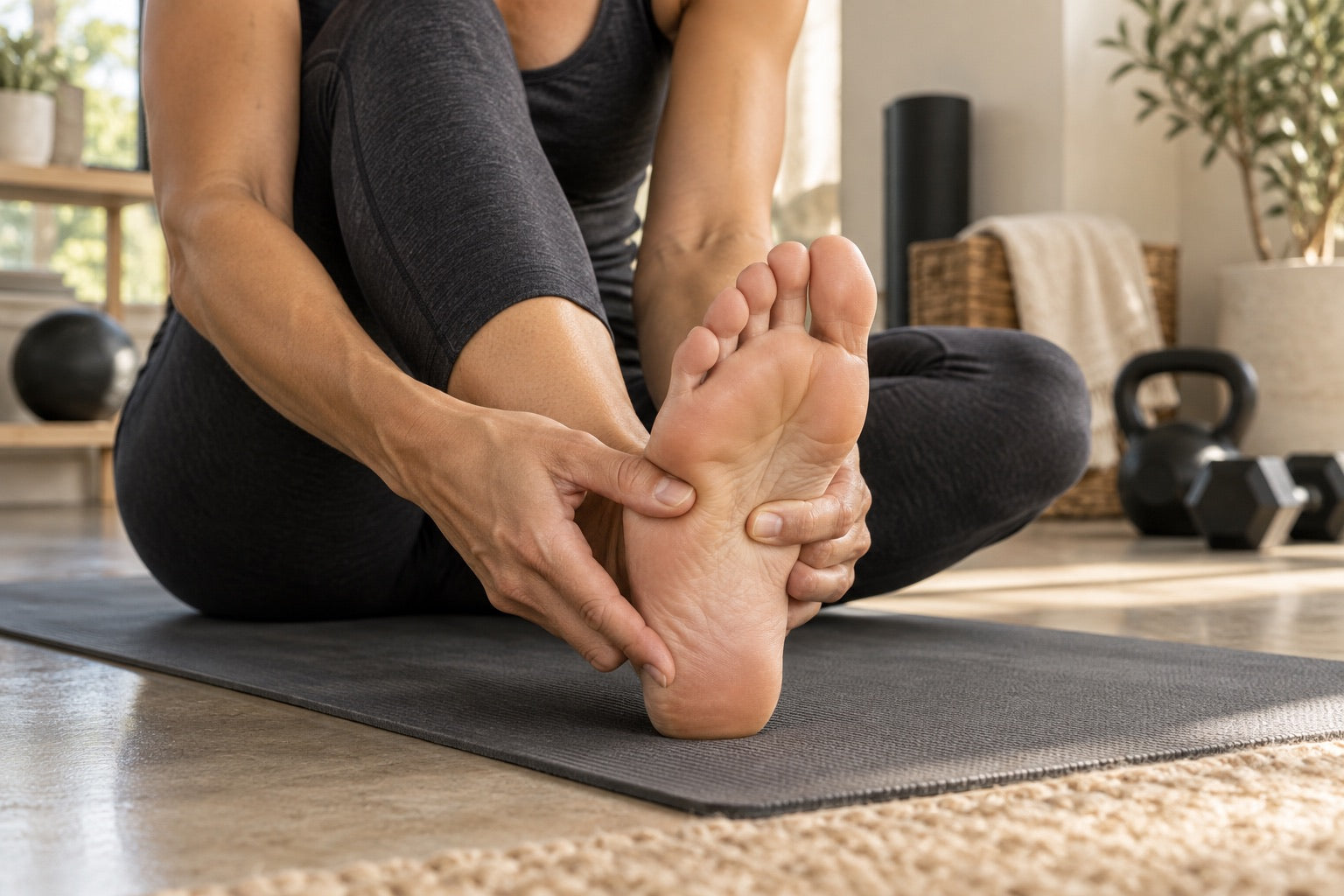
Six months in, the morning stab hasn’t backed off. You’ve cycled through stretches, foam rolling, two pairs of cushioned shoes, and a stack of inserts that mostly disappointed. The podiatrist is now talking about shockwave. Or PRP. Or a corticosteroid injection. The cost is real, the needles are not appealing, and nobody is giving you a clear answer about which one to actually choose.
Stubborn plantar fasciitis — symptoms that persist beyond roughly six months of consistent first-line care — affects somewhere between 10 and 20 percent of patients who develop the condition, depending on which natural-history series you read. For everyone else the heel quiets down within a year. For the stubborn 10 to 20 percent, the decision tree gets harder, and 2026 has rewritten parts of it.
A new network meta-analysis published in Scientific Reports pooled 63 randomized trials covering more than four thousand patients and ranked the most-studied minimally invasive plantar fasciitis treatments[1] head-to-head. The 2023 clinical practice guideline from JOSPT[2] still anchors first-line care in load management, calf and fascia stretching, taping, and prefabricated foot orthoses. Read together, the two documents draw a clearer ladder than most patients ever see in clinic.
The dominant wrong belief: “I’ve failed conservative care”
The most common mistake at this decision point is treating the choice as binary — either keep doing the same low-effort home plan that isn’t working, or escalate to needles. The third option, and statistically the one most patients haven’t actually tried, is optimized first-line care. Stretching three times a week, walking in unsupportive sandals around the house, and rotating between two pairs of generic inserts is not first-line care. It looks like first-line care, but the load on the fascia hasn’t actually changed.
Before any decision tree about injections or shockwave, an honest audit of the foundation is worth doing. The Tien 2026 review explicitly deals with what to do after conservative management has been adequately tried. Inserts were not in the comparison — the review was scoped to minimally invasive procedures — but the JOSPT guideline keeps them in the first row of the ladder for exactly this reason: when applied consistently, they change the daily tensile load on the plantar fascia in a way that stretching alone cannot.
Step 1: Have you actually optimized first-line care?
Before considering any escalation, the honest checklist is the following. Each item should be in place for a continuous block of at least 8 to 12 weeks, ideally longer, before declaring conservative care a failure.
Load management. The fascia is a tension structure. It will not calm down if it is being asked to do the same job every day. Reduce volume on the activities that spike symptoms — usually long standing shifts, high-impact training, or barefoot walking on hard floors at home — for the 8 to 12-week window. The goal is not bed rest; it is a deliberate, temporary drop in cumulative load.
Calf and fascia stretching, daily. The JOSPT 2023 guideline gives the strongest evidence rating to plantar fascia–specific stretching[2] (the non–weight-bearing pull on the toes) and gastrocnemius/soleus stretching. Done twice a day, the cumulative effect over 8 to 12 weeks is meaningful.
Foot orthoses that change the load, not just the cushion. The Landorf 2006 randomized trial[3] in Archives of Internal Medicine compared prefabricated foot orthoses with sham orthoses in a three-arm design and found a meaningful short-term advantage for the real orthoses on pain and function. The Hawke 2008 Cochrane review[4] followed by concluding that prefabricated orthoses and custom orthoses produce broadly comparable results for foot pain when the prefab device has appropriate contour and material properties. Cushion alone, without arch contour, does not produce the same load-redistribution effect. If you are weighing devices, our breakdown of why most plantar fasciitis inserts fail walks through what contour actually has to do.
Footwear discipline. Around-the-house footwear matters as much as work shoes for chronic cases. Flat, unstructured sandals or bare feet on hardwood for the first hour of the day expose the fascia to its highest-strain task — first-step loading after a night of shortening — with the least support.
If any of the four pieces above has been missing, the conservative ladder hasn’t been climbed yet. Reinstall it for a full 8-to-12-week block before considering Step 2. This is the single highest-yield decision the average reader can make.
Step 2: If conservative care really is optimized, what are the options?
Once first-line care has had a clean 8-to-12-week trial without meaningful improvement, escalation becomes a real conversation. The Tien 2026 network meta-analysis is the most useful map we have. Here is what it actually says about each option.
Extracorporeal shock wave therapy (ESWT). Across the Tien 2026 analysis, shockwave came out with broad, durable benefit profiles — not the largest single short-term pain effect, but consistent improvement across pain and function follow-up windows with low procedural risk. It is non-invasive (no needle, no medication), can be repeated, and is increasingly available in physical therapy and podiatry clinics in 2026. It is typically the first escalation step recommended after optimized conservative care for chronic cases, and the JOSPT 2023 guideline includes it as a moderately recommended adjunct[2].
Corticosteroid injection (CSI). The single largest short-term function gain in the Tien 2026 ranking[1] came from corticosteroid injection. The catch is the same one clinicians have flagged for two decades: short-lived benefit, a meaningful rate of relapse, and a small but real risk of plantar fascia rupture and plantar fat pad atrophy with repeated injections. The JOSPT 2023 guideline positions CSI as an option for short-term symptom control, not as a long-term solution. In a decision tree, it is most justifiable as a one-time bridge for a specific event — a wedding, a deadline travel block, the start of a treatment plan that needs a window of reduced pain to actually let the patient walk again — rather than as a default escalation.
Platelet-rich plasma (PRP). The Tien 2026 analysis credited PRP with the strongest long-term function improvement of the injection options. PRP avoids the fascia-thinning risk associated with repeated corticosteroid injections and, in the longer follow-up windows, outperforms it on function. The trade-offs are cost (often not covered by insurance), variability in preparation protocols across clinics, and a longer time-to-effect curve than CSI. For patients who have failed conservative care, are willing to absorb out-of-pocket cost, and want a more durable benefit profile than CSI offers, PRP is a defensible second-line injection choice.
Botulinum toxin A. Botox A produced the largest short-term pain reduction in the Tien analysis and also showed the largest reduction in plantar fascia thickness on ultrasound. It is not yet a mainstream first-tier escalation in U.S. practice, partly because of cost and partly because insurance coverage is uneven, but it is a legitimate option in centers that offer it.
Prolotherapy. Prolotherapy — injection of a hyperosmolar dextrose or similar irritant solution to stimulate a healing response — produced sustained mid-term pain relief in the Tien analysis. It is less common in U.S. podiatric practice than ESWT or CSI, and availability varies. It is a reasonable second-line option in clinics with experience using it.
Surgery. Plantar fascia release is genuinely a last resort. The literature on long-term outcomes is mixed, complication rates are non-trivial, and most patients who escalate carefully through ESWT and the injection options never need it.
Step 3: A practical decision tree
The cleanest way to apply the 2026 evidence is to match the escalation to the clinical picture, not to default to whichever procedure your specific clinic happens to offer first. The framework below is consistent with both Tien 2026 and the JOSPT 2023 guideline.
If you have not actually optimized first-line care (the 8-to-12-week stack of load management, stretching, contoured orthoses, and footwear discipline): do that first. The most likely outcome is that you do not need Step 2 at all.
If conservative care has been optimized for at least 8 to 12 weeks and symptoms persist: shockwave therapy is the most defensible first escalation. It is non-invasive, repeatable, low-risk, and the broad benefit profile in Tien 2026 supports it as the right step before a needle.
If shockwave does not produce meaningful benefit after a complete course, or is not available: the injection options open up. For patients who want a durable, lower-risk repeatable injection and can absorb the out-of-pocket cost, PRP is the most defensible choice based on the 2026 long-term function ranking. For patients who need a short-term symptom window for a specific event or to enable participation in physical therapy, corticosteroid injection — once, with explicit downstream planning to avoid repeat injections — is justifiable.
If escalation through shockwave and at least one injection option has failed and symptoms remain disabling at 9 to 12 months: a surgical consultation is reasonable, but it should genuinely be a final option, not a default at the end of a stalled treatment plan.
The piece that keeps showing up at every level
One detail that gets lost in the conversation about escalation: contoured foot orthoses do not get put away when you start shockwave or PRP. They stay on the plan. The mechanical loading of the plantar fascia — the daily tensile cost of standing, walking, and pushing off — is what put the fascia in chronic overload in the first place. Resolving the inflammatory and degenerative changes inside the tissue with a procedure does not change the mechanical environment the fascia returns to once the procedure is done. If the environment is the same, the cycle restarts.
This is why the JOSPT 2023 guideline lists prefabricated foot orthoses as a Grade A recommendation[2] and keeps them in the plan as an ongoing component. The Pfeffer 1999 trial[5] in Foot & Ankle International — one of the longest-cited foundational comparisons in this space — showed that prefabricated orthoses with appropriate contour were as effective as custom devices in initial treatment of proximal plantar fasciitis. The mechanical case is the same whether you are at Step 1 of the tree or post-procedure on Step 3. If quick fixes have already let you down, our look at why fast plantar fasciitis relief fails explains why the load math matters more than the shortcut.
The shared-decision conversation
Once you reach Step 2 or Step 3, the decision belongs to a real shared conversation between you and your provider. The questions worth bringing to that visit:
Have we actually completed an 8-to-12-week optimized conservative trial, or am I escalating because the home plan has been informal? Is shockwave available to me, and what is the typical protocol (number of sessions, energy level, expected timeline to benefit)? If we are considering an injection, why this one over the others, and what is the plan if it doesn’t hold? Are we addressing the mechanical load (orthoses, footwear, activity volume) as well as the procedure, so we are not setting up a repeat?
The 2026 evidence does not declare a single winner. It gives a clearer map of which option does what, in which window, with which trade-offs. The patient who walks into the clinic with that map asks better questions and ends up on a better plan. The constant across every branch is unchanged: a contoured device that redistributes plantar-fascia load is part of the plan at every step, which is the engineering principle behind the FCSS™ Pro.
Frequently Asked Questions
How long should I try conservative care before considering shockwave or injections?
A continuous, genuinely optimized block of at least 8 to 12 weeks — load management, daily calf and plantar fascia stretching, contoured foot orthoses, and around-the-house footwear discipline all in place at once. An informal home plan that drops one or more of those pieces is not a true conservative trial, and most patients who reinstall the full stack improve without needing to escalate.
Is PRP better than a corticosteroid injection for stubborn plantar fasciitis?
In the 2026 network meta-analysis, corticosteroid injection produced the largest short-term function gain, while PRP showed the strongest long-term function improvement and avoids the fascia-thinning and fat-pad-atrophy risk linked to repeated steroid injections. PRP’s trade-offs are higher out-of-pocket cost, variable preparation protocols, and a slower time to effect. Steroid is best used as a one-time short-term bridge; PRP is the more durable second-line injection.
Do I still need orthotic inserts after shockwave or PRP?
Yes. A procedure can resolve the inflammatory and degenerative changes inside the tissue, but it does not change the mechanical load the fascia returns to afterward. If the daily tensile environment is unchanged, the overload cycle can restart. Contoured foot orthoses that redistribute load stay on the plan at every step, which is why the JOSPT guideline keeps prefabricated orthoses in the plan as an ongoing Grade A component.
The WYATT takeaway
Every step, every standing shift, and every barefoot first-hour on hard floors loads the plantar fascia at the same high tensile cost that put it into chronic overload — and shockwave or an injection does not change that daily mechanical environment.
If the load math stays the same after the procedure, the fascia returns to the exact environment that overloaded it, the inflammatory and degenerative cycle restarts, and the expensive escalation buys only a temporary window.
The FCSS™ Pro is a removable, contoured device you add to your existing shoes — it redistributes plantar-fascia load on every step so the mechanical environment actually changes, the constant the JOSPT guideline keeps on the plan at Step 1 and after any procedure.
Related reading
References
- Tien C-L, et al. Comparative efficacy of minimally invasive treatments for plantar fasciitis: a network meta-analysis. Scientific Reports, 2026. doi.org
- Koc TA Jr, et al. Heel Pain – Plantar Fasciitis: Revision 2023. Clinical Practice Guidelines. JOSPT, 53(12), 2023. jospt.org
- Landorf KB, Keenan A-M, Herbert RD. Effectiveness of Foot Orthoses to Treat Plantar Fasciitis: A Randomized Trial. Archives of Internal Medicine, 166(12), 2006. pubmed.ncbi.nlm.nih.gov
- Hawke F, et al. Custom-made foot orthoses for the treatment of foot pain. Cochrane Database of Systematic Reviews, 2008. cochranelibrary.com
- Pfeffer G, Bacchetti P, et al. Comparison of Custom and Prefabricated Orthoses in the Initial Treatment of Proximal Plantar Fasciitis. Foot & Ankle International, 20(4), 1999. journals.sagepub.com
This article is for informational purposes only and is not medical advice. Consult a qualified healthcare provider before starting any treatment program.