Knee Pain Starts at the Feet: How Orthotic Inserts Reduce the Strain
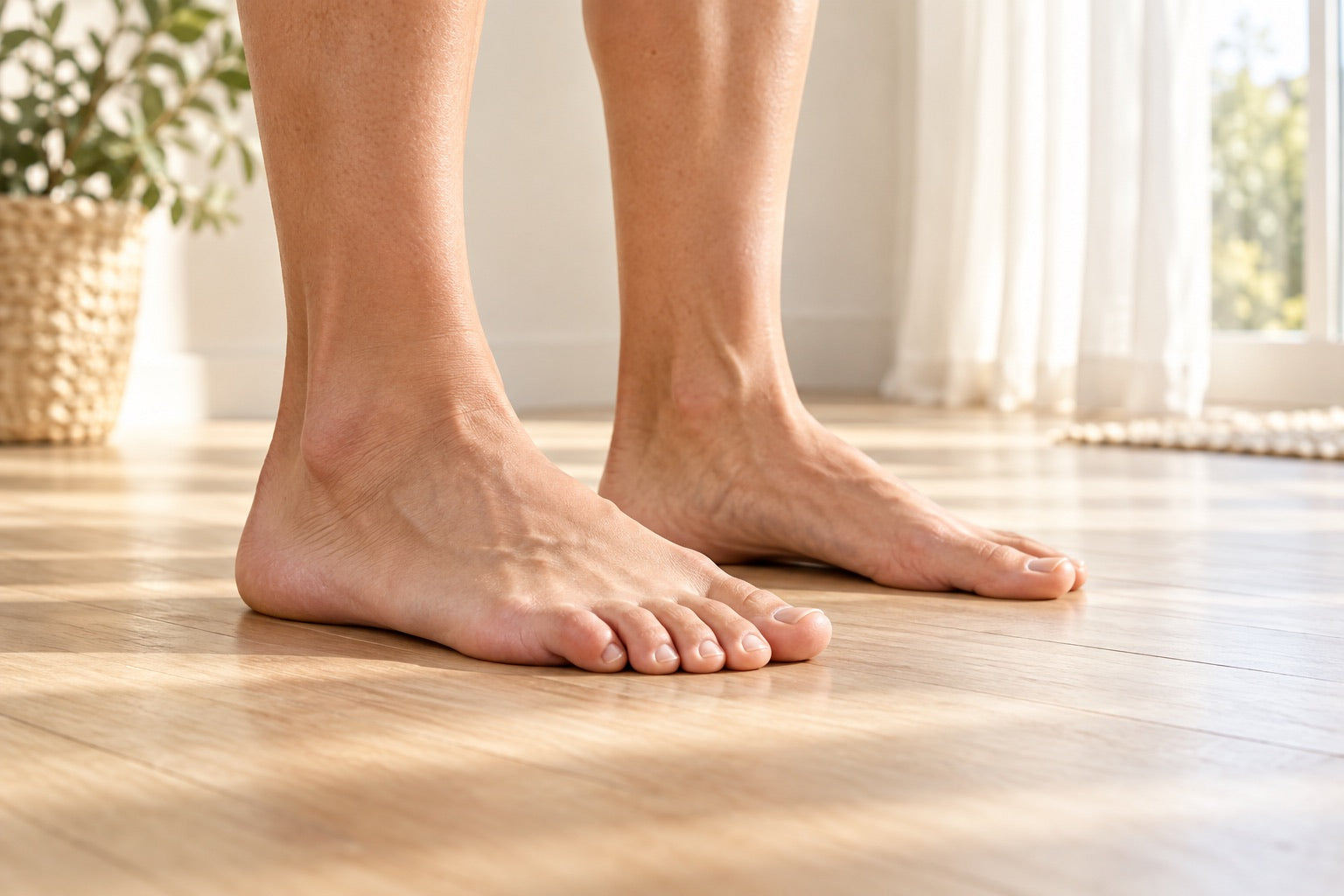
Knee pain that won't go away with rest, ice, or quad strengthening usually has a cause you haven't checked: your feet. The kinetic chain that runs from the ground up means a foot that pronates wrong, an arch that collapses under load, or a heel that strikes off-axis sends rotational and shear forces into the tibia, the patellofemoral joint, and the iliotibial band on every step. The knee gets loaded asymmetrically not because the knee is broken — but because the foundation under it is shifting.
If you've been told to strengthen your quads, ice your knee, or take anti-inflammatories, those tools address the symptom. They don't change the input. The fastest way to figure out whether your knee pain is foot-driven is to look at the most common causes, what the research actually says about orthotic inserts for knee pain, and the kind of insert architecture that makes a measurable difference.
This is the honest version of that conversation.
Why Knee Pain Often Starts in Your Feet
Your foot is the single point of contact between your body and the ground. When it strikes the floor, force travels up the leg in a sequence — heel impact, midfoot loading, push-off — and at each step in that chain, the bones of your lower body have to translate force without producing torsion at the joints above.
When the foot pronates excessively, the tibia internally rotates, which alters the angle at which the patella tracks in the femoral groove. Over thousands of steps, that altered tracking inflames the cartilage behind the patella — the most common pattern in patellofemoral pain syndrome (PFPS), better known as runner's knee. The knee isn't damaged from the inside out. It's stressed from below.
Patrick McKeon and colleagues in the British Journal of Sports Medicine framed the foot as a "foot core system" — a network of intrinsic muscles, the plantar fascia, and the small stabilizers that, together, control how force is distributed up the kinetic chain. When that system is weak or asymmetrically loaded, joints upstream — knee, hip, lower back — absorb the dysfunction (McKeon et al., British Journal of Sports Medicine, 2015[1]).
Three foot-mechanics issues drive most foot-derived knee pain:
Overpronation. The arch collapses inward more than it should during the loading phase. This causes internal tibial rotation, which compresses the lateral patellofemoral joint and stresses the medial knee structures. People with overpronation often present with both PFPS and IT-band irritation.
Flat feet. An inadequate medial longitudinal arch loads the foot, ankle, and knee in a flatter angle than the joints are built for. The result over miles is medial knee strain and, in some cases, patellar tendon irritation. (See the deeper flat-feet biomechanics breakdown.)
Heel strike asymmetry. A foot that strikes off-axis — often after an old ankle sprain that never fully rehabilitated — sends shear forces through the knee at the wrong angle. The knee compensates by torquing slightly with each step. Pain shows up on long walks, runs, or shifts on hard floors.
For a deeper look at how foot mechanics propagate up the body, our breakdown of how foot alignment affects your knees, hips, and lower back walks through the full chain.
Will Orthotic Inserts Actually Help Your Knee Pain?
The honest answer: it depends on the cause, but for foot-driven knee pain — which is most knee pain in walkers, runners, and standing professions — the research base is more favorable than most people realize.
A 2018 systematic review by Bonanno and colleagues in the British Journal of Sports Medicine reported that prefabricated foot orthoses produced clinically meaningful reductions in lower-limb overuse injury risk, with the strongest evidence in populations under repetitive impact load — military recruits, runners, multi-hour walkers (Bonanno et al., British Journal of Sports Medicine, 2018[2]). The mechanism: structured inserts change how force is delivered up the kinetic chain — and when the chain is realigned, the joints upstream get loaded the way they were built for.
For PFPS specifically, multiple randomized trials have shown that foot orthoses reduce knee pain in patients with biomechanical contributors. A widely cited study by Mündermann and colleagues found that orthoses produced measurable changes in lower-limb kinematics, kinetics, and EMG activity in recreational runners (Mündermann et al., Medicine & Science in Sports & Exercise, 2003[3]).
Here's the harder truth: orthotics don't help knee pain that's purely intra-articular — meaning damage to the cartilage, ligaments, or meniscus from acute injury or advanced osteoarthritis. If you've torn an MCL, ruptured an ACL, or have late-stage arthritic changes, you need orthopedic evaluation, not a pair of inserts. Inserts are for biomechanical knee pain. They're powerful for that subset and ineffective outside it.
The way to tell which one you have: foot-driven knee pain typically gets worse the longer you're on your feet, builds across the day, and improves with rest. Intra-articular knee pain is more localized, often involves swelling or instability, and doesn't respond to changes in footwear or surfaces.
Best Inserts for Knee Pain: What to Actually Look For
Most of the inserts marketed for knee pain are foam or gel — soft, cushioned, immediately comfortable in the package, and structurally compromised within four to six weeks of full-time wear. They feel like they're helping. They aren't, mechanically. Cushioning compresses; it doesn't realign.
What actually works for knee pain is structural support — an insert that physically controls the foot's mechanics during the loading phase, so the chain above it loads symmetrically. Four design features matter:
1. A rigid-but-flexible shell. Polypropylene is the gold-standard material — firm enough to control overpronation, flexible enough to allow normal foot motion through the gait cycle. Soft foam shells deform under load and stop doing structural work within weeks.
2. A deep heel cup. A heel cup that wraps the calcaneus locks the heel into a neutral strike position and prevents the side-to-side rocking that translates upward into knee torque. Shallow cups (typical of inexpensive drugstore inserts) don't do this.
3. Three-arch support — not just the medial arch. The foot has three arches: medial, lateral, and transverse. Most inserts only support the medial arch, which is half the picture. Three-arch architecture distributes load across the whole foot the way the foot is built to handle it. The result is a more symmetric kinetic chain — which is what your knees actually need.
4. Engagement, not bypass. This is the most important and least-discussed feature. Cheap inserts and most custom orthotics work passively — they prop up the arch and let the foot's intrinsic muscles do less. Over time, those muscles atrophy and you become dependent on the bridge. Better-designed inserts engage the foot's musculature during wear, training the foot core to do its job rather than replacing it. This is the difference between a brace and a workout.
Why FCSS™ Pro for Knee Pain
Our FCSS™ Pro orthotic inserts were engineered around exactly this design brief, and the patented architecture has been refined over 35+ years of pedorthic clinical feedback. The shell is rigid polypropylene; the heel cup is deep and locks the calcaneus in a controlled neutral position; the three-arch support contours engage all three foot arches across the gait cycle; and the contour profile recruits the intrinsic foot musculature rather than replacing it. They're a 3/4-length structural insert designed to fit inside most athletic, work, and casual shoes — slide them in over your shoe's existing liner.
For people with foot-driven knee pain, the mechanism is direct: realigned foot mechanics → symmetric tibial rotation → reduced torsional stress at the patellofemoral joint and IT band → less irritation per mile. Most users report meaningful relief within the first week of consistent wear, with break-in maturing across two to three weeks. If you don't feel a difference within 30 days of full-shift use, return them for a refund — that's the policy.
How Long Until You Feel a Difference
The realistic timeline for knee pain improvement, based on consistent daily wear:
Week 1. Initial reduction in end-of-day knee soreness for most people. The polypropylene shell needs a brief break-in period — typically 3 to 5 days of full wear — for your foot to adapt to having actual structural support.
Week 2–3. Compounded relief. The patellofemoral joint and IT band, which were inflamed from chronic asymmetric loading, start to settle. Activities that previously triggered knee pain (long walks, descents, post-shift recovery) get easier.
Week 4–6. Foot-core conditioning effect. The intrinsic muscles strengthen with consistent use, the foot becomes more capable of distributing load on its own, and the upstream chain — knee, hip, back — settles into a more symmetric pattern.
If you're not feeling meaningful improvement at the four-to-six-week mark, the most likely explanations are (a) your knee pain has a non-biomechanical component — see a sports medicine physician — or (b) the insert isn't fitting your shoe correctly, which is typically solvable by checking that you've removed the original liner before sliding them in.
When Inserts Won't Help Your Knee Pain
To be honest about it: orthotic inserts are a powerful tool for biomechanical knee pain and the wrong tool for several other knee conditions.
Inserts won't help if your knee pain is from an acute traumatic injury (ligament tear, meniscus tear, fracture). Get imaging.
Inserts have limited effect on advanced osteoarthritis. They can reduce shear forces and modestly slow degenerative change, but they don't reverse joint damage already present.
Inserts won't fix knee pain that's purely from quadriceps weakness. If your knee pain comes from a deconditioned vastus medialis or weak glutes failing to stabilize the femur, you need targeted strengthening alongside the inserts, not instead of them.
The single best diagnostic question: does your knee pain consistently get worse the longer you're on your feet, and consistently improve with rest? If yes, biomechanical contribution is likely, and structural inserts are likely to help. If your pain pattern doesn't follow that load-dependent shape, dig deeper before reaching for a pair of inserts.
Frequently Asked Questions
Will inserts help knee pain from running?
Yes, in most cases. Runner's knee (patellofemoral pain syndrome) is one of the most common foot-derived knee complaints, and it responds well to structural support that controls overpronation and tibial rotation. Multiple randomized trials and the 2018 Bonanno meta-analysis support orthoses for running-related lower-limb overuse injury — including PFPS — when the underlying mechanics are biomechanical rather than purely intra-articular.
Are custom orthotics better than prefab inserts for knee pain?
Not for most people. The 2008 Hawke Cochrane review[4] and subsequent comparative trials have repeatedly shown that high-quality prefabricated inserts perform comparably to custom orthotics for the most common biomechanical conditions — at a fraction of the cost. Custom orthotics tend to be most justified in complex cases involving severe foot deformities, post-surgical recovery, or specific pediatric conditions, not garden-variety knee pain from overpronation.
Can foam or gel inserts help knee pain?
Foam and gel inserts add cushioning under the foot but don't change foot mechanics. The clinical literature is consistent: cushioning alone doesn't reduce the rotational and shear forces transmitted up the kinetic chain. For knee pain specifically, you need structural support — a rigid-but-flexible shell, deep heel cup, and three-arch architecture — not a softer landing surface.
How long do orthotic inserts last for knee pain relief?
It depends on the construction. Foam and gel inserts compress within 4 to 8 weeks of full-time wear and stop doing structural work. Polypropylene-shell inserts like FCSS™ Pro hold their shape under continuous load and are warranted for life against shell cracking — only the top cover needs replacement over time. For a deeper look at insert lifespan, see how long orthotics last.
Will inserts help knee pain from standing all day at work?
Yes — for most people in standing professions, knee pain by end of shift has a clear biomechanical component. Asymmetric loading on hard floors over 8-12 hours produces exactly the kind of cumulative knee stress that structural inserts mitigate. Nurses, retail workers, teachers, and trades workers consistently report knee-and-back relief alongside the more obvious foot relief.
Should I see a doctor before trying inserts for knee pain?
If your knee pain involves acute swelling, instability, locking, or followed a specific injury, yes — get evaluated before reaching for inserts. For chronic load-dependent knee pain that builds across the day and resolves with rest, structural inserts are a low-risk first move. If you don't feel meaningful improvement within 30 days of consistent wear, that's a useful signal to seek deeper diagnosis.
Most Knee Pain Has a Foot-Alignment Component
FCSS™ Pro orthotic inserts — rigid polypropylene shell, three-arch support, deep heel cup. Engineered to correct foot mechanics from the ground up, so your knees stop absorbing what your feet should be handling.
Related Reading
- How Foot Alignment Affects Your Knees, Hips, and Lower Back
- Postural Chain: Why Your Foot Health Affects Your Entire Body
- The Best Inserts for Running: Why Most Runners Are Still Getting It Wrong
- Shin Splints and Foot Mechanics: Why the Problem Starts Below Your Knee
- Flat Feet and Overpronation: Why Orthotic Inserts Outperform Cushioned Inserts
References
- McKeon PO, Hertel J, Bramble D, Davis I. The foot core system: a new paradigm for understanding intrinsic foot muscle function. British Journal of Sports Medicine. 2015; 49(5):290–298. DOI: 10.1136/bjsports-2013-092690
- Bonanno DR, Murley GS, Munteanu SE, Landorf KB, Menz HB. Effectiveness of foot orthoses for the prevention of lower limb overuse injuries: a systematic review and meta-analysis. British Journal of Sports Medicine. 2018; 52:298–308. DOI: 10.1136/bjsports-2016-096671
- Mündermann A, Nigg BM, Humble RN, Stefanyshyn DJ. Orthotic comfort is related to kinematics, kinetics, and electromyography in recreational runners. Medicine & Science in Sports & Exercise. 2003; 35(10):1710–1719. PubMed: 14523311
- Hawke F, Burns J, Radford JA, du Toit V. Custom-made foot orthoses for the treatment of foot pain. Cochrane Database of Systematic Reviews. 2008; Issue 3. Art. No.: CD006801. PubMed: 18843725
Medical disclaimer: This article is educational only and is not a substitute for individualized medical advice. If your knee pain is severe, persistent, or accompanied by swelling, instability, or following a specific injury, consult a qualified medical professional.
The WYATT takeaway
The article's central point is to include foot mechanics in the conversation about knee discomfort. Keep that broader perspective when considering support for your shoes.