Postural Chain: Why Your Foot Health Affects Your Entire Body
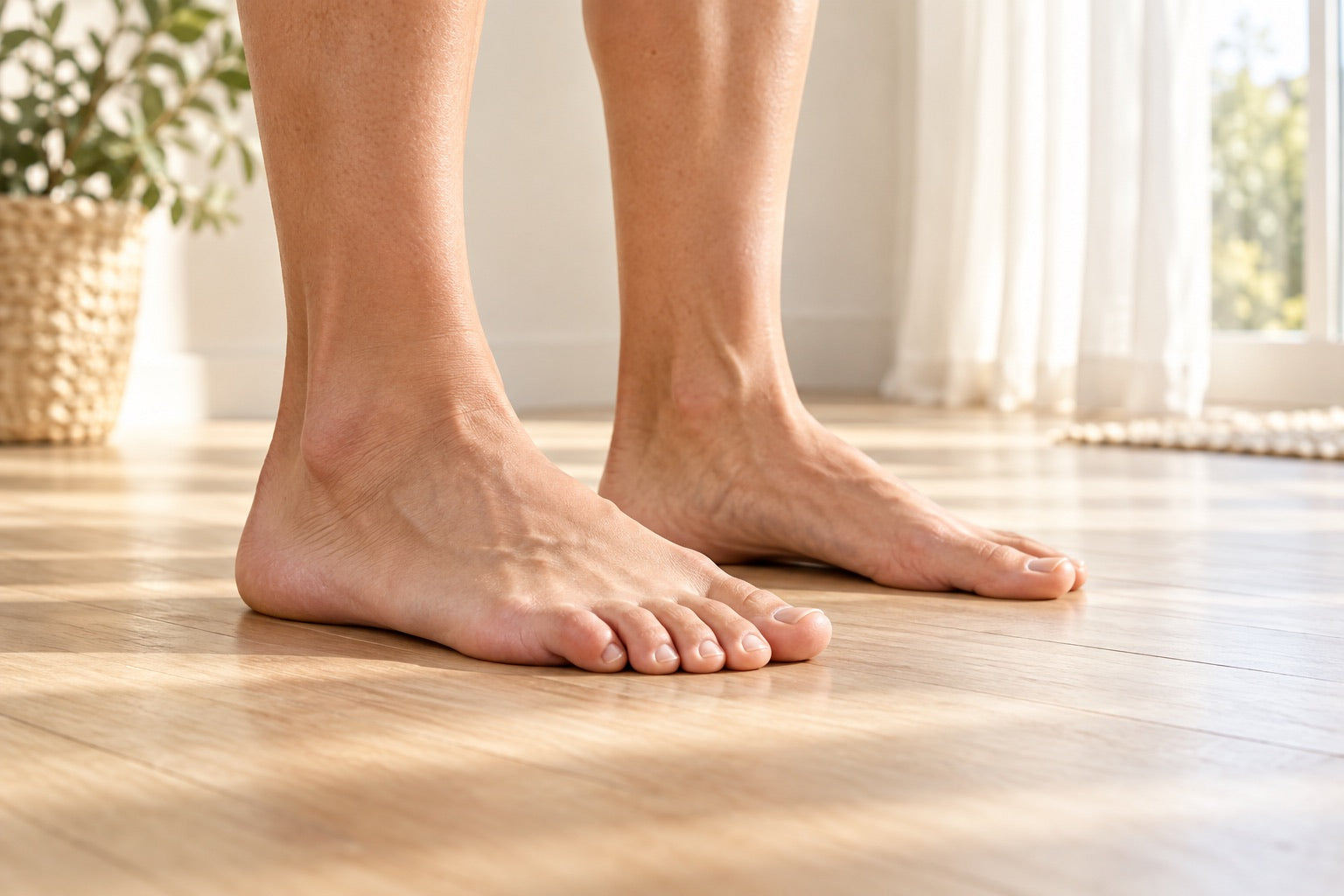
Foot pain rarely stays in the foot. The body is built like a stack of linked levers, and when the bottom of that stack — the foot — fails to do its job, the rest of the system absorbs the cost. Knees twist inward. Hips rotate. The lower back compensates. The shoulders drift forward. Within a few weeks of a quiet biomechanical breakdown at ground level, you have a person rubbing their lumbar spine and wondering when their back "started" hurting.
This is the postural chain at work. And if you have been chasing pain around your body — heel one month, IT band the next, sciatic-feeling tightness after that — there is a reasonable chance the foot is the part you have been ignoring.
What the postural chain actually is
"Kinetic chain" and "postural chain" are clinical shorthand for a basic physical truth: every joint in the body influences the joints above and below it. Push on one link and the rest move with it. The chain runs from the metatarsal heads at the front of the foot up through the arch, the subtalar joint, the ankle, the tibia, the knee, the femur, the hip, the pelvis, the lumbar spine, the thoracic spine, and finally the cervical spine and head.
This is not theory. It is measurable on a force plate. When the foot makes contact with the ground during walking, ground reaction force enters the body at roughly 1.0 to 1.2 times bodyweight. During running, that number climbs to between 2.0 and 3.0 times bodyweight. The chain is responsible for distributing that force. When one link distributes it incorrectly — usually because it is collapsing, locking, or rotating in a direction it shouldn't — the rest of the chain has to take the leftover load.
A 2014 study in the Journal of Foot and Ankle Research demonstrated that altered foot posture significantly changes lower limb kinematics during gait, with measurable differences in tibial rotation, knee abduction, and hip adduction angles. In plain language: how your foot hits the ground decides what your knee and hip have to do for the next 0.6 seconds.
Where it usually starts: the foot
Three foot types account for the vast majority of postural chain dysfunction:
Overpronation. The foot collapses inward and the arch flattens excessively under load. This rolls the tibia inward (internal rotation), which drags the femur with it, which tilts the pelvis forward, which compresses the lumbar spine. People with overpronation often present with medial knee pain, IT band irritation, and a deep ache low in the back after standing.
Supination (oversupination). The opposite problem. The foot stays rigid and rolls outward. The chain runs the other direction — external tibial rotation, lateral knee load, hip drift, often with a one-sided lower-back ache. People with high, rigid arches frequently fall into this pattern and experience lateral foot pain, peroneal tendon irritation, and stress fractures along the outside of the leg.
Functional flat foot. The arch holds shape at rest but collapses under load. This is the trickiest pattern because the foot looks normal in the office and fails on the trail. It produces the same downstream consequences as structural overpronation but is missed on static exam.
The links above the foot
Once the foot has communicated its dysfunction up the chain, the body adapts. Those adaptations have names.
Knee: Patellofemoral pain syndrome ("runner's knee") is the most common downstream consequence. The patella tracks poorly because the femur is rotating with the tibia, which is rotating with the foot. A 2010 systematic review in the British Journal of Sports Medicine identified abnormal foot pronation as one of the most consistent risk factors for patellofemoral pain across study populations.
Hip: The gluteus medius is the primary stabilizer of the pelvis during single-leg stance — which is what walking actually is, repeated thousands of times. When the foot collapses, the gluteus medius works harder to keep the pelvis level. Chronic overload leads to gluteal tendinopathy, trochanteric bursitis, and the classic Trendelenburg gait pattern where the opposite hip drops with each step.
Lumbar spine: Foot dysfunction creates asymmetric leg-length changes (functional, not anatomical) and pelvic tilt. The lumbar spine has to laterally flex, rotate, and extend to keep the head level. Over years, this produces facet joint arthritis, disc compression on the loaded side, and the chronic, dull lower-back pain that plagues so many people who stand for a living.
Upper back and neck: Less obvious but well-documented. When the pelvis tips forward (anterior pelvic tilt), the body compensates by extending the lumbar spine, which forces the thoracic spine to flex, which drives the head forward to keep the eyes level. The result is the modern posture epidemic — forward head, rounded shoulders, neck pain — that gets blamed on phones and laptops but often starts at the feet.
Numbers: how much force the chain is moving
| Activity | Ground Reaction Force (× bodyweight) | Foot Strikes per Mile | Total Daily Load (170 lb adult) |
|---|---|---|---|
| Walking | 1.0–1.2× | ~2,000 | ~340,000 lb (avg 5,000 steps) |
| Standing (shifting weight) | 0.8–1.0× | N/A | 8 hours = continuous load |
| Easy jogging | 2.0–2.5× | ~1,500 | 510,000–637,500 lb per 3-mile run |
| Hard running / sprinting | 2.8–3.5× | ~1,500 | 714,000–892,500 lb per 3 miles |
| Jumping (landing) | 3.0–6.0× | N/A | Per landing: 510–1,020 lb |
The point of this table is not to alarm you. It is to make a single fact undeniable: the foot is moving an enormous amount of force every day, and where that force gets distributed depends entirely on whether the foot is doing its job correctly.
The everyday signs the chain is breaking down
Most people do not present with a single, localized complaint. They present with a constellation of small symptoms that don't seem connected. Here are the ones we see most frequently:
Morning heel pain that fades after the first ten minutes of walking. A nagging pull on the outside of one knee after long walks. Glute tightness on one side that no amount of stretching seems to release. Lower-back stiffness after a day of standing that improves overnight. Hip "clicking" with stair climbing. Calves that cramp at night for no obvious reason. A feeling that one shoe wears out faster than the other. The same shoulder always tighter than its twin.
Any one of these in isolation is not necessarily a postural chain problem. But three or four of them clustered together — particularly with a history of overpronation, flat feet, or high arches — almost always trace back to ground level.
Fixing the chain from the bottom up
The frustrating truth about kinetic chain pain is that you usually cannot fix it where it hurts. Treating chronic IT band pain with foam rolling and stretching while the foot continues to overpronate is rolling a wheel uphill. The pain comes back because the input never changed.
The hierarchy of intervention, in order:
1. Restore the base. Address foot mechanics first. This usually means a properly designed orthotic insert that provides arch support sufficient to control pronation, a deep heel cup to stabilize the calcaneus, and forefoot cushioning to dampen the impact spike. This is the role our FCSS™ Pro orthotic inserts are built for — they give the foot the structural input it needs so the rest of the chain has something stable to work against.
2. Strengthen the weakest link above the foot. Almost always the gluteus medius and the deep core. Strong hips can compensate for moderate foot dysfunction; weak hips cannot. A 2011 study in JOSPT found that hip strengthening reduced patellofemoral pain in runners more than knee-focused interventions. The chain rewards strength at the points of greatest stability.
3. Restore mobility at the locked links. Usually the ankle and the thoracic spine. A stiff ankle forces the foot to compensate by collapsing through the arch. A stiff upper back forces the lumbar spine to take more rotation than it was designed for.
4. Address the symptomatic site last. The knee, the hip, the back. Once the inputs above and below have been corrected, these usually quiet down on their own. If they don't, that is when targeted treatment is warranted — but treating them first is treating the smoke instead of the fire.
Why orthotic inserts matter so much at step one
The foot strikes the ground roughly 5,000 times per day in a moderately active adult. Each of those strikes is a chance for the chain to either work cleanly or compensate. An orthotic insert is the only intervention that operates at every single strike, all day, for as long as you wear shoes.
Stretching helps for the next hour. A massage helps for the next day. Strengthening helps for the next workout. A properly designed insert helps for the next 5,000 foot strikes — and then 5,000 more tomorrow. It is the only mechanical intervention with the dose-response profile to actually re-train the chain over weeks and months.
This is why the clinical literature on orthotic intervention for downstream pain is so consistent. A 2014 systematic review in Sports Medicine concluded that foot orthoses provide moderate to strong evidence of benefit for patellofemoral pain syndrome — a knee problem treated by changing the foot.
What "good support" actually means
Not all inserts are created equal, and the difference matters. The market is split between two categories that look similar but behave very differently. Soft, flat cushioning inserts distribute pressure but provide no structural correction — they are a comfort product. Structural orthotic inserts provide a contoured arch, a stabilizing heel cup, and material density tuned to control motion without locking out the foot's natural mechanics.
The FCSS™ Pro design uses a semi-rigid shell with progressive cushioning specifically because chain dysfunction requires both structure (to control motion) and shock absorption (to manage the load). One without the other fails. Pure cushioning lets the foot continue to collapse; pure rigidity creates new problems by transmitting too much force to the joints above.
How long it takes the chain to recover
Most people who address foot mechanics correctly notice changes in the following sequence:
Week 1: Foot fatigue or mild arch soreness as the intrinsic foot muscles adjust to working in a corrected position. This is normal and resolves in 7–10 days.
Weeks 2–4: Knee and hip symptoms typically begin to settle. Patellar tracking improves first, often before the patient notices.
Weeks 4–8: Lower back tension starts to ease. The lumbar spine no longer has to compensate for asymmetric inputs, and chronic muscle guarding begins to release.
Weeks 8–12: Postural changes become visible. Forward head posture decreases. Shoulder tension reduces. People often report their clothes fitting differently.
This timeline assumes the inserts are worn during all weight-bearing hours, that secondary work (hip strengthening, ankle mobility) is being done in parallel, and that the underlying foot type is being addressed by an appropriately designed product — not just generic cushioning.
Frequently Asked Questions
Can foot problems really cause back pain?
Yes, and the link is well-documented. Asymmetric foot mechanics produce functional leg-length differences and pelvic tilt, both of which force the lumbar spine to compensate. Studies on orthotic intervention for chronic low back pain have demonstrated meaningful symptom reduction in patients whose pain originated at the foot.
How do I know if my pain is coming from my feet?
Look for clusters: heel or arch pain plus knee pain plus lower back pain on the same side, or unexplained one-sided symptoms that move around the body without obvious cause. If your pain pattern is asymmetric and includes the foot, the chain is the most likely explanation.
Will inserts fix my back pain on their own?
Usually not on their own — but they are almost always part of the answer. Inserts correct the input. Strengthening, mobility work, and posture training correct the body's response to that input. The combination is what produces durable change.
How long does it take to feel a difference after starting orthotic inserts?
Heel and arch symptoms often improve within the first two weeks. Knee and hip symptoms typically take three to six weeks. Lower back and postural changes can take eight to twelve weeks. Chain adaptation is slower than local tissue healing because every link has to recalibrate.
Should I keep stretching and foam rolling while I wear inserts?
Yes. Soft tissue work and inserts address different parts of the same problem. Stretching releases the compensations that built up while the chain was dysfunctional; inserts prevent new compensations from forming. Both matter.
Can I wear my inserts in any shoe?
The FCSS™ Pro is designed to fit most athletic, casual, and work shoes with a removable footbed. Pull the original insert out, drop the insert in. For dress shoes or ultra-low-volume footwear, fit varies — most users wear their primary daily shoe with the insert and rotate other footwear secondarily.
Do I need a different insert for each activity?
Most people don't. A well-designed semi-rigid orthotic handles walking, standing, hiking, gym work, and most running mileage. Athletes doing very high-impact training (sprints, jumping sports) sometimes benefit from a sport-specific second pair, but for the vast majority of users, one good insert worn consistently is what changes the chain.
The WYATT takeaway
Footwear decisions belong in the wider conversation about how you stand and move. WYATT's focus starts at the foot, with the rest of that chain in mind.