
Memorial Day Race Recovery: The 72-Hour Foot Protocol That Speeds Healing After a Holiday-Weekend Endurance Event
Why Holiday-Weekend Races Are Uniquely Brutal on Your Feet
You trained for months. You crossed the finish line. And now, a day later, the bottom of your foot feels like someone drove a nail through your heel.
This is one of the most common post-race complaints sports medicine clinicians hear after long-weekend endurance events — and it's not just ordinary muscle soreness. Holiday-weekend races like those held over Memorial Day combine several variables that make foot injuries particularly likely and particularly slow to heal: pre-race travel fatigue, suboptimal sleep, compressed taper windows, and the sheer volume of walking and standing that surrounds race weekend even before the gun goes off.
Understanding what actually happens inside your foot during and after a hard effort — and following a structured 72-hour protocol — can meaningfully accelerate your recovery and prevent the acute soreness from calcifying into a chronic problem.
What a Long Race Actually Does to Your Feet
During a half or full marathon, the plantar fascia — the thick band of connective tissue running from your heel bone to the base of your toes — absorbs somewhere between 1.5 and 3 times your body weight with every footstrike. Over 26.2 miles, that means the fascia cycles through roughly 40,000 to 50,000 loading events. Even in well-trained runners, this produces microscopic tears in the collagen fibers, localized inflammatory cascades, and measurable fluid accumulation in the heel pad.
One study using ultrasonographic imaging of marathon runners' plantar fascia[1] documented statistically significant thickening of the fascial band immediately post-race compared to pre-race baselines — a hallmark of acute strain that typically resolves over days to weeks depending on load management and tissue quality.
Concurrently, the intrinsic foot muscles responsible for arch support — flexor digitorum brevis, abductor hallucis, and the lumbricals — are often significantly fatigued by mile 18 or earlier in recreational runners. When these muscles can no longer actively contribute to arch support, the passive structures (fascia, plantar ligaments, heel fat pad) take over an increasing share of the load. This is the window where plantar fasciitis, heel stress reactions, and metatarsal bruising most commonly originate.
Holiday-weekend races introduce one additional stressor that weekday events don't: most runners spend the 24 hours before a race and several hours after on their feet — expo halls, parking structures, hotel lobbies — on hard surfaces without the cushioning of a shoe optimized for static standing. By the time the race starts, your plantar fascia may already be carrying an elevated inflammatory burden. That pre-race accumulation is exactly why the post-race window deserves a deliberate plan rather than improvisation.
The 72-Hour Foot Recovery Protocol
The period immediately after an endurance event is when your recovery trajectory is largely set. Ignore the acute phase and minor inflammation can become persistent structural change. Manage it correctly and most runners are functional — if not fully recovered — within a week.
Hours 0–12: Reduce Inflammation, Protect the Tissue
The primary goals in the first half-day post-race are controlling inflammatory load and protecting the damaged tissue from additional mechanical stress.
Footwear matters immediately. The worst thing you can do after crossing a finish line is walk back to the hotel in your racing flats, flip-flops, or bare feet. Racing shoes — especially carbon-plated models — are built for energy return, not shock absorption or arch support. Flat sandals provide almost no fascial offloading. Put on shoes with a substantial heel-to-toe drop (8–12mm) and firm arch support as soon as the race is over. If you've been dealing with any heel or arch discomfort in training, this is when having a pair of orthotic inserts in your recovery shoes pays off significantly — the structured arch contact reduces tensile load on the plantar fascia during the post-race walking you inevitably have to do.
Ice and elevation. Fifteen to twenty minutes of ice application (wrapped in a cloth to prevent skin injury) to the heel and arch, combined with elevating the feet above heart level, has empirical support for reducing post-exercise edema. While the evidence base for cryotherapy as an anti-inflammatory intervention[2] has been debated in recent years, its role in reducing acute pain perception and fluid accumulation in the hours immediately after tissue trauma remains well-supported clinically.
Avoid NSAIDs for the first 6 hours. This runs counter to common practice, but there is meaningful evidence that non-steroidal anti-inflammatory drugs taken immediately post-exercise may blunt the acute inflammatory cascade that initiates tissue repair. The inflammation after a hard race is not purely pathological — it's a necessary signal for collagen remodeling. If pain management is essential, acetaminophen is a reasonable short-term alternative during this window.
Compression. Graduated compression socks or sleeves (15–20 mmHg) during the first 12 hours reduce venous pooling in the lower leg and foot, supporting lymphatic clearance of metabolic byproducts. Several controlled trials examining compression garments worn after a marathon[3] have found they modestly improve perceived muscle soreness scores and accelerate the return of lower-limb proprioception.
Hours 12–48: Gentle Mobility, Targeted Load
This window is where most recreational athletes get it wrong in one of two directions: they either do nothing (full couch rest) or they do too much (a "shake out" jog the next morning). Both approaches delay recovery.
Contrast bathing. Alternating 3-minute warm immersion (not hot — around 38–40°C) with 1-minute cool water cycles three to four times, ending on cool, promotes vascular flushing in the feet and lower legs without the rebound inflammation risk of aggressive hot/cold extremes. This technique has been used in competitive athletics for decades and has a reasonable evidence base for contrast water therapy reducing acute muscle soreness[4] in the 24–48 hour window.
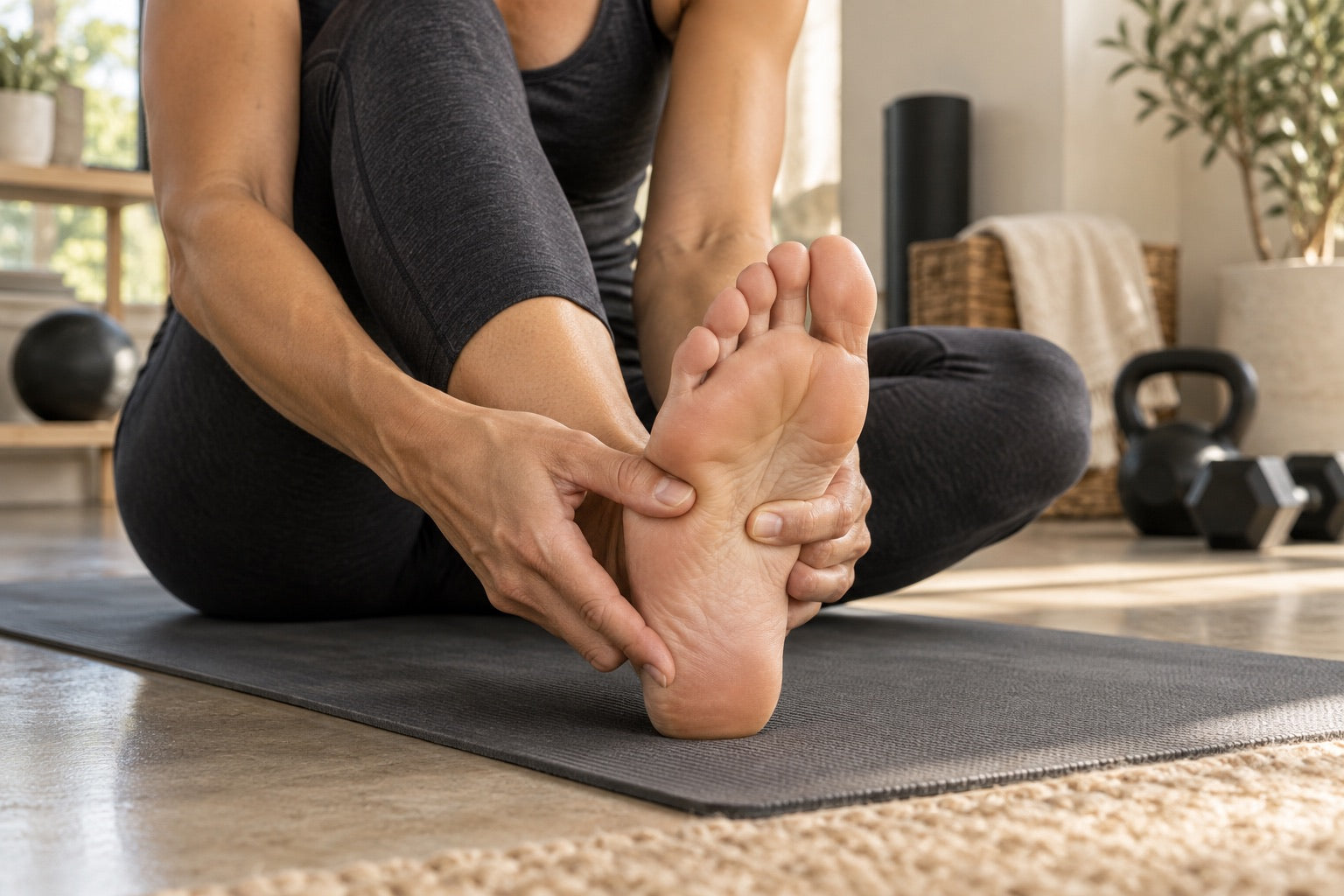
Foot and calf mobilization. Begin gentle plantar fascia stretching — seated, with the affected foot crossed over the knee, pulling the toes back toward the shin until tension is felt in the arch. Hold for 20–30 seconds, three repetitions per foot. Research has consistently found that this tissue-specific plantar fascia stretch[5] reduces fascial strain during the initial steps of weight-bearing, which is clinically significant in the post-race period when the first steps after rest are typically the most painful.
Short walks with support. Twenty to thirty minutes of walking at a comfortable pace (not running) on the day after a race promotes blood flow and prevents the fascial stiffening that comes from complete immobilization — but only in shoes with structured support. This is not the time for minimalist footwear or maximalist stack-height shoes without a firm midsole. What your foot needs is controlled compression of the arch against a stable, contoured surface. Orthotic inserts with a semi-rigid shell perform this function better than stock inserts in most off-the-shelf footwear.
Nutritional support for collagen synthesis. The 24–72 hour period post-exercise is an important window for tissue remodeling. Vitamin C intake in the range of 200–500mg taken alongside a hydrolyzed collagen supplement (10–15g) approximately one hour before light activity has been shown in controlled studies measuring gelatin and vitamin C supplementation for collagen synthesis[6] to increase collagen synthesis markers in connective tissue. While research specific to plantar fascia repair is limited, the collagen-rich composition of this structure makes the pathway plausible and low-risk to implement.
Hours 48–72: Active Recovery and Load Testing
By the third day after a hard endurance effort, the acute inflammatory phase has largely concluded in runners without pre-existing pathology. What remains is a remodeling process that benefits from controlled mechanical loading — the stimulus that tells collagen fibers to align properly rather than laying down disorganized scar tissue.
Single-leg heel raises. Stand near a wall for balance. Rise onto the toes of one foot for a 3-second count, lower for a 3-second count. Start with 3 sets of 10 and assess. This exercise eccentrically loads the Achilles-plantar fascia complex in a controlled manner that promotes ordered collagen remodeling without exceeding the tissue's current load tolerance. A widely cited trial establishing the eccentric heel-raise loading protocol for tendinopathy[7] found it superior to passive stretching alone for long-term outcomes — and similar principles apply to fascial recovery.
Non-impact cardio. Swimming or cycling (stationary is fine) for 30–45 minutes maintains cardiovascular conditioning, promotes systemic circulation that aids tissue repair, and allows you to assess your pain response to movement without the ground reaction forces of running.
Assess for alarm signs. If heel pain is worsening rather than improving between days 2 and 3, or if pain is localized to a specific point on the heel rather than diffusely along the arch, consider imaging. Acute heel stress reactions and fat pad contusions can present similarly to plantar fasciitis but require different management. Sharp, point-specific pain warrants clinical evaluation rather than continued home management.
The Role of Orthotic Support in Post-Race Recovery
One of the most consistent findings in plantar fasciitis research is that mechanical offloading — reducing tensile strain on the fascial band through arch support — is among the most effective non-surgical interventions for both acute and chronic presentations, as summarized in a clinical practice guideline on heel pain and plantar fasciitis[8]. In the post-race context, this translates to a practical argument: the days immediately after a hard effort are when your feet are most vulnerable to developing a persistent condition, and also when support is most often absent (people shuffle around in flip-flops and hotel slippers).
Prefabricated orthotic inserts with a semi-rigid arch shell and heel cup provide three functions that matter in recovery: they maintain the medial longitudinal arch in a supported position (reducing fascial tension with each step), they cushion the heel's fat pad against hard surface impact, and they moderate excessive pronation that distributes stress unevenly across the plantar fascia's attachment point.
Moving inserts from your training shoes into your daily recovery footwear — whether that's a neutral trainer or a supportive sneaker — is a low-effort intervention that costs you nothing and meaningfully reduces your cumulative fascial load during the days you're spending on your feet. If you want a deeper breakdown of how arch support changes fascial mechanics, our guide to orthotic inserts for plantar fasciitis walks through the underlying biomechanics in detail.
For runners who already have FCSS™ Pro Orthotic Inserts, the post-race protocol is simple: inserts go into every shoe you wear for the first 72 hours. Not just your run shoes. Every shoe.
When Post-Race Soreness Becomes Something More Serious
The distinction between expected post-race foot soreness and a developing injury is clinically important. Normal post-race foot pain is diffuse, symmetric (both feet feel similarly sore), worst on the first steps after rest and gradually improves with movement, and trending toward resolution by day 3–4.
Signs that warrant medical evaluation include: pain that is worsening after 72 hours rather than improving; pain that is entirely localized to one heel or one specific spot on the foot; any bruising or swelling that is disproportionate to what you'd expect from running; numbness, tingling, or burning that follows a nerve distribution; or any sensation of "giving way" in the arch or ankle.
Plantar fascia tears, though rare, do occur in endurance runners — particularly in the setting of a sudden training spike or an event run significantly faster than training paces. These present with acute, severe pain during or immediately after the race, often described as a "pop," and require imaging confirmation and a very different management approach than standard post-race inflammation.
Building a Race Weekend Foot Care Kit
The simplest way to protect your feet across a race weekend is to pack with recovery in mind, not just performance:
- Day-before shoes: A supportive sneaker or trail shoe with your orthotic inserts — worn for expo walking, packet pickup, and all pre-race movement.
- Post-race shoes: A wide-toe-box sneaker with room for a compression sock plus insert.
- Compression socks: Two pairs — one to wear during race-day travel, one for immediate post-race.
- Small ice pack: Reusable gel packs fold flat in a carry bag and can be used at the hotel without access to an ice machine.
- Vitamin C packets and collagen powder: Easy to travel with; mix in water the evening before and the evening of race day.
This isn't about over-engineering a weekend race. It's about giving your foot tissue the margin it needs so that one hard effort in May doesn't turn into a summer spent managing heel pain.
The Bottom Line
Post-race foot recovery isn't passive. The 72 hours after an endurance event are a window during which your choices — footwear, load management, nutrition, and targeted mobility work — meaningfully influence whether your feet heal completely or carry chronic damage into your next training cycle.
The protocol outlined here isn't complicated. Ice, elevate, and protect the tissue in the first 12 hours. Gentle mobility and contrast bathing through day two. Controlled loading and eccentric exercise by day three. And throughout: structured arch support in every shoe you put on.
Most post-race foot problems are preventable. The runners who avoid them treat the recovery window as seriously as the training block — and their next race start line is healthier for it.
The WYATT takeaway
In the 72 hours after a holiday-weekend race, you spend almost every waking minute on your feet — expo halls, hotel lobbies, parking structures, sightseeing — on hard, flat surfaces, often in flip-flops or recovery slides that offer zero arch support.
Your intrinsic foot muscles are already fatigued from the race, so the passive plantar fascia absorbs each unsupported step. Continuous tensile loading on freshly micro-torn collagen is precisely what turns transient post-race soreness into chronic plantar fasciitis.
The FCSS™ Pro is a removable, semi-rigid arch shell and heel cup you drop into whatever shoe you are already wearing during recovery. It redistributes the post-race load off the inflamed fascia and onto a contoured support surface — then comes back out once you are healed. No surgery, no rebuilding your foot, just a load-redistributing modification you control.
References
- Journal of Orthopaedic & Sports Physical Therapy. Plantar fascia thickening in recreational marathon runners assessed by ultrasonography, 2021. jospt.org
- Review of cryotherapy and cold-water immersion for exercise-induced muscle damage and inflammation (PubMed 28177536). pubmed.ncbi.nlm.nih.gov
- Controlled study of compression garments and recovery markers after endurance running (PubMed 27348020). pubmed.ncbi.nlm.nih.gov
- Meta-analysis of contrast water therapy for recovery and delayed-onset muscle soreness (PubMed 24149160). pubmed.ncbi.nlm.nih.gov
- Randomized study of tissue-specific plantar fascia stretching for plantar fasciitis (PubMed 12911243). pubmed.ncbi.nlm.nih.gov
- Controlled trial of gelatin and vitamin C supplementation for collagen synthesis (PubMed 28978912). pubmed.ncbi.nlm.nih.gov
- Trial of eccentric loading protocol for lower-limb tendinopathy outcomes (PubMed 12485432). pubmed.ncbi.nlm.nih.gov
- Clinical practice guideline on heel pain and plantar fasciitis management (PubMed 34001977). pubmed.ncbi.nlm.nih.gov