

Why NFL Draft Prospects Train Their Feet First
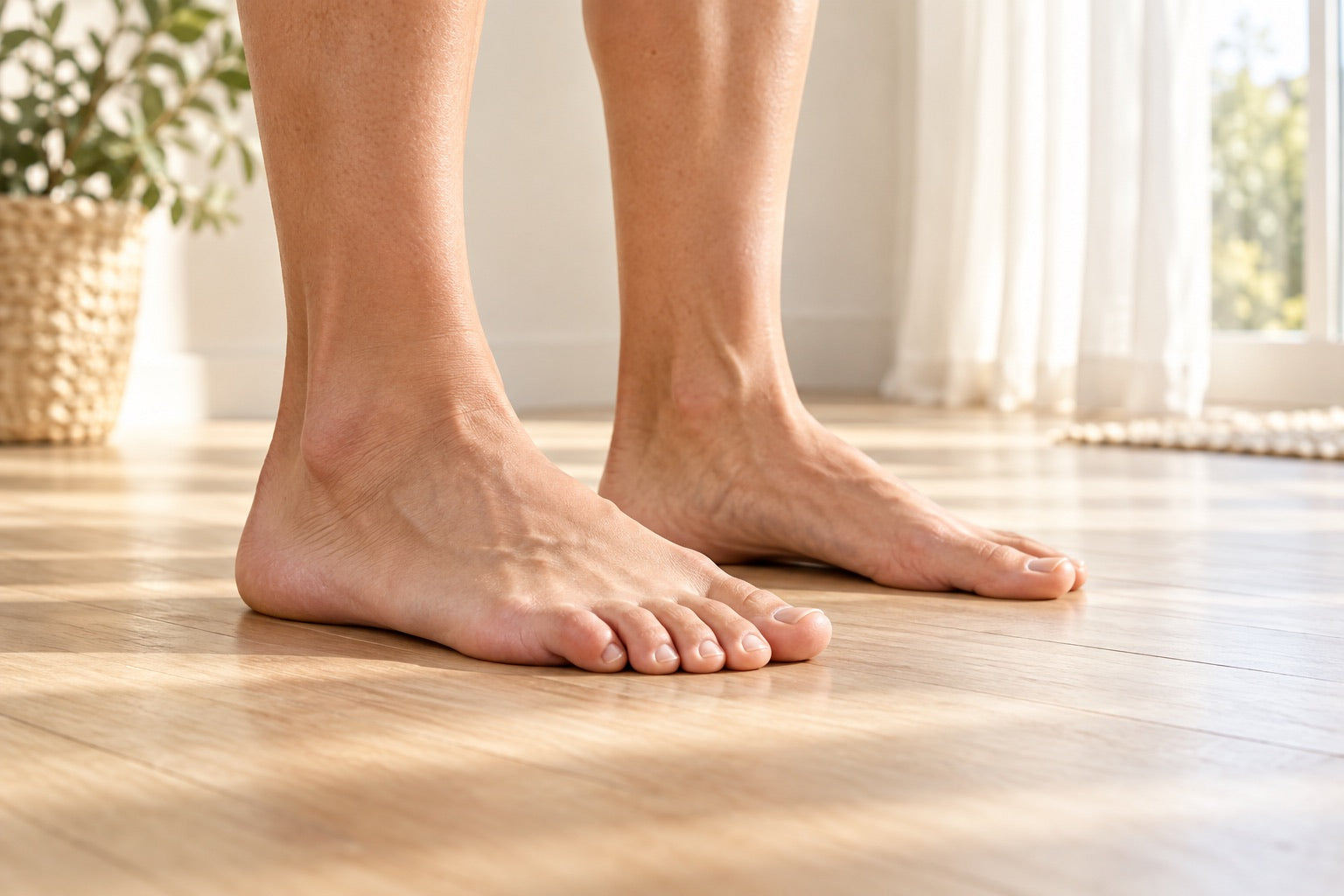
Every January, NFL teams bring in draft prospects for the NFL Combine. For speed and strength, athletes train explosively for months. But the real training revolution—barely visible to casual fans—happens in the facility's basement: foot training.
Elite athletic programs now treat foot and ankle strength as foundational work that precedes speed and strength training. This isn't fringe practice—it's standard in top programs. The reason is biomechanical: power transfer, stability, and injury prevention all originate at the foot. This guide explains why elite trainers prioritize foot training, what protocols they use, and how recreational and semi-elite athletes can apply the same principles.
What the elite-athlete biomechanics literature confirms
The reason elite-athlete development programs invest heavily in foot-specific training and structural support isn't branding — it's biomechanics. According to PubMed, Clansey and colleagues' randomized controlled trial showed that targeted intervention can significantly reduce peak tibial axial acceleration and vertical loading rate without sacrificing performance (Clansey et al., 2014). For an athlete whose career depends on cumulative loading over a 15-year window, the difference between high and low loading rate per step compounds enormously. The Malisoux randomized trial of 800+ runners found that those in the lower-loading-rate condition had 52% lower injury risk over six months (Malisoux et al., 2020; Malisoux et al., 2021). NFL prospects training their feet aren't doing it for the glamour shots. They're doing it because tissue adaptation is the rate-limiting step in athletic longevity, and the foot is the foundation of that adaptation.
The NFL Combine Data: Foot Mechanics Are Formally Evaluated
The NFL Combine includes measurements and observations that directly assess foot and ankle function. Speed drills (40-yard dash, 20-yard shuttle, three-cone drill) are filmed and analyzed for foot strike patterns, pronation, ankle mobility, and proprioceptive stability. Teams use this data to assess injury risk and movement quality, not just raw speed.
Pro scouts now formally document:
Foot strike pattern during acceleration: Midfoot or forefoot strikers during acceleration phase accelerate faster (0-10 yards) than heel strikers and have lower knee injury risk. Heel strikers produce more force through the GRF, but at a biomechanical disadvantage for acceleration.
Ankle stability during cutting: The 3-cone drill evaluates directional changes. Ankle instability (foot rolling, uncontrolled eversion) is recorded. Athletes with chronic ankle instability are flagged as higher injury risk, even if they're quick.
Proprioceptive control: Single-leg balance and weight transfer during dynamic movement are observed. These are proxies for neuromuscular control. An athlete who appears off-balance or uses their arms excessively for balance is showing poor proprioceptive training.
Foot positioning during plant-and-cut: How the foot contacts the ground during direction change. Optimal positioning is forefoot contact with the foot slightly supinated (rolled outward), allowing rapid direction change. Pronated foot contact increases ACL injury risk on cuts.
These aren't minor evaluation metrics. Teams use this data to predict injury likelihood. An athletically gifted prospect with foot stability issues gets rated lower than a slightly slower prospect with excellent foot mechanics, all else being equal.
The Kinetic Chain: Why Foot Strength Powers Everything Above It
Power in athletics transfers from the ground up through a kinetic chain: foot → ankle → knee → hip → trunk → upper body. This is literally true in jumping, sprinting, cutting, and kicking. The chain is only as strong as its weakest link.
If foot strength is inadequate, the ankle must compensate. The ankle's muscles (particularly the peroneals and anterior tibialis) become overworked and fatigued. This reduces ankle stability. An unstable ankle means the knee can't function optimally—it's receiving unstable input from below. An unstable knee means the hip must compensate. An unstable hip limits power transfer to the trunk and explosive movement.
Conversely, a strong foot with excellent proprioceptive control creates a stable foundation. The ankle receives stable input and can focus on propulsive forces. The knee can function in optimal alignment. The hip can transfer maximum power. The athlete is faster, more powerful, and significantly less injury-prone.
This is why elite trainers start with the foot. It's not glamorous—there's no YouTube video of someone getting famous doing single-leg calf raises. But it's foundational. You cannot build elite performance on a weak foundation.
Specific Foot Training Protocols Used by NFL Prep Facilities
Phase 1: Proprioceptive Awakening (Weeks 1-2)
This phase activates the small muscles and proprioceptive system of the foot. These muscles have been dormant in many athletes because modern footwear and flat surfaces reduce proprioceptive demand.
Barefoot walking: 10-15 minutes daily on grass or sand. The uneven surface forces constant micro-adjustments. Proprioceptors fire continuously, rebuilding the neural map of foot position.
Short foot exercise: Sitting, shorten the arch by pulling the ball of the foot toward the heel without curling the toes. This activates intrinsic foot muscles. 3 sets of 10 reps daily.
Single-leg balance: Stand on one leg on flat ground. Progress to unstable surfaces (balance pad, foam). Progress to eyes closed. Start 20-30 seconds per leg, build to 60-90 seconds. 3 sets daily.
Phase 2: Ankle Mobility and Strength (Weeks 3-4)
Ankle mobility work: Controlled ankle circles (slow, full range of motion), inversion/eversion stretches (hold 30 seconds each direction). 5 minutes daily.
Resisted ankle inversion/eversion: Resistance band around forefoot. Pull inward (inversion) against resistance. 3 sets of 15 reps. Do the same for eversion (pull outward). This strengthens the peroneal and tibialis muscles that stabilize the ankle.
Single-leg balance progression: Balance on one leg while throwing a ball against a wall and catching it. Or balance on one leg while performing upper body movements (arm circles, reaches). 3 sets of 30-45 seconds per leg.
Phase 3: Dynamic Proprioceptive Control (Weeks 5-6)
Single-leg reaching: Stand on one leg. Reach forward, backward, and to the sides with the opposite leg, touching the ground lightly. This trains dynamic balance. 3 sets of 10 reps per direction per leg.
Single-leg hops: Gentle hops in place on one leg. Focus on control and soft landing, not height. 3 sets of 10-15 reps per leg. This introduces dynamic loading while maintaining proprioceptive control.
Lateral bounds: Small bounds side to side, landing on alternate legs. 3 sets of 8-10 per direction. This trains foot and ankle stability during lateral movement, which is critical for cutting.
Phase 4: Sport-Specific Power Transfer (Weeks 7-8)
Single-leg calf raises: Stand on one leg, raise the heel. 3 sets of 10-15 reps per leg. This combines strength and balance.
Forward/lateral bounds: Explosive single-leg hops covering distance. Land on the opposite leg and immediately bound again. 3 sets of 5-8 reps per leg. This trains power transfer from foot through the kinetic chain.
Box step-ups: Step up onto a box (12-18 inches) one leg at a time, focusing on control and balance. 3 sets of 8-10 per leg. This combines strength, balance, and proprioceptive challenge.
How Amateur and Recreational Athletes Can Apply These Principles
You don't need an NFL training facility to do foot training. The principles are the same regardless of sport or activity level.
Frequency: Foot training should happen 4-5 days per week. It's not time-intensive—15-20 minutes per session. Think of it like brushing your teeth: non-negotiable daily habit.
Progression: Start with Phase 1 work (proprioceptive awakening) for 2 weeks, regardless of your current fitness level. Then progress to Phase 2. Progress slowly—each phase should take 2-3 weeks. Rushing creates injury.
Integration into training: Do foot training before your main workout, when your nervous system is fresh. Even 10-15 minutes before your sport or strength training counts.
Winter/Off-season work: Use the off-season to build foot and ankle strength systematically. You'll return to your sport better prepared and less injury-prone.
The Role of Orthotics: Foundation, Not Crutch
An orthotic insert isn't a substitute for foot training—it's a foundation that allows training to happen. Here's the distinction:
Athletes with flat feet, overpronation, or anatomical constraints may struggle with proprioceptive training and balance work because their feet are structurally compromised. A semi-rigid insert provides the base stability needed to perform balance and proprioceptive training effectively. With inserts, the athlete can complete all phases of foot training and build strength and proprioception on top of a stable foundation.
This is why many NFL programs use inserts for prospects with structural foot issues. It's not because the inserts make them perform better—it's because the inserts enable better training, which makes them more injury-resistant and able to perform at their natural level without compensation patterns.
Frequently Asked Questions
Q: How long before I notice improvements in speed and athleticism from foot training?
A: Proprioceptive improvements happen within 2-3 weeks. You'll notice better balance and control immediately. Strength improvements take 4-6 weeks to become apparent. Speed and power improvements follow—these typically manifest at 8-12 weeks as the kinetic chain becomes more efficient. The investment is front-loaded with slow, foundational work, but the payoff is substantial.
Q: Can I do foot training while training for my sport?
A: Yes. In fact, that's the ideal approach. Foot training 4-5 days per week (15-20 minutes) enhances your sport training and makes you more resilient to injury. It doesn't interfere with strength training, conditioning, or skill work.
Q: What if I've had ankle injuries in the past?
A: Foot training is especially important for you. Ankle injuries often leave residual proprioceptive deficits even after the injury heals. Systematic foot training rebuilds proprioception and reduces the likelihood of re-injury. Start slowly (Phase 1 work for 3 weeks minimum) and progress gradually.
Q: Do I need special equipment for foot training?
A: Minimal. A resistance band, a balance pad (optional—a pillow works), a box or step for step-ups. Most of the work is bodyweight. Total equipment investment is under $50.
The Bottom Line
Elite athletes train their feet first because that's where performance originates. The foot is the interface between the athlete and the ground. Everything—speed, power, direction change, injury resistance—flows from foot mechanics upward. A weak or unstable foot limits how fast you can go, how much power you can generate, and how quickly you get injured.
If you want to be faster, more powerful, and more injury-resistant, start with your feet. Spend 8 weeks systematically building foot strength and proprioception using the protocols outlined here. You'll be surprised how much your overall athleticism improves.
Related reading

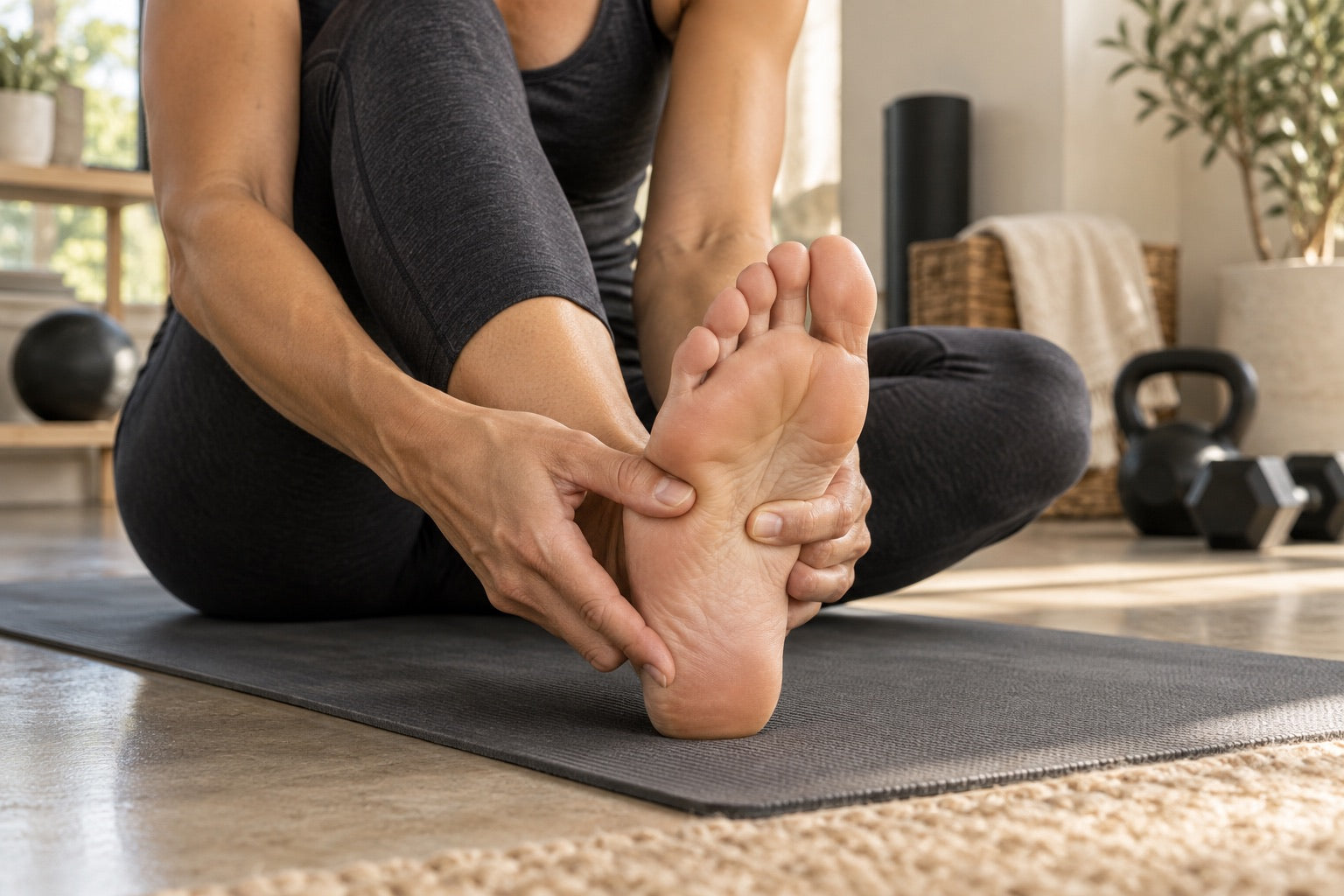
The takeaway for the rest of us
The same principles elite athletes train around apply directly to anyone who runs, lifts, or stands for a living. Loading rate per footstrike doesn't care whether the foot belongs to an NFL prospect or a nurse working a 12-hour shift. Plantar fat-pad atrophy — first identified as a distinct etiology requiring its own treatment pathway in the heel-pain population (Saggini et al., 2018) — happens to recreational runners and standing-occupation workers on the same biomechanical timeline. The structural support layer that lets a draft prospect maintain quad and core function across a 12-week combine prep is the same support layer that lets a teacher walk into class on Monday morning without the cumulative inflammation of last week's shifts. The training intensity differs. The foot's engineering doesn't.
The cushioning paradox is also worth keeping in mind. According to PubMed, Baltich and colleagues found that softer midsoles produced higher peak forces because the body pre-tenses the leg in anticipation of a sinkier landing — meaning more foam isn't categorically more protective (Baltich et al., 2015). What works is calibrated cushioning paired with structural support that prevents the medial arch from collapsing under load.
The WYATT takeaway
Foot preparation deserves a place alongside the rest of an athlete's training. Bring that same attention to the fit and support of everyday training footwear.