Soccer-Related Injuries: The WYATT MVMT Orthotic Solution for Reducing Injury Risk
What the foot-pain literature shows about soccer-specific risk
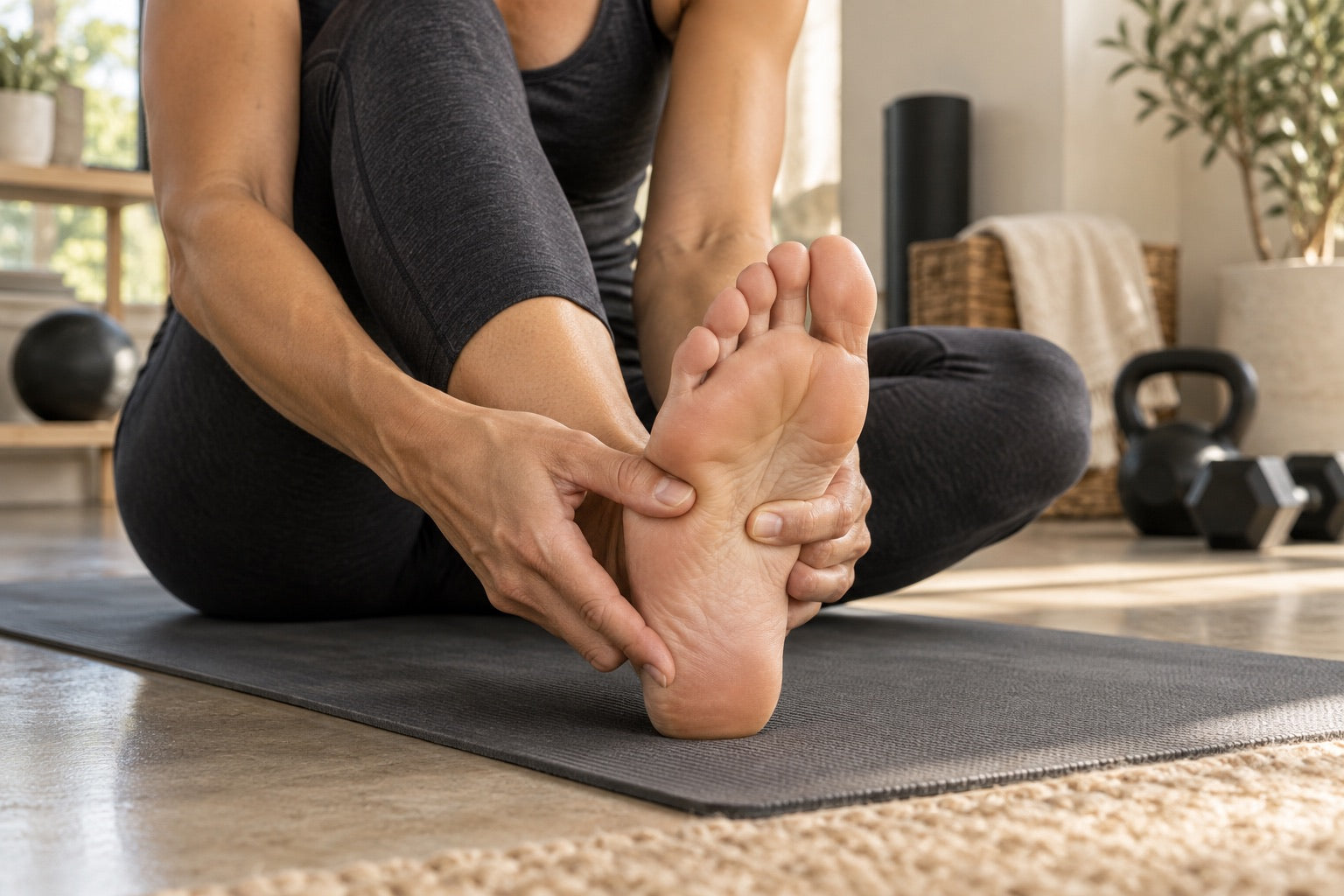
Soccer players present a distinct foot-pain profile because the demands of the sport — sustained running, multi-directional acceleration, kicking forces transmitted through the rearfoot — concentrate load on tissues that the foot's native shock-absorbing system can't protect indefinitely. According to PubMed, Saggini and colleagues' retrospective study of 1,473 soccer players (professional, semi-professional, and amateur) found that 65% of players evaluated had inferior heel pain. The team identified seven distinct etiologies — sural nerve compression, abductor digiti minimi compression, fat-pad atrophy and inflammation, plantar fasciitis, heel-spur stress injury, calcaneal stress fracture, and heel spur — each requiring its own treatment pathway, which the authors argue should be matched to the underlying mechanism rather than applied generically (Saggini et al., 2018). The implication for prevention: a generic cushioned insert does not address most of these mechanisms. A structured orthotic insert that supports the medial arch, holds the rearfoot vertical, and absorbs impact at the heel-strike zone addresses the upstream loading patterns that drive most of these conditions in the first place.
Soccer Foot Injuries: The Position-by-Position Prevention Guide for Serious Players
Soccer is the world's most popular sport, with roughly 265 million players globally. It's also a sport with substantial foot and ankle injury rates — accounting for 25-30% of all soccer injuries according to FIFA injury surveillance data.
But here's the critical insight that most players miss: foot injury risk is not distributed evenly across positions. A goalkeeper's foot stress is fundamentally different from a striker's. A defender's injury profile differs from a midfielder's. Understanding your position-specific risk allows targeted prevention.
The Position-Specific Injury Data from FIFA
Goalkeepers: Impact-Dominant Stress
Primary foot injury risk: metatarsal stress fractures, plantar fasciitis, turf toe (hallux limitus).
Why: Goalkeepers experience enormous vertical loading. Diving creates impact forces of 3-5x body weight landing on uneven ground. Standing on the goal line for 90 minutes with high alertness creates sustained tension. Repeated explosive movements (diving, jumping to punch the ball) load the metatarsal heads and forefoot intensely.
Biomechanical specificity: Most goalkeeper diving is onto hard ground (grass, artificial turf) with uneven surfaces. Landing mechanics are unpredictable. The foot absorbs forces at odd angles, creating stress concentration in specific areas (often the metatarsal heads and medial forefoot).
Prevention priority: Excellent cushioning (shock absorption), metatarsal support (to prevent pressure concentration), and proprioceptive training (to control landing mechanics). Turf toe prevention is critical — wearing a firm shoe with a reinforced toe box and insert support that limits excessive motion at the big toe joint.
Defenders: Lateral Movement and Ankle Dominance
Primary foot injury risk: ankle sprains (50-60% of defender foot injuries), lateral foot pain, subtalar joint dysfunction.
Why: Defenders cover enormous ground laterally — moving sideways to track forwards, shifting weight to block shots, and pivoting to change direction. This constant lateral movement creates repetitive inversion stress (feet rolling outward), which stresses the lateral ankle ligaments and subtalar joint.
Position specifics: Full backs (outside defenders) have the highest ankle injury risk because they cover entire sidelines and perform maximum lateral movement. Central defenders have somewhat lower lateral movement demands but greater load during static positioning (standing, watching play).
Prevention priority: Ankle stability (proprioceptive training, ankle-reinforced shoes), arch support (to stabilize the subtalar joint during lateral movement), and potentially ankle bracing for players with previous ankle injuries. Appropriate footwear with lateral support is essential — not all soccer shoes are created equal.
Midfielders: Volume and Repetitive Stress
Primary foot injury risk: plantar fasciitis, Achilles tendinopathy, metatarsalgia, overuse stress fractures.
Why: Midfielders cover the most ground of any position — often 10-13km per match (compared to 8-10km for defenders, 8-9km for strikers). This massive volume creates cumulative loading that manifests as chronic overuse injuries rather than acute injuries.
Position specifics: Defensive midfielders (sitting deep, protecting the defense) experience more lateral movement stress. Attacking midfielders and wingers have more vertical and transitional loading (sprinting, cutting). Central midfielders experience the most balanced stress across all directions.
Prevention priority: Proper arch support (to handle the enormous volume), excellent cushioning (to manage cumulative impact), and structured training progressions that avoid sudden volume increases. Overuse injuries in midfielders are often preventable through intelligent training management.
Strikers: Explosive Power and Ground Contact Quality
Primary foot injury risk: turf toe, metatarsal stress fractures, Achilles tendinopathy, heel pain.
Why: Strikers perform explosive movements — sprints, sharp cuts, jumping for headers, rapid accelerations and decelerations. Each explosive movement places enormous force through the forefoot (during acceleration) and the whole foot (during dynamic cuts and turns).
Biomechanical specificity: Turf toe is particularly common in strikers because they're constantly pushing off (accelerating) which loads the first metatarsophalangeal joint (big toe joint) maximally. Repetitive maximal loading of this joint can cause degenerative changes even in young players.
Prevention priority: Turf toe prevention (rigid forefoot support, limiting excessive motion of the big toe joint), metatarsal support (to distribute pressure across all toes evenly during pushing), Achilles support (to manage the explosive loading), and proper footwear that provides firm support during rapid acceleration and deceleration.
The Cleat Biomechanics: Surface-Specific Stress
FG vs SG vs AG vs TF: Why Each is Different
Soccer cleats come in different configurations for different surfaces, and surface choice directly affects foot injury risk:
- FG (Firm Ground) — designed for dry natural grass. Moderate number of studs (usually 10-13), moderate stud length (0.7-0.9 inches). Creates good traction without excessive foot torque.
- SG (Soft Ground) — designed for wet, muddy natural grass. Fewer studs (usually 6-8), longer studs (0.9-1.2 inches). Creates traction in soft surfaces but increases foot torque on firm ground (injury risk).
- AG (Artificial Ground) — designed for artificial turf. More, shorter studs (usually 13-17 very short studs). Designed to prevent the foot from getting caught in turf during quick cuts.
- TF (Turf) — designed for hard artificial turf or indoor surfaces. Very many tiny rubber studs or bumps. Minimal foot torque, designed for rapid cuts.
The injury implication: Using the wrong cleat for the surface massively increases injury risk. Wearing SG cleats on firm ground creates excessive torque during cuts, increasing ankle sprain risk. Wearing FG cleats on soft ground creates insufficient grip, leading to slipping and unstable foot position. Playing in TF cleats on natural grass creates poor grip and frequent foot slipping.
The most common error: players buying one pair of cleats and wearing them on all surfaces. Professional and semi-professional players own 2-3 pairs of cleats for different conditions. Serious recreational players should own at least 2 pairs (FG/SG for natural grass, AG/TF for artificial).
Natural Grass vs Artificial Turf: Impact Forces and Stability
Natural grass provides shock absorption (grass flexes, dissipates energy). The surface is forgiving — minor missteps are absorbed. Artificial turf is less forgiving; it's closer to hard pavement in shock absorption. Impact forces on artificial turf are 10-20% higher than natural grass.
Injury rates are roughly 20-30% higher on artificial turf than natural grass. This is partly equipment-related (cleat grip differences) and partly environmental (artificial turf doesn't dissipate energy as well).
The Age-Specific Injury Pattern: Youth Through Professional
Youth Players (U12-U17): Growth Plate Vulnerability
Growth plates (epiphyses) don't fully ossify until age 16-18. High-load sports stress can create stress fractures in growth plates, which are weaker than bone. Calcaneal (heel bone) apophysitis is common in adolescent soccer players from repetitive loading on the growth plate of the heel bone.
Prevention: limit high-intensity training volume, proper footwear with good cushioning, and avoid excessive standing on hard surfaces (like concrete training areas). Gradual training progressions matter enormously.
Adult Players (18-35): Peak Performance and Overuse
This is the age of maximum training intensity and volume. Injuries are common from pushing excessively hard without adequate recovery. Acute ankle sprains peak in this age group (high-speed, high-intensity play creates injury risk).
Prevention: structured training that balances intensity with recovery, proper technique emphasis (good biomechanics reduce injury risk), appropriate footwear, and orthotic support for those with biomechanical dysfunction.
Masters Players (35+): Degenerative Changes and Accumulated Damage
Joint cartilage has degenerated. Previous injuries have left residual instability or weakness. Recovery takes longer. Overuse injuries become more common.
Prevention: maintain training but modify intensity (less sprinting, more technical work), better footwear and orthotic support, and realistic expectations about recovery time.
The Complete Prevention Protocol for Soccer
1. Position-Appropriate Footwear
Own 2+ pairs of cleats for different surfaces. Choose the right cleat type for the surface you're playing on.
2. Orthotic Support
Soccer puts enormous stress on the foot arch and forefoot. Semi-rigid orthotics like FCSS™ Pro fit into soccer cleats and provide arch support, metatarsal support, and improved proprioceptive feedback. This is especially valuable for:
- Players with flat feet or overpronation (which affects 60% of the population)
- Players with previous foot injuries
- Strikers and midfielders (high-volume, explosive movement)
- Players transitioning from other sports with different foot demands
3. Proprioceptive Training
Soccer demands extraordinary balance and ankle control. 10-15 minutes of proprioceptive training (balance board work, single-leg stance, controlled ankle movements) 3x per week reduces ankle injury risk by 40-50%.
4. Warm-Up Specificity
Generic warm-ups (light jogging) are insufficient. Soccer-specific warm-ups should include:
- Dynamic calf stretches
- Ankle circles and controlled inversion/eversion
- Walking lunges and lateral lunges
- Gradual intensification of running, cutting, and acceleration
5. Training Load Management
Sudden increases in training volume cause overuse injuries. Gradual progressions (no more than 10% volume increase per week) prevent the overuse injuries that plague midfielders and youth players.
Frequently Asked Questions
Do I need position-specific orthotics?
Not necessarily. FCSS™ Pro works well across all soccer positions. The key is having adequate arch support, metatarsal support, and cushioning. Position-specific adjustments (like extra metatarsal support for strikers or enhanced ankle stability posts for defenders) can be useful but aren't essential for most players.
Can orthotics fit in soccer cleats?
Yes. FCSS™ Pro is thin (3.5mm) and fits in most soccer cleats without difficulty. The only constraint is shoe volume — cleats with very low volume may not accommodate inserts, but standard cleats accommodate them easily.
Will orthotics affect my kicking accuracy?
No. Once you're adjusted to them (usually 3-5 days), they enhance proprioceptive feedback, which many players report improves feel and control.
What if I'm playing on multiple surfaces in a week?
Ideally, own cleats appropriate for each surface and wear them appropriately. If you must use one pair, compromise with AG (artificial ground) cleats, which work reasonably well on both natural grass and artificial turf (they're not optimal for either, but acceptable for both).
How much difference does turf toe prevention actually make?
Enormous. Turf toe can end athletic careers or cause chronic pain for years if severe. It's preventable through proper footwear (firm forefoot support), insert support (limiting big toe motion), and technique awareness. If you're a striker, turf toe prevention should be a priority.
The WYATT takeaway
Soccer support has to make sense inside the cleats you actually wear. Consider the fit and the demands of play together when comparing your options.
1 comment
The Foot Medic Orthotic Solution seems like a game-changer for both preventing injuries and speeding up recovery. Thanks for sharing these valuable tips!