
Hardwood Floor Fasciitis: The Remote Work Epidemic of Indoor Heel Pain
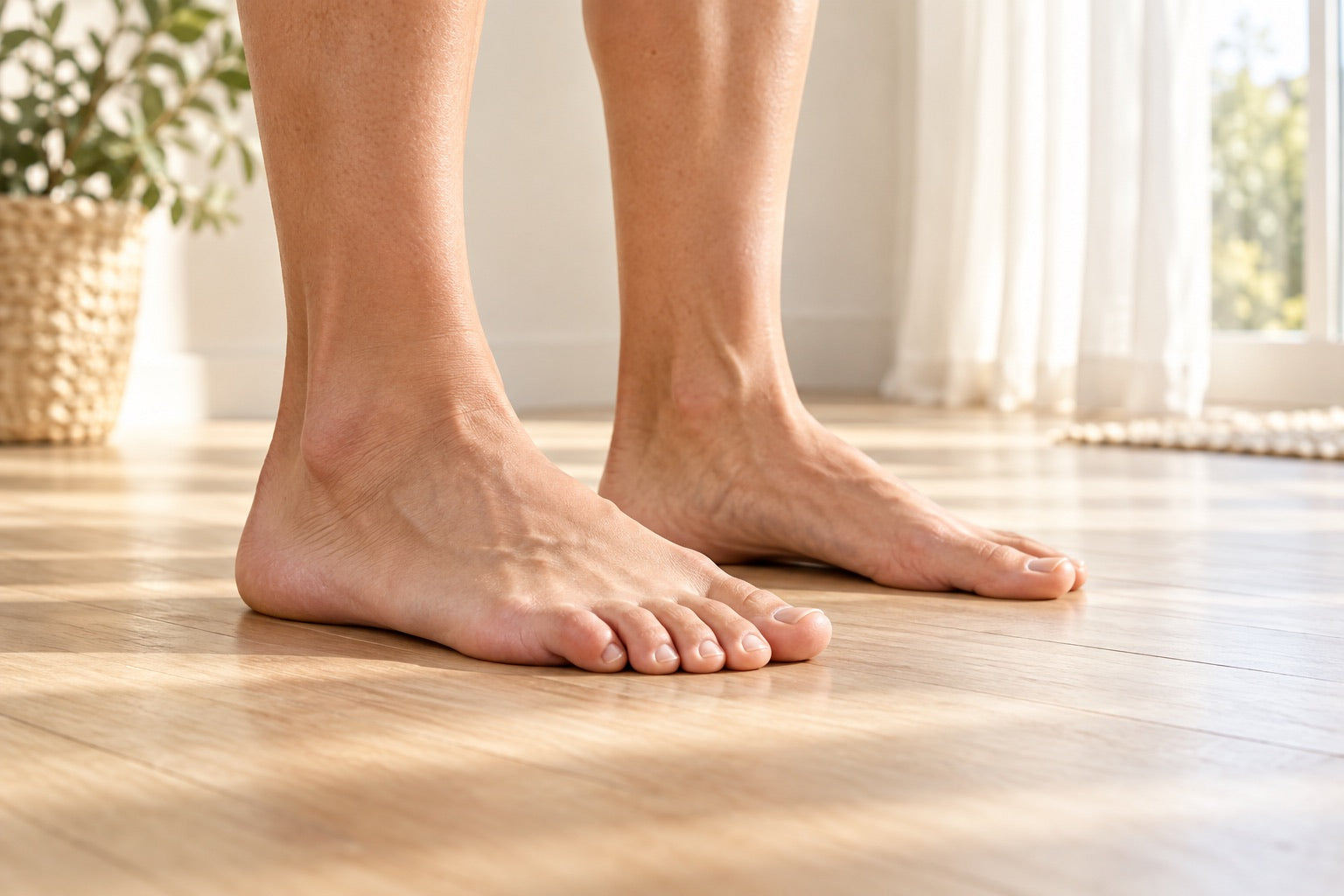
Let's start with the part nobody should apologize for: working from home is, biomechanically and otherwise, a genuinely good deal for your body. You've escaped the rigid corporate dress code that forced your feet into narrow, pointed, elevated-heel office shoes for nine hours a day. You've deleted a commute that used to mean sprinting through a parking garage in stiff dress flats. You get to stand up mid-meeting, stretch, walk to the kitchen, and move on your own schedule instead of being pinned to a chair under fluorescent lights. That freedom is real, and it's worth protecting.
Which is exactly why the trend showing up in clinics is so counterintuitive. A wave of remote workers — people who barely touch a sidewalk on a given workday, who would laugh at the idea of “logging miles” — are developing sharp, burning, first-step-in-the-morning heel pain that looks identical to what we see in marathoners and restaurant workers. They're not overtraining. They're not pounding pavement. They're padding around a beautiful home in socks. And their feet are quietly paying for the one variable the home office never advertises: the floor.
The Mechanics of Indoor Floor Strain
Here is the chain of events, start to finish:
To see why that chain fires so reliably indoors, you have to compare surfaces honestly. When you walk outside on earth, grass, a rubberized track, or even modern asphalt, the ground itself deforms a little under each step. That give is free shock absorption — the surface shares the impact load with your foot. Hardwood planks, ceramic tile, and sealed concrete slabs do none of that. They are effectively immovable. Every bit of force your body generates on heel strike gets reflected straight back up into the foot, and your arch becomes the only structure left to manage it.
That's where the windlass mechanism matters. The plantar fascia is a thick band of connective tissue running from the heel bone to the base of the toes, and it works like the tie-rod on a bridge truss — a tensioned cable that keeps the arch from collapsing and the foot from splaying apart under load. Cadaver work shows the fascia supplies roughly a quarter of the arch's stiffness on its own (windlass and arch-spring mechanics). On a rigid, flat surface with no arch support beneath you, the arch flattens further with every step, and that flattening stretches and re-stretches the fascia at its weakest point — the calcaneal insertion, where it anchors to the heel. Do that a few thousand times a day, day after day, and you get exactly what the timeline above describes: chronic micro-tearing and the inflammatory, knife-in-the-heel pain of plantar fasciitis.
None of this is hypothetical. In a matched case-control study of plantar fasciitis, the single biggest occupational risk factor was spending the majority of the workday on your feet — people who were weight-bearing more than 80% of the day carried roughly three-and-a-half times the odds of developing the condition, alongside limited ankle dorsiflexion and higher body weight. A standing desk in a home office, on a hard floor, in socks, checks every one of those boxes — without a single mile of running.
The reason it sneaks up on people is that the dose is invisible. A typical adult takes several thousand steps just moving around a house over a workday — kitchen, bathroom, doorbell, back to the desk — and each one is a small tensile tug on the fascia. Individually, none of those steps is an injury. Collectively, on an unforgiving surface with no arch support absorbing any of the load, they're a repetitive-strain exposure no different in kind from a runner's training volume. The runner at least knows they're loading their feet and plans recovery around it. The remote worker has no idea they're in a high-volume foot-loading job, so there's no recovery, no support, and no warning until the heel finally announces itself.
Why the Pain Peaks First Thing in the Morning
The hallmark of this condition is the brutal first step out of bed — and the mechanism is worth understanding, because it tells you exactly when you're most exposed. While you sleep, your foot rests in a slightly pointed, plantarflexed position and the fascia shortens and stiffens as the day's micro-tears begin to knit. The moment you stand and take that first barefoot step onto cold hardwood, you abruptly load and stretch that freshly contracted, un-warmed tissue across its full length — re-tearing the very fibers that tried to heal overnight. That's the stab. It eases after a few minutes of walking because the tissue warms and lengthens, which is also why people convince themselves it's “fine” by mid-morning and never address it. The damage is happening at the threshold moments — first step of the day, first step after a long sitting session at the desk — precisely when a bare foot meets a hard floor with no support in between.
The Slipper Delusion
The instinctive fix is to reach for the plushest thing in the closet: memory-foam house slippers, fluffy wool socks, those cloud-soft recovery slides. They feel wonderful for the first thirty seconds, and that's the trap. Soft, unstructured cushioning compresses completely under your body weight and then bottoms out, leaving your heel right back on the hard floor — now with zero structural defense. Worse, a pure-cushion surface lets the arch sink and flatten more freely, because there's nothing rigid underneath to resist the collapse. Plush feels like support. Mechanically, it's the opposite: it removes the one thing the arch actually needs, which is a contoured structure that holds its shape under load instead of caving with it.
There's a useful distinction here between cushioning and support, because the marketing on most “comfort” footwear deliberately blurs it. Cushioning manages the impact of the foot hitting the ground — it's a shock absorber. Support manages the shape of the foot under load — it keeps the arch from collapsing in the first place. Plantar fasciitis is fundamentally a problem of arch mechanics, not just impact, which is why throwing more foam at it rarely works and frequently backfires. What stops the windlass over-stretch is a firm, anatomically contoured platform that meets the arch and shares the tensile load the fascia would otherwise carry alone. A little cushioning on top of that structure is pleasant. Cushioning instead of that structure is the slipper delusion in a nutshell.
The Minimalist Connection
It's worth naming the bigger trend this sits inside. The same cultural current that made open-plan barefoot homes aspirational also fuels the minimalist-footwear movement — the idea that the more “natural” and unsupported the foot, the better. There's a real kernel of truth in training the foot's intrinsic muscles. But the leap most people make is dangerous: transitioning to walking completely barefoot on hard indoor floors without any structural preparation, on the assumption that bare equals healthy.
If you make that jump cold, you'll run straight into the exact failure points we break down in our analysis of why zero-drop shoes can worsen plantar fasciitis. Both habits — barefoot-on-hardwood and an abrupt switch to zero-drop — demand an unmanaged ankle range of motion that a tight posterior chain simply isn't ready to deliver. The calf and Achilles stay short, the dorsiflexion you need never shows up, and the load that should be shared across the leg dumps directly onto the fascia. The minimalist payoff is real, but only if the transition is gradual and the arch is supported while your foot earns the strength to go without.
The remote-work setting makes this trap especially easy to fall into, because the home blurs the line between “resting” and “training.” At a gym you'd never decide to add barefoot work and a footwear change and hours of standing all in the same week — that's an obvious overload. But at home those three changes arrive quietly and simultaneously: you're barefoot because it's your living room, you're standing more because the desk encourages it, and you've swapped structured shoes for socks because shoes indoors feel absurd. Three meaningful loading changes, stacked, with none of the deliberate progression you'd apply to any other physical adaptation. The fix isn't to abandon the freedom — it's to reintroduce a single piece of structure into the one part of the day that's quietly doing the most damage.
Essential Rules for Home Foot Health
If your heel is already barking, or you'd like to make sure it never starts, here's the protocol that actually moves the needle for remote workers:
- The strict no-barefoot policy. Never step out of bed straight onto bare hardwood or tile — especially first thing in the morning, when the fascia has tightened and contracted overnight and is at its most vulnerable to micro-tearing. Keep supportive footwear at the bedside and put it on before that first step.
- Active under-desk mobilization. Park a lacrosse or tennis ball under your desk and roll the arch out during calls to break up tissue adhesions and drive local circulation. Pair it with a daily calf and plantar-fascia stretch — limited ankle dorsiflexion is one of the strongest predictors of this condition, and it's one of the few risk factors you can directly train away.
- Transition to supportive indoor footwear. Make structured indoor shoes with a rigid, contoured arch insert your default work-from-home uniform. Quality prefabricated inserts hold up well here: a landmark randomized trial found well-made prefab orthoses performed comparably to far more expensive custom-molded devices for plantar fasciitis. You don't need a lab cast — you need real structure under the arch, every step you take indoors.
The home office didn't break your feet. The floor did — and the floor is the one variable you can neutralize in under a minute without giving up a single thing you love about working from home. Put a real structure between your arch and the hardwood, and let the rest of the day stay exactly as free as you built it.
The WYATT takeaway
You spend your entire remote workday standing and walking on completely rigid, flat, unyielding hardwood or tile floors that return every ounce of impact straight back into your feet.
Your arches flatten under body weight with every step, driving a continuous windlass over-stretch that micro-tears the plantar fascia where it anchors to the heel bone — the source of that first-step-in-the-morning stab.