Standing Desk, Bare Floors: The Home-Office Kinetic Chain That Quietly Fails at the Foot
The standing desk is one of the best things to happen to the home office. Trading eight sedentary hours for a posture you can shift, stretch into, and move through is a genuine win — it eases the lower-back ache that comes from a slumped chair, keeps your energy steadier through the afternoon, and gets your circulation working instead of pooling. If you bought a sit-stand desk and actually use it, you made a smart call. The research on prolonged sitting is unkind enough that almost any move toward standing and motion is a step in the right direction.
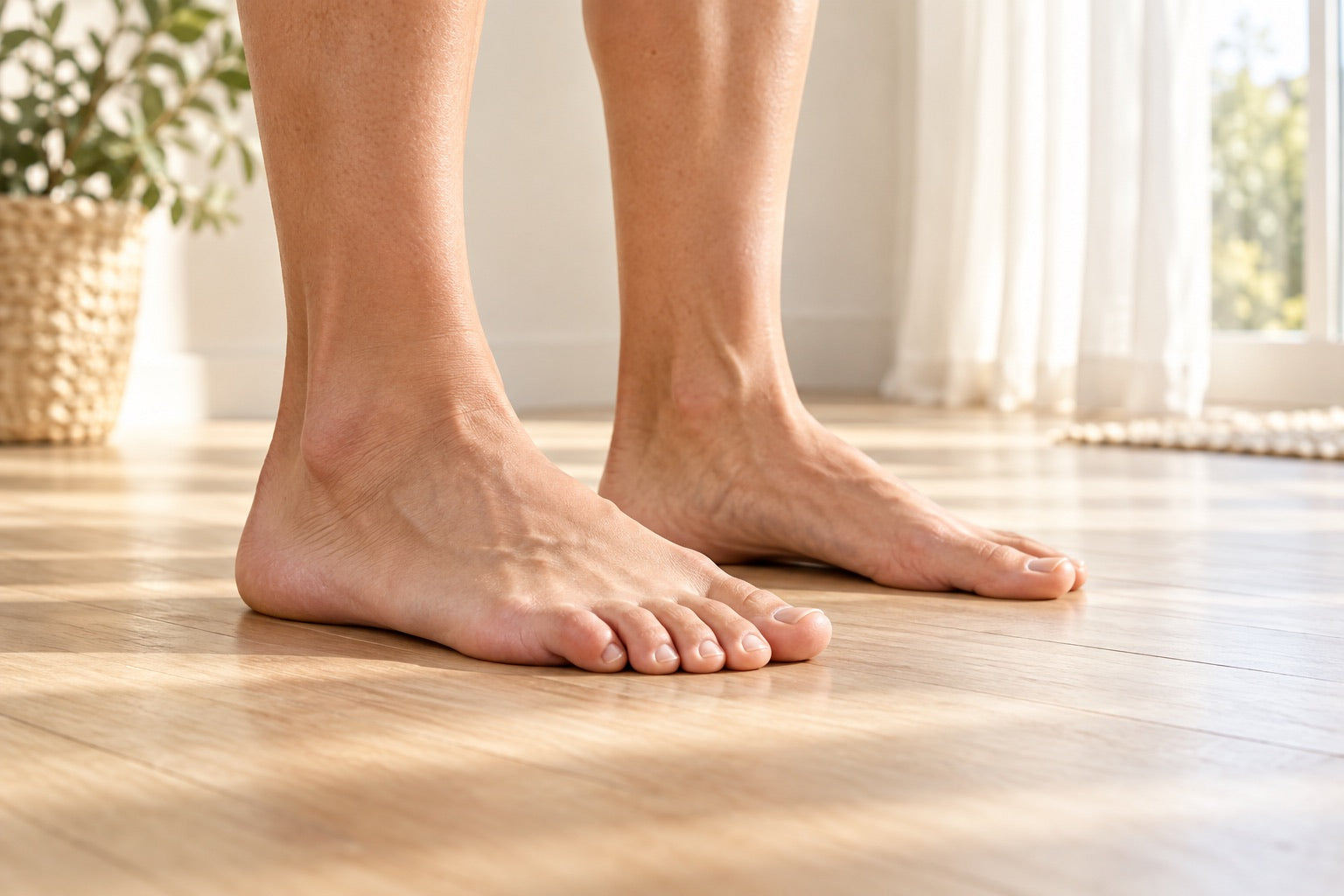
But there's a quiet variable most home setups never account for, and it lives about five and a half feet below your monitor: the floor. The corner office got carpet, padding, and a forgiving subfloor. Your home office got beautiful engineered hardwood, luxury vinyl plank, polished concrete, or tile — surfaces chosen for how they photograph, not for what they do to a foot asked to stand on them for hours. Pair an unforgiving floor with bare feet or thin house slippers, and you've quietly rebuilt the exact standing-on-hard-surfaces exposure that occupational-health researchers have linked to heel pain for decades. The desk is doing its job. The surface underneath it is the part nobody engineered.
Why "standing more" is still the right instinct
Let's keep the credit where it belongs. Standing recruits the postural muscles of your legs, hips, and trunk that a chair switches off. It encourages micro-movements — weight shifts, calf pumps, the occasional stretch — that move blood and lymph back up out of your lower legs. Over a workday, that beats static sitting on nearly every circulatory and musculoskeletal measure people care about. None of that is in dispute, and nothing here is an argument to sit back down.
The catch is that your body wasn't built to stand still on a rigid plane for hours either. Standing is healthiest when it's dynamic and well-supported. The home office tends to deliver the opposite: long, fixed stretches of standing — locked into a video call, deep in a spreadsheet — on a surface with essentially zero give. That combination is where the trouble starts, and it starts at the foot.
The kinetic chain, and where the home office breaks it
Your foot is the first link in what clinicians call the kinetic chain — the connected stack of joints and soft tissue that runs foot to ankle to knee to hip to spine. Load enters at the ground and travels up. When the foot can absorb and distribute that load well, the links above it share the work. When the foot can't, the load doesn't disappear; it just gets passed upstream to structures that are worse at handling it.
On a hard floor, two things happen at once. First, there's no shock absorption coming from below, so the full force of standing is met entirely by your own tissues — the heel's fat pad, the plantar fascia, the arch. Second, because you're standing more or less still, the small intrinsic muscles inside your foot and the larger muscles of your calf are asked to hold a near-constant low-grade contraction. Research on prolonged standing shows this kind of sustained co-contraction fatigues those muscles, lowering their output and reducing ankle range of motion over the course of the day (Zhang et al., 2022, Int. J. Environ. Res. Public Health). Tired muscles stop sharing the load. What they used to absorb gets dumped onto the passive structures — most notably the plantar fascia, the thick band along the bottom of your foot that was never designed to be the primary shock absorber.
This is the gap nobody sees coming. You feel productive and energized at your standing desk. Meanwhile the first link in your chain is quietly fatiguing on a surface that gives it nothing back, and the heel takes the overflow.
What the occupational data actually says
This isn't theoretical. The clearest evidence comes from workplaces that have studied standing exposure for years. In a cross-sectional study of automobile assembly-plant workers, researchers found that for every additional 10% of time spent standing on hard surfaces, the risk of presenting with plantar fasciitis rose by roughly 30% — and that combined standing-and-walking exposure carried an even larger risk increase (Werner et al., 2010, PM&R). Notably, one of the protective factors that study identified wasn't standing less — it was rotating footwear and changing what was under the foot. The surface and the support mattered as much as the hours.
Broader workforce data points the same direction. Analysis of the Fifth Korean Working Conditions Survey found that prolonged standing at work was independently associated with more lower-limb musculoskeletal symptoms and greater physical fatigue compared with jobs that allowed posture changes (Lee et al., 2021, Yonsei Medical Journal). For decades this was framed as a factory-floor, retail, and healthcare problem. The remote-work era quietly imported the same exposure into the spare bedroom — minus the cushioned mats, supportive work shoes, and sit-down breaks those environments often build in. We covered the indoor version of this heel-pain surge in detail in our piece on hardwood-floor fasciitis and the remote-work epidemic of indoor heel pain.
The barefoot-at-home problem
Here's where many home workers make their setup worse without realizing it: they stand at the desk barefoot, in socks, or in flat, unstructured slippers. It feels natural and comfortable, and for short bursts on a soft surface it's fine. The issue is duration on a hard one. With nothing between your foot and an unyielding floor, the heel's fat pad — your built-in cushion — absorbs the full impact of every hour, and the arch gets no help holding its shape. Over time, that constant, unsupported loading is exactly the mechanism podiatric guidance warns against for anyone prone to heel pain.
This is also why the "just go more minimal" logic that works for some people backfires here. Thin, flat, zero-structure footwear on a hard indoor floor removes support precisely when the foot needs it most — during long static standing. We unpacked why that approach often disappoints people hoping it will fix their heel pain in our analysis of why zero-drop shoes don't fix plantar fasciitis. The home office is the hardest place to get away with no support, not the easiest.
How the load travels up the chain
Because the foot is the base of the kinetic chain, a fatigued, unsupported foot rarely stays a foot-only problem. When the arch flattens and the intrinsic muscles give out, the lower leg compensates — the calf and the posterior tibialis work harder, which can show up as tightness or Achilles strain. Above that, altered foot mechanics change how the knee tracks and how the hip and pelvis sit. This is why people who stand all day on hard floors often report a constellation of complaints — heel, arch, calf, knee, even lower back — rather than one isolated ache. Fatigue at the base reshapes the alignment of everything stacked on top of it, and the small foot muscles that help control single-limb stability are among the first to tire.
The practical takeaway is that propping up the first link protects the whole stack. You don't have to abandon the standing desk or accept that "standing just hurts." You have to give the foot back the support and shock absorption the floor was never going to provide.
Fixing the home-office floor problem (without buying a new floor)
You have a few levers, and the best results come from stacking them:
Support the foot directly. The most portable, consistent fix is structured support under the arch and cushioning under the heel — worn inside whatever you have on your feet. A quality orthotic insert moves the support with you, whether you're at the desk, in the kitchen, or walking the dog, instead of being tied to one mat in one spot.
Wear something on your feet. Barefoot on hardwood for six hours is the exposure to break. Even a supportive house shoe or sneaker — with an insert inside it — changes the loading meaningfully.
Add cushioning underfoot where you can. An anti-fatigue mat at the desk gives the surface some of the give it lacks and gently encourages the weight-shifting and micro-movement that keep muscles from locking into one fatigued position.
Keep it dynamic. Alternate sitting and standing. Shift your weight. Do calf raises and a brief arch stretch every hour. Movement is the antidote to the static-loading half of the problem; support is the antidote to the hard-surface half. You want both.
Rotate. The assembly-plant data found footwear rotation protective. The home equivalent: don't stand in the same flat slippers on the same hard spot all day, every day. Vary the surface and what's under your feet.
When to take heel pain seriously
If you're getting sharp heel pain with your first steps in the morning, or pain that builds through a standing workday and eases when you sit, those are classic plantar-fascia patterns worth addressing early — before compensation patterns travel up the chain. Conservative support, footwear changes, and load management resolve the large majority of cases (Cleveland Clinic). Persistent or worsening pain, numbness, or swelling warrants a visit to a podiatrist or physician.
Frequently asked questions
Is a standing desk bad for plantar fasciitis?
No — the standing desk isn't the problem; the hard, unsupported surface under it is. Standing beats prolonged sitting on most health measures. The risk comes from long, static standing on a rigid floor with bare or unsupported feet. Add cushioning, supportive footwear with an arch-supporting insert, and regular movement, and a standing desk can be entirely heel-friendly.
Should I stand at my desk barefoot?
For short stretches on a soft surface, it's fine. For hours on hardwood, tile, vinyl, or concrete, it's the exposure most likely to aggravate heel pain — the fat pad and plantar fascia absorb the full load with no help. Wear something supportive, ideally with a structured insert, when you stand for long periods.
Do anti-fatigue mats fix the problem on their own?
They help with the hard-surface half by adding shock absorption and nudging you to keep moving, but a mat only works in the one spot you put it. Direct foot support travels with you to every hard surface in the house, which is why combining the two works better than relying on a mat alone.
The WYATT takeaway
You're standing for hours at a home desk on hardwood, vinyl, tile, or concrete — often barefoot or in flat slippers — with none of the cushioned matting, supportive shoes, or sit-breaks a workplace would build in.
With no give from the floor and no support under the arch, your foot's intrinsic muscles fatigue and stop sharing the load. The overflow lands on the heel fat pad and plantar fascia — the passive tissues least equipped to be your primary shock absorber — link one of a kinetic chain that runs all the way to your spine.
The FCSS™ Pro orthotic insert is a removable structural modification for your existing shoes or slippers. It restores arch support and cushioning at the exact point the floor takes it away — so you can keep standing and stay active without dumping the load onto your heel.
Reviewed and approved by the WYATT MVMT Podiatric Care Team — backing every step with 35+ years of custom orthotic engineering.