
PGA Championship 2026 Foot Recovery: What Aaron Rai's Aronimink Win Tells Weekend Golfers About Walking Wear-and-Tear
Aaron Rai's closing 65 at Aronimink on Sunday delivered one of the more unexpected major championship results of the decade — the 31-year-old Englishman became the first from his country to lift the Wanamaker Trophy since Jim Barnes in 1919, finishing nine-under and three clear of Jon Rahm and Alex Smalley, a result chronicled in PGA TOUR's final-round coverage[1]. By Monday morning, golf shops from Philadelphia to Phoenix were running on the same script they run after every major: weekend players showing up for tee times, eager to chase the swing they just watched on television, suddenly aware that 18 holes feels different at 47 than it did at 32.
The PGA Championship is the major that quietly turns into a participation event. Television ratings spike, club-pro lesson books fill, and pace-of-play data at public courses jumps measurably in the two weeks that follow. So does foot pain. Sports medicine clinics and podiatry practices see a reliable post-major bump in heel-pain consultations, particularly from weekend golfers who walked their first 36-hole weekend of the season chasing the energy of a tournament they didn't play in.
If Rai's win sent you out for an unexpected Saturday-Sunday double, and your feet are now letting you know about it, you're in good company — and there's a structured 7-day recovery window that will get you back to the course without the morning heel stab becoming a six-week problem. Here's the biomechanics behind why golf wrecks feet, what the post-major injury pattern looks like, and the recovery protocol that actually works.
How Far You Actually Walk in 18 Holes
Most weekend golfers underestimate the load they take on during a walked round. A 2024 study in the Journal of Functional Morphology and Kinesiology recruited 16 high-level golfers to play tournament-style 18-hole rounds under both walking and cart conditions, tracking step counts, energy expenditure, and physiological data with continuous monitoring. Walking produced a mean of 17,007 steps per round[2], compared with 6,274 for the cart group — roughly 2.7 times the daily ambulatory load.
That figure varies with course length, terrain, and how often you stray into the rough searching for your drive — but the working range for a walked 18 is 4 to 7 miles, with elevation gain at hilly courses like Aronimink adding meaningful extra load on the calf, Achilles, and plantar fascia. A 36-hole weekend on a walked course can therefore add up to 30,000–35,000 steps and 8–14 miles of weight-bearing ambulation, much of it on soft, uneven turf that requires constant micro-adjustments from the intrinsic foot muscles.
For a recreational golfer whose Tuesday-through-Friday step count averages 4,000–5,000, that's a 6x to 8x acute spike in load — concentrated into two days and combined with the rotational stress of 70 to 100 full swings.
The Two Loads Golf Layers Onto the Foot
Golf is unusual among recreational sports in how it loads the foot. Most overuse foot injuries from running or walking come from repetitive vertical impact — the same forefoot or heel strike repeated thousands of times. Golf adds a second, biomechanically distinct load: rotational shear.
A 2023 systematic review and meta-analysis in Applied Sciences examined ground reaction forces during the golf swing[3] across multiple skill levels. Their key finding: the lead foot (left foot for a right-handed golfer) generates substantially higher vertical and horizontal ground reaction forces than the trail foot, with peak vertical loads occurring just before impact and shear forces remaining high through follow-through. Tour-level players show roughly 40–60% stronger braking forces in the lead leg compared to the trail leg, and the rotational torque generated by the swing transfers to the ground through the medial column of the foot — the same anatomical region that houses the plantar fascia's insertion at the heel.
The walking load and the rotational swing load layer on top of each other across an 18-hole round. By the back nine, the plantar fascia is dealing with the cumulative tensile strain of 10,000+ walking steps plus 50+ full-swing torque events. The result is a hyperloaded fascia going into the post-round period — and a predictable next-morning heel stab when the tissue cools, stiffens, and gets reloaded with the first weight-bearing step out of bed.
The Post-Major Heel Pain Pattern Clinicians See
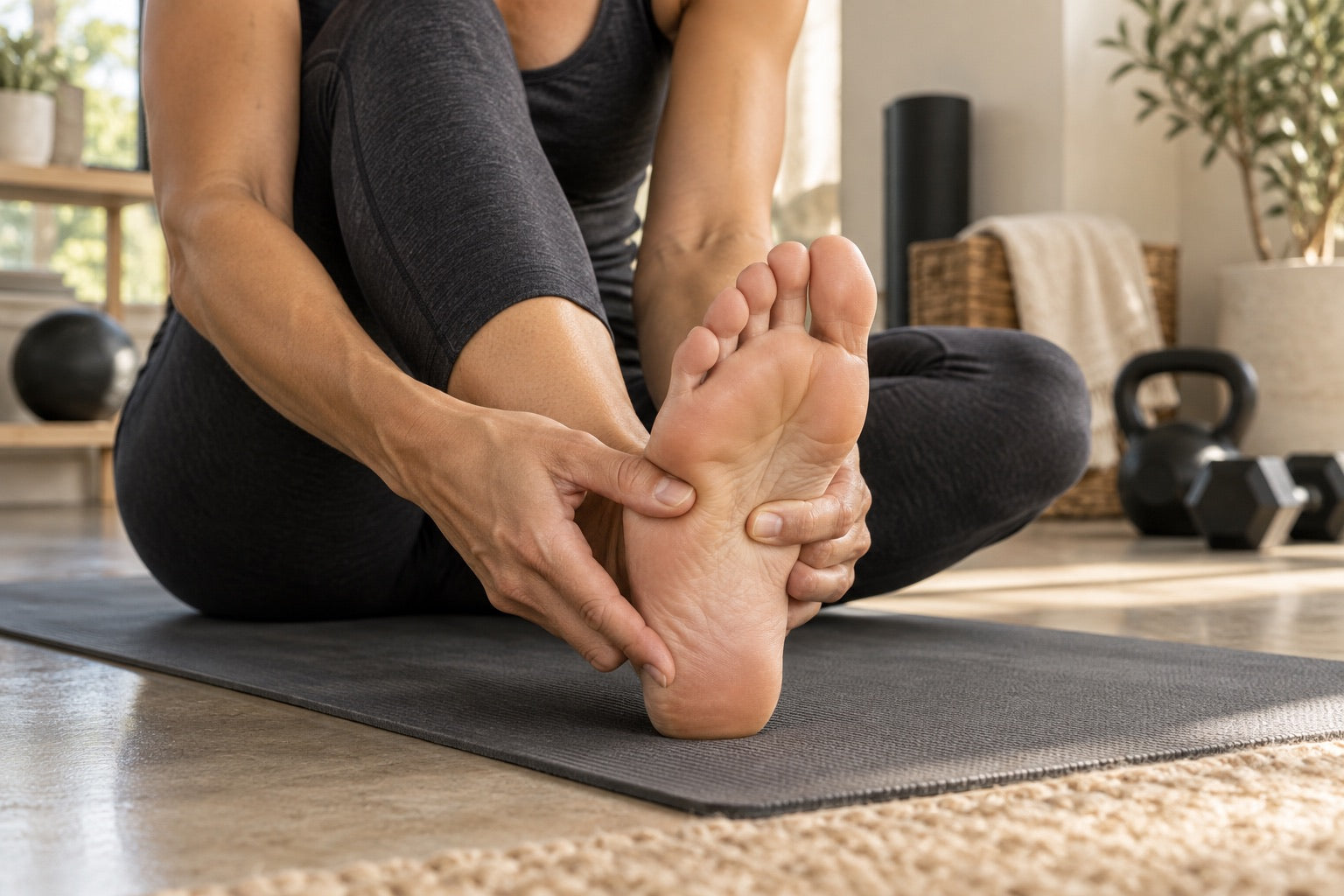
Plantar fasciitis is the single most common cause of heel pain in adults, accounting for an estimated 1 million outpatient visits annually[4] in the United States. The hallmark presentation is sharp, localized pain at the inner heel that's worst with the first steps in the morning or after sitting, eases with movement, and returns with a vengeance after sustained activity.
For golfers, the post-round pattern tends to look like this:
- Round day: Mild tightness in the arch on the back nine. Usually written off as "I'm just out of shape."
- The next morning: The textbook stab of pain at the inner heel with the first steps out of bed. Walks off within 15–20 minutes.
- Days 2–4: Stiffness peaks. Going up and down stairs feels distinct. The arch feels "bruised."
- Day 5+: Either resolves with rest and load management — or progresses into a 4-to-8-week subacute problem if reloaded too aggressively.
The 2003 case-control study by Riddle and colleagues — still the gold-standard epidemiology on plantar fasciitis — identified three independent risk factors[5]: BMI over 27, occupations involving long periods of weight-bearing, and reduced ankle dorsiflexion. Recreational golf doesn't change BMI, but a walked 36-hole weekend absolutely changes the second risk factor — adding 14+ miles of weight-bearing on uneven turf to a population whose previous weekly exposure was minimal. The same load pattern shows up in our breakdown of what golf does to your feet over 18 holes.
The 7-Day Post-Major Recovery Window
The good news: most post-major foot pain in recreational golfers resolves cleanly with a structured 7-day protocol — provided you don't re-load before the tissue catches up. The principles aren't glamorous, but they work.
Days 1–2: De-load. No walked rounds. If you must play, use a cart. Keep daily step count below 7,000. Apply ice to the medial heel for 10–15 minutes morning and evening. A short course of NSAIDs (if you tolerate them and your physician hasn't ruled them out) can reduce the inflammatory response in the first 48 hours, when it's most useful.
Days 1–7: Morning protocol. Before your first weight-bearing step, perform 10 slow ankle circles in each direction while still in bed, then 10 toe curls and 10 toe spreads. This pre-warms the plantar fascia before it gets loaded cold. Wall calf stretches — 30 seconds per side, knee straight then knee bent — should be performed before any prolonged walking and again at midday.
Days 3–5: Add intrinsic foot work. Short-foot exercises (drawing the ball of the foot toward the heel without curling the toes), 3 sets of 10 reps per foot, twice daily. Single-leg calf raises off a step, 3 sets of 15 with a 3-second lowering phase, every other day. These exercises rebuild the foot's intrinsic stabilizing muscles that the swing's rotational load just exposed.
Days 5–7: Reintroduce walking carefully. Start with 30-minute flat-ground walks at conversational pace. If the next-morning heel pain is unchanged or improved, you're cleared for a short range-session and a cart round on day 7. Hold the next walked round until day 10–14, depending on symptoms.
Throughout: Upgrade what's under your foot. The single highest-leverage change for any recreational golfer dealing with post-round heel pain is replacing the stock insert that came with your golf shoes. Stock inserts are flat foam pads designed for shelf appeal, not biomechanical load management. A properly contoured insert with a deep heel cup, structured arch support, and forefoot cushioning measurably reduces peak plantar pressures and the medial arch collapse that drives plantar fascia strain during the swing.
Our orthotic inserts for plantar fasciitis drop into virtually every modern golf shoe — spiked or spikeless — without affecting fit or feel. The deep heel cup cradles the calcaneus through both the walking load and the rotational swing load. The medial arch wedge supports the medial longitudinal arch without overcorrecting. The forefoot pad redistributes pressure away from the metatarsal heads where most golfers feel late-round forefoot burn. Pair with a fresh pair of moisture-wicking socks for the next 36-hole weekend and you'll feel the difference by the 14th hole.
Why Spikeless Shoes Have Complicated This
The dominant shift in golf footwear over the past five years has been the rise of the spikeless category — sneaker-styled golf shoes with rubber outsole nubs instead of soft spikes. They look better in the clubhouse, they're more comfortable off the course, and they've eaten roughly 60–70% of the consumer golf shoe market.
They've also quietly created a foot health problem. Spikeless models typically use a lower-profile midsole and a much less structured footbed than traditional spiked golf shoes. The stock insert is often a flat 3mm foam pad. For a golfer walking 5+ miles on uneven turf while generating peak swing torque through the medial column of the foot, the spikeless category provides almost no arch support and minimal heel cradling. The post-major heel pain spike clinicians describe correlates closely with the spikeless adoption curve.
The fix isn't going back to soft spikes. It's adding a structured insert to the spikeless shoe you already own. That single change — a 5-minute swap of the stock insert for a properly contoured one — recovers the structural support the shoe was missing and keeps the modern aesthetic.
The Tournament-Level Foot Work Tour Players Get Right
One detail from Sunday's broadcast that didn't get much commentary: Aaron Rai famously wears two gloves and walks a notably balanced, stable address position. Tour players spend significant time on foot pressure and balance drills — increasingly using force plates in their pre-season work to measure exactly how their weight transfers through each foot during the swing.
A 2019 study published in the Journal of Physical Therapy Science evaluated foot pressure distribution and postural structure in national-level golfers[6] and found measurably better medial-lateral pressure control and reduced peak rearfoot pressures compared with recreational players. Tour players aren't more durable because they're younger or fitter (many aren't). They're more durable because their foot mechanics are trained and their footwear is built for the load.
Recreational golfers can't replicate the training load. But they can copy two things tour players take seriously: (1) the shoe-and-insert combination they walk in, and (2) a five-minute foot-and-calf warm-up before the first tee. Those two changes close most of the gap.
The Evidence for Inserts in Plantar Heel Pain
The case for adding a contoured insert to your golf shoe isn't anecdotal. A 2022 systematic review and meta-analysis in The Foot concluded that prefabricated foot orthoses produced clinically meaningful reductions in plantar heel pain[7] compared with sham or no intervention, with effect sizes comparable to custom devices at a fraction of the cost. The American Physical Therapy Association's clinical practice guidelines on heel pain[8] list foot orthoses among the highest-evidence first-line interventions.
The mechanism is straightforward: a quality insert reduces strain rate and peak strain on the plantar fascia by supporting the medial longitudinal arch, deepening the heel cup, and redistributing pressure away from the most aggravated tissues. In the golf swing specifically, that medial arch support resists the rotational collapse that loads the fascia during the downswing and follow-through.
The plantar fascia experiences peak loads of 1.2 to 3.7 times bodyweight during walking[9], with the upper end of that range showing up in heavier walkers on uneven surfaces — a textbook description of a golfer on a hilly walked course. An insert that reduces that peak strain by 15–20% per step compounds across 17,000 steps into a meaningfully lower cumulative load on the fascia by the 18th hole.
When to Stop Self-Treating and See Someone
The 7-day protocol resolves most post-major heel pain. But certain patterns warrant a sports medicine or podiatry visit rather than another round:
- Heel pain that hasn't improved after two weeks of conservative management.
- Sharp, pinpoint pain on a specific bone with point tenderness — possible stress reaction or fracture.
- Pain that's worse at night or at rest (not characteristic of simple plantar fasciitis).
- Sudden sharp arch pain during a swing accompanied by a popping sensation — possible plantar fascia rupture, requires evaluation.
- Numbness, tingling, or burning radiating into the toes (think nerve entrapment, not fasciitis).
- Visible swelling, warmth, or bruising in the heel or arch.
For everything else — the morning heel stab after Sunday's round, the arch fatigue that builds through the back nine, the dull ache that lingers Monday morning — the playbook is consistent: de-load briefly, warm up the fascia before reloading, upgrade the insert under your foot, and respect the 7-day window before the next walked 18.
The Recovery Window Closes Faster Than You Think
The most common mistake recreational golfers make after a major weekend isn't ignoring the heel pain. It's playing through it. The fascia tolerates one heavy weekend; it does not tolerate three consecutive heavy weekends without recovery. Most of the chronic plantar fasciitis cases that end up in clinical practice started as a manageable post-round flare-up that got reloaded twice in seven days.
The Wanamaker Trophy is back in a glass case in Aaron Rai's hand. Your next round doesn't have to send you to a clinic. De-load, warm up the foot, swap the stock insert for a structured one, and the next 36-hole weekend will feel like the one you watched on TV — without the morning after.
Frequently Asked Questions
How many steps do you really walk in 18 holes of golf?
A 2024 study tracking high-level golfers found a walked round averages about 17,007 steps, versus 6,274 in a cart — typically 4 to 7 miles depending on course length and terrain. A walked 36-hole weekend can reach 30,000–35,000 steps.
Why do my feet hurt the morning after a round of golf?
The plantar fascia ends a walked round hyperloaded from the combined walking and rotational swing loads. Overnight it cools and stiffens, so the first weight-bearing step in the morning reloads tightened tissue — producing the classic sharp inner-heel stab that eases after 15–20 minutes of movement.
Will an insert actually help golf-related heel pain?
Yes. Systematic reviews show prefabricated foot orthoses produce clinically meaningful reductions in plantar heel pain, and heel-pain clinical practice guidelines list them among the highest-evidence first-line options. A structured insert supports the medial arch and deepens the heel cup, reducing peak strain on the fascia through both the walking and swing loads.
How long should I rest before playing again?
Most post-major flare-ups resolve with a structured 7-day window: de-load for the first two days, reintroduce flat-ground walking on days 5–7, and hold the next walked 18 until day 10–14. See a clinician if pain persists beyond two weeks or involves night pain, point tenderness, or a popping sensation.
The WYATT takeaway
You walked your first 36-hole weekend of the season chasing the major you watched on TV — roughly 30,000 steps and 8–14 miles on soft, uneven turf, stacked on top of 100+ full-swing torque events through the medial column of the foot.
The walking load and the rotational swing load layer onto the same medial arch at once. The plantar fascia ends the round hyperloaded, then cools and stiffens overnight — producing the textbook morning heel stab and, if reloaded too soon, a multi-week subacute flare.
The FCSS™ Pro is a removable insert that drops into the golf shoe you already own — spiked or spikeless. Its deep heel cup and structured medial arch redistribute the walking and swing loads away from the fascia's insertion, so you can stay active through the recovery window instead of sitting out the season.
References
- Aaron Rai wins 108th PGA Championship at Aronimink. PGA TOUR. May 17, 2026. pgatour.com
- Riding a Golf Cart Versus Walking: Physiological and Performance Differences in Tournament Golf. Journal of Functional Morphology and Kinesiology. 2024. pmc.ncbi.nlm.nih.gov
- The Relationship between Ground Reaction Forces, Foot Positions and Type of Clubs Used in Golf: A Systematic Review and Meta-Analysis. Applied Sciences. 2023;13(12):7209. mdpi.com
- Buchanan BK, Kushner D. Plantar Fasciitis. American Family Physician. 2019;99(12):744-750. aafp.org
- Riddle DL, et al. Risk factors for Plantar Fasciitis: a matched case-control study. Journal of Bone and Joint Surgery. 2003;85(5):872-7. pubmed.ncbi.nlm.nih.gov
- The evaluation of foot pressure and postural structure of national golfers. Journal of Physical Therapy Science. 2019. pmc.ncbi.nlm.nih.gov
- Whittaker GA, et al. Foot orthoses for plantar heel pain: a systematic review and meta-analysis. The Foot. 2022;50:101867. pubmed.ncbi.nlm.nih.gov
- Martin RL, et al. Heel pain — plantar fasciitis: clinical practice guidelines. JOSPT. 2014;44(11):A1-33. jospt.org
- Wearing SC, et al. The pathomechanics of plantar fasciitis. Sports Medicine. 2006;36(7):585-611. pubmed.ncbi.nlm.nih.gov