
Ozempic Feet: Why Rapid GLP-1 Weight Loss Is Thinning the Heel's Fat Pad (and Unmasking Plantar Pain)
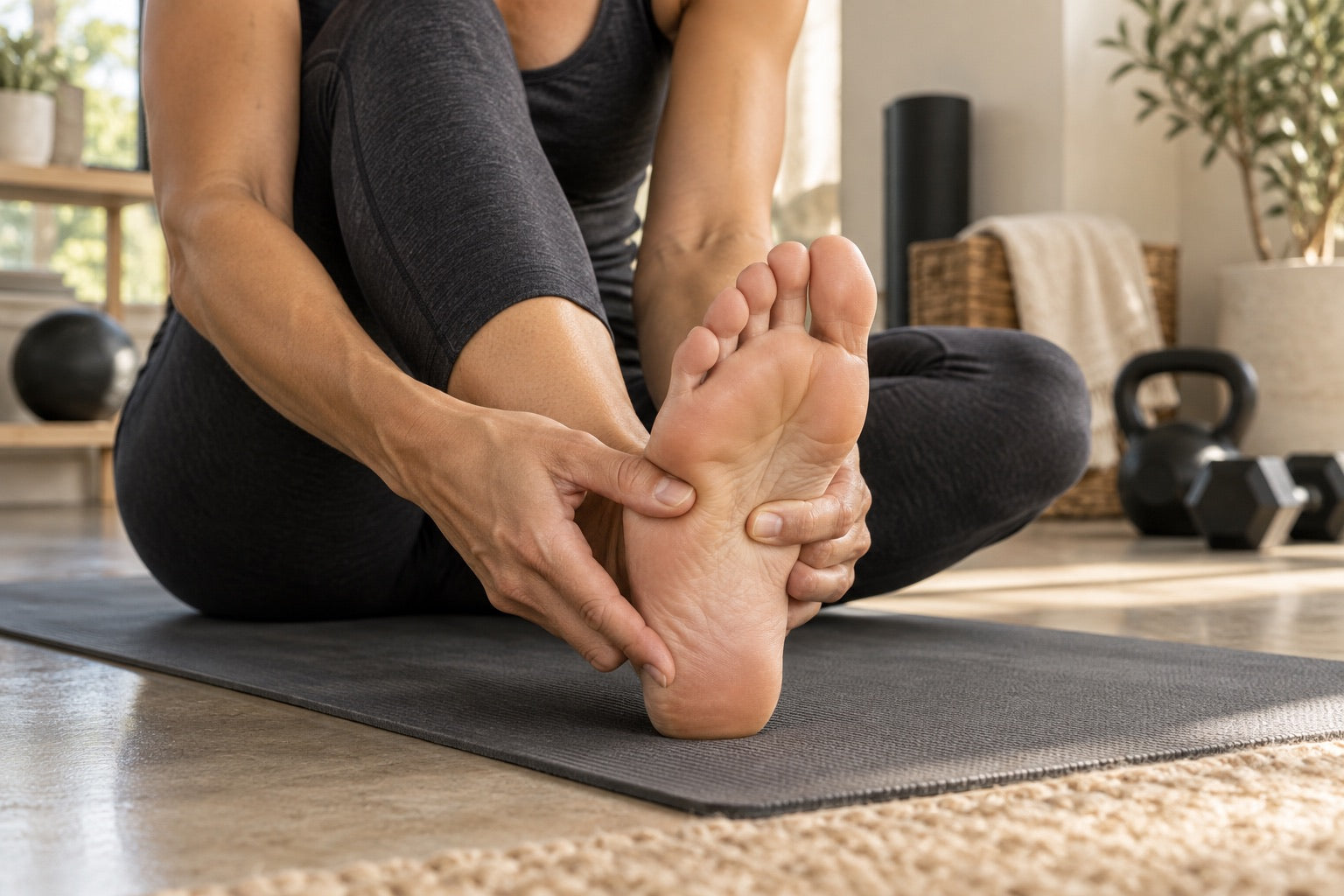
If you have spent the last year on a GLP-1 medication — semaglutide (Ozempic, Wegovy), tirzepatide (Mounjaro, Zepbound), or one of the newer entrants — and the weight has genuinely come off, you have done something hard and worthwhile. The cardiometabolic case for these medications is one of the strongest stories in modern medicine: lower blood pressure, better glucose control, reduced cardiovascular risk, and for many people the first real freedom from a decades-long fight with their own appetite. Moving through the world in a lighter body feels better in a hundred ways, and your knees, hips, and heart are all quietly thanking you. None of what follows is an argument against any of that.
But a growing number of people are noticing something the brochure never mentioned: a new, deep, bruise-like ache under the heel or the ball of the foot — a tenderness that shows up after the weight came off, not before. It is common enough now that it has earned a nickname in podiatry clinics and across social media: "Ozempic feet." And while the name is catchy, the mechanism underneath it is real, specific, and — importantly — manageable once you understand what is actually happening down there.
The cushion you never think about
Under your heel and the ball of your foot sits one of the most elegant pieces of engineering in the human body: the plantar fat pad. It is not ordinary, soft, jiggly body fat. The heel pad in particular is a specialized shock absorber — a dense lattice of fat globules packed into closed chambers built from tough, springy walls of collagen and elastin. Anatomists describe it as a honeycomb of closely packed fat held together by a collagenous septum[1], sitting directly over the heel bone. Every time your heel strikes the ground, this pad absorbs and disperses the impact — roughly the force of your entire body weight, thousands of times a day — so that your calcaneus, the bone underneath, never feels the full blow.
Here is the catch that makes "Ozempic feet" possible: this pad is partly made of fat. And the body, under the metabolic conditions a GLP-1 creates, does not always distinguish between the soft fat you want to lose and the structural fat you very much need to keep.
Why rapid loss thins the pad faster than slow loss
The plantar fat pad naturally thins with age and accumulated stress — that part is normal and gradual. What is different about pharmaceutical weight loss is the speed. GLP-1 patients commonly shed 12 to 18 percent of their body weight in the first year, and tirzepatide users sometimes more. That is a metabolic pace the foot's specialized tissues were never designed to track.
When weight comes off gradually, the foot has time to adapt — the pad remodels, the surrounding tissues recalibrate, and the cushioning holds up reasonably well. When it comes off fast, the lipid stored inside those collagen chambers can be mobilized faster than the protective architecture can adjust, and the pad loses thickness before anything else compensates. The result is a heel pad that is measurably thinner and less able to do its one critical job: absorbing impact. And this matters more than it sounds, because the research on heel pain is clear that pad thickness is not incidental. Studies measuring the thickness of the heel fat pad in patients with heel pain[2] have found the pad is thinner, and its elasticity reduced, in painful heels compared with healthy ones — and that a thinner, stiffer pad means less shock absorption and more force transmitted straight into the bone.
There is a second, compounding reason the GLP-1 era is hard on feet, and it is the one most people miss: these medications take muscle along with fat. A meaningful share of GLP-1 weight loss is lean mass, not just adipose — clinicians tracking body composition during treatment have reported that roughly 40 percent of the weight lost on semaglutide alone can come from lean tissue[3], including muscle. The small intrinsic muscles that hold your arch up are skeletal muscle too, and they atrophy under the same systemic pressure. So at the exact moment the heel's passive cushion is thinning, the foot's active support system is also weakening. We unpack that muscle-and-fascia side of the story in depth in our companion piece on why shedding pounds doesn't automatically fix the heel — this article focuses on the cushion itself.
What "Ozempic feet" actually feels like
Heel fat pad atrophy produces a distinct kind of pain, and learning to recognize it matters — because it is frequently mistaken for plantar fasciitis, and the two are managed differently even though they often coexist.
Fat pad pain tends to feel deep, dull, and bruise-like, sitting right in the center of the heel — patients often describe it as walking on a stone, or as if the natural padding simply isn't there anymore. It is typically worse on hard surfaces (tile, concrete, hardwood) and after long periods on your feet, and it can be reproduced by pressing directly into the middle of the heel. Plantar fasciitis, by contrast, classically produces a sharp, stabbing pain on the first steps out of bed that eases as you warm up, and the tenderness lives more toward the front-inside edge of the heel where the fascia attaches.
The clinically important part: heel fat pad syndrome is the second most common cause of plantar heel pain after plantar fasciitis, and you can absolutely have both at once. In fact they feed each other. A thinning pad transmits more force to the fascia's origin, and an irritated fascia changes the way you walk, which accelerates pad breakdown. For someone losing weight rapidly on a GLP-1, that two-way street is exactly the trap — both structures are being stressed at the same time, from the same root cause.
The weight really did need to come off — the foot just needs a bridge
It would be easy to read all this as a reason to second-guess the medication. It is not. The link between excess weight and heel pain is one of the most consistent findings in the orthopedic literature — a systematic review in the British Journal of Sports Medicine found that a BMI above 27 carried nearly four times the odds of plantar fasciopathy[4]. Carrying less weight is genuinely protective for your feet over the long run. The problem is never the destination. It is the transition window — the months where the scale has already moved but the foot's tissues have not yet caught up.
Encouragingly, the clinical signal on these medications and the foot is not all bad news. A 2026 prospective study even examined whether semaglutide use was associated with outcomes in chronic plantar heel pain[5], reflecting how seriously the connection between GLP-1 therapy and heel health is now being studied. The takeaway from the broader picture is consistent: weight loss helps the foot eventually, but the cushioning and support need active management while the body recalibrates.
What actually helps "Ozempic feet"
The good news is that fat pad pain responds well to a handful of practical, evidence-aligned strategies — none of which require pausing your medication. The goal is simple: protect the heel from impact and redistribute load while your body composition stabilizes and the foot adapts.
Get off hard surfaces wherever you can. A thinning pad and a tile kitchen floor are a bad combination. Anti-fatigue mats at standing workstations, cushioned house shoes instead of barefoot on hardwood, and avoiding long stretches on concrete all reduce the peak force the pad has to absorb. This single change — never walking barefoot on hard floors while the pad is compromised — resolves a surprising share of early cases.
Redistribute the load with structured support. This is where the heel-pad problem and the arch problem converge on the same solution. A thin pad needs the impact spread out rather than concentrated; a weakening arch needs its support restored. A well-engineered orthotic insert does both — cupping and containing the heel so the remaining pad isn't splayed and overloaded, and supporting the arch so the fascia stops inheriting force the muscles can no longer carry. Think of it as external cushioning plus structural support, sitting inside whatever shoes you are already walking more in. And those shoes probably don't fit the same anymore, because feet often narrow with significant weight loss — which is one more reason a properly fitted insert matters more during this window, not less.
Defend your lean mass. Because muscle loss is part of why the foot's support fails, protecting muscle protects your feet. The most reliable levers are protein and resistance training: aim for a protein target tied to your goal body weight (clinicians frequently cite roughly 1.2 g/kg/day for GLP-1 patients), and add two to three short strength sessions a week. Include foot-specific work — short-foot holds, towel scrunches, slow calf raises, single-leg balance — so the intrinsic muscles that support your arch rebuild instead of fading along with everything else.
Ramp activity gradually. Feeling lighter makes people want to walk more, join the pickleball league, and get back to the gym all at once — which is wonderful for your health and brutal for a deconditioned, under-cushioned foot. Add steps and intensity in deliberate increments rather than all at once, so the tissues that protect your heel have time to adapt to the new demand.
Warm up and roll out the feet. Tissue tolerates load better warm than cold. Rolling each foot over a ball, doing a few ankle circles, and a gentle calf stretch before a long day or a workout gives the heel and fascia a gentler on-ramp.
When to see a professional
Most early fat pad and heel pain responds to load management and support, and conservative care resolves the large majority of plantar heel pain cases (Cleveland Clinic)[6] when it is addressed before it becomes chronic. But see a podiatrist or your physician if the pain is severe, isn't improving after a few weeks of cushioning and support, or is accompanied by swelling, numbness, color changes, or pain that wakes you at night. Those features can point to something other than simple fat pad thinning and deserve a proper evaluation — especially if you have diabetes or any condition affecting circulation or sensation in the feet.
The bottom line
"Ozempic feet" is not a reason to regret the weight you've lost or the medication that helped you lose it. It is a predictable, temporary side effect of a body changing faster than its specialized cushioning can keep up — a thinning heel pad and a weakening arch arriving at the same moment, just as you start moving more. The fix isn't to stop. It's to bridge the gap: protect the heel from hard surfaces, redistribute the load with proper support, defend your muscle with protein and strength work, and ramp your activity with a little patience. Do that, and the lighter, more active life you've worked for stops being something your feet pay for — and starts being something they can carry comfortably for the long haul.
This article is for educational purposes and does not replace evaluation by a podiatrist, primary care physician, or the clinician managing your GLP-1 therapy. If your foot pain is new, severe, worsening, or accompanied by swelling, numbness, or color changes, consult a clinician — especially if you have diabetes.
Frequently asked questions
What exactly are "Ozempic feet"?
"Ozempic feet" is an informal term for the new heel and ball-of-foot pain some people develop after rapid weight loss on GLP-1 medications like Ozempic, Wegovy, Mounjaro, or Zepbound. The most common driver is thinning of the plantar fat pad — the specialized shock-absorbing cushion under the heel — which can lose thickness faster than it regenerates when weight comes off quickly. The result is a deep, bruise-like ache, often worse on hard floors, as more impact reaches the heel bone.
How is fat pad pain different from plantar fasciitis?
Fat pad atrophy tends to feel deep, dull, and bruise-like in the center of the heel, worse on hard surfaces, and reproducible by pressing into the middle of the heel. Plantar fasciitis classically causes a sharp, stabbing pain on your first steps out of bed that eases as you warm up, with tenderness toward the inside-front edge of the heel. They are managed somewhat differently, but they frequently occur together — a thinning pad overloads the fascia, and an irritated fascia accelerates pad wear.
Do I need to stop my GLP-1 medication to fix it?
No. The cardiometabolic benefits of these medications are significant, and carrying less weight is protective for your feet over the long term. The pain comes from the transition window, not the destination. Most people manage it by staying off hard surfaces, using structured cushioning and arch support, protecting lean mass with protein and resistance training, and ramping activity gradually — all without pausing treatment. Talk to your prescriber before changing any medication.
The WYATT takeaway
You're losing weight fast on a GLP-1 and feeling lighter everywhere — except a new, deep, bruise-like ache under your heel that shows up on hard floors and after long days on your feet, as if the padding suddenly went missing.
Rapid loss thins the heel's specialized fat pad faster than it can regenerate, while lean-mass loss weakens the muscles holding your arch. Less cushion plus less active support means more impact driven straight into the heel bone and the plantar fascia.
The FCSS™ Pro is a removable insert that redistributes pressure off the thinning heel pad and restores arch support — a structural bridge that lets you keep moving through the transition window, then comes out when your feet have caught up.
References
- Heel Fat Pad Syndrome (anatomy and pathophysiology of the plantar heel pad). Physiopedia. physio-pedia.com
- The thickness of heel fat-pad in patients with plantar fasciitis. PubMed Central, 2020. pmc.ncbi.nlm.nih.gov
- Muscle matters: the challenge of preserving lean mass during obesity treatment. Healio Endocrinology, 2025. healio.com
- van Leeuwen KDB, et al. Higher body mass index is associated with plantar fasciopathy: systematic review and meta-analysis. British Journal of Sports Medicine, 2016. pubmed.ncbi.nlm.nih.gov
- Association of semaglutide use with outcomes in chronic plantar heel pain: a prospective observational cohort and a pilot interventional study. PubMed, 2026. pubmed.ncbi.nlm.nih.gov
- Cleveland Clinic. Plantar Fasciitis: Causes, Symptoms & Treatment. my.clevelandclinic.org
Reviewed and approved by the WYATT MVMT Podiatric Care Team — backing every step with 35+ years of custom orthotic engineering.