GLP-1 and the Gym: Why Staying Active on Ozempic Needs a Foot Plan, Not Just a Meal Plan
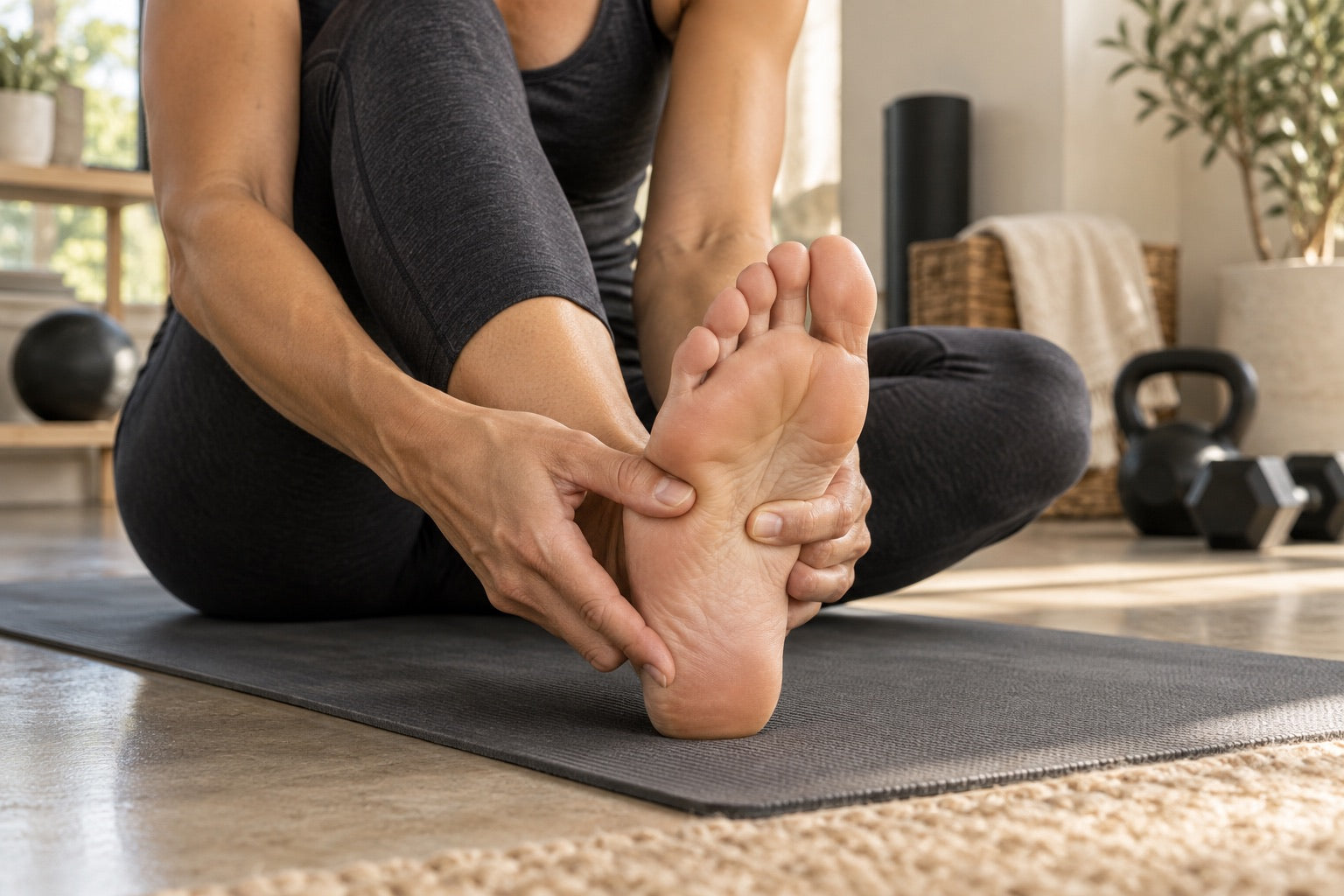
If you are taking a GLP-1 medication like Ozempic, Wegovy, Mounjaro, or Zepbound and you have started walking more, lifting, or getting back into the gym, you are doing exactly the right thing. The single most important decision anyone on these drugs can make is to pair the medication with movement. Weight coming off the scale is only half the story; staying active is what protects your muscle, your bones, your metabolism, and your long-term function while the number drops. It is no surprise that "Exercise for Weight Management" — explicitly including clients on obesity-management medications — climbed to its highest-ever position on the American College of Sports Medicine's 2026 worldwide fitness trends survey.[2] The science is clear that people who keep exercising through pharmacologic weight loss preserve more lean mass and hold onto their results better than those who rely on the drug alone.[3]
So let's be clear from the start: getting active on a GLP-1 is not the problem — it is the answer. But there is a quiet gap between the meal-and-medication plan most patients are handed and what actually happens at the far end of the kinetic chain, at your feet. Your appetite, your portions, and your dosing schedule get a plan. Your feet almost never do. And when heel or arch pain shows up three weeks into your new routine, that missing foot plan is usually where the answer is hiding.
Why Staying Active Is the Smartest Thing You Can Do on a GLP-1
Rapid weight loss from any source — diet, surgery, or medication — takes fat and lean tissue together. In the landmark STEP-1 trial of semaglutide, participants lost roughly 15% of their body weight, but a substantial share of that loss, on the order of 40%, came from lean mass rather than fat.[3] Lean mass is not just the muscle you see in the mirror; it includes the deep stabilizing muscle throughout your body, the tissue that keeps joints aligned and absorbs force. Resistance training and adequate protein — generally in the range of 1.2 to 1.6 grams per kilogram of body weight — are the two best-documented tools for blunting that lean-mass loss.[3] This is precisely why the fitness and medical communities are unanimous: don't just lose weight on a GLP-1, train through it.
That message is landing, and it is a good thing. The gyms filling with GLP-1 users represent millions of people making a genuinely healthy pivot. The issue is not the direction — it is the on-ramp. Because at the same time your body is becoming lighter and you are asking it to do more, the structures at the bottom of the chain are changing in ways your meal plan never mentions.
The Catch Nobody Prints on the Prescription
Here is the uncomfortable reality behind the optimistic headlines. Research presented at the 2026 ENDO meeting found that people losing weight on GLP-1 drugs actually became significantly less physically active during treatment, not more.[1] The intention to exercise and the behavior often diverge — energy dips, nausea, and a lighter frame can all conspire to keep people on the couch. That matters because the whole protective effect of a GLP-1 depends on movement being part of the package.
For the subset of people who do get active — the readers this article is written for — the risk flips to the opposite problem. When motivation returns and the weight is dropping fast, the temptation is to ramp quickly: from zero to daily long walks, from years off to bootcamp three times a week. Your cardiovascular system and your enthusiasm are ready. The connective tissue in your feet is not. The plantar fascia, the thick band along the sole that supports your arch, adapts to load slowly — over weeks, not days. Ask it to absorb a sudden spike in mileage or standing time and you get the classic overuse cascade: cumulative stress outruns the tissue's ability to repair, and the fascia becomes irritated and inflamed.[5] This is the same load-management failure we describe for why shedding pounds doesn't automatically fix the heel — except now you have added a training spike on top of it.
Three Things Change at Your Feet While the Scale Drops
To build a real foot plan, you have to understand what is happening under you. Three shifts occur more or less at once during GLP-1 weight loss, and each one changes how much punishment your feet can take.
1. Your heel's built-in cushion gets thinner. Under your heel bone sits the calcaneal fat pad, a specialized shock absorber roughly 1 to 2 centimeters thick that spreads and dampens the force of every step.[4] This pad is metabolically active fat, and rapid, large-scale weight loss can reduce its volume and resilience along with fat everywhere else. A thinner, less springy heel pad means more of each footstrike's force reaches the bone and surrounding tissue directly — a phenomenon we cover in depth in our piece on how rapid GLP-1 weight loss thins the heel's fat pad. You may weigh less, but each step can land harder.
2. The muscles that hold up your arch are part of the lean mass you're losing. Your arch is not a passive stone bridge; it is held in shape partly by small intrinsic muscles inside the foot itself. Those muscles are lean tissue, and they are subject to the same catabolic pressure as the rest of your body during aggressive weight loss. As they weaken, more of the job of supporting your arch falls onto the passive plantar fascia — the very tissue you are simultaneously asking to handle more activity. Losing arch stability from below while adding load from above is a squeeze that shows up as heel and arch pain.
3. Your body is recalibrating faster than your feet can keep up. Even good change is still change. Your gait, your balance, and the distribution of pressure across your foot all shift as your body mass and shape change over a matter of months. Tissues adapt to the stresses they experience, but adaptation lags the stimulus. During the fastest phase of weight loss, your feet are essentially being asked to operate a slightly different machine every few weeks — and they are always a step behind the new specifications.
Why the Meal Plan Misses Your Feet
A GLP-1 protocol is, at its core, a metabolic plan. It manages hunger hormones, blood sugar, and calories in. A good one adds a protein target and a nudge toward resistance training to protect lean mass. All of that is essential — and all of it operates above the ankle. Nothing in a standard plan accounts for the fact that the surface you are now walking, jogging, and standing on is being met by a foot with less cushioning and a less-supported arch than it had a few months ago.
This is the same blind spot that trips up new exercisers who are not on medication, just amplified. Enthusiasm and cardiovascular readiness run ahead of tissue tolerance. The difference on a GLP-1 is that the tissue tolerance is not just failing to keep up — in the case of the heel pad and intrinsic muscles, it may actually be moving backward for a while. That is not a reason to stop. It is a reason to plan for it, the same way you would plan your protein.
Building the Foot Plan: How to Ramp Without Wrecking Your Arches
The good news is that protecting your feet through GLP-1 weight loss does not require anything exotic. It requires treating your feet as a system that needs its own progression, just like your muscles do. Five principles cover most of it.
Respect the 10% rule. Whether it is running mileage, walking volume, or time on your feet, avoid increasing your weekly load by more than about 10% at a time.[5] Your motivation may be ready to double your steps; your fascia is not. Gradual progression is the single most protective habit you can adopt.
Feed the muscle you are trying to keep. Hit your protein target — roughly 1.2 to 1.6 g/kg — and keep resistance training in the routine.[3] Preserving lean mass is not only about the gym mirror; it directly protects the intrinsic foot muscles that stabilize your arch. This is where the meal plan and the foot plan overlap.
Replace the cushioning and support you're temporarily losing. This is the one most people miss. Quality footwear with genuine structure, paired with well-designed orthotic inserts, does two things at once: it reduces the peak force reaching a thinner heel pad, and it offloads the plantar fascia that your weakened intrinsic muscles can no longer fully assist. Foot orthoses are among the best-supported conservative treatments for plantar fasciitis in the clinical literature, shown to reduce pain and improve function in randomized trials.[6] Think of them as scaffolding while your feet adapt to the new, lighter you.
Mind your surfaces. A thinner heel pad feels hard pavement and bare hardwood far more than it used to. Bias early-phase walking and easy cardio toward softer surfaces — a track, a treadmill, a trail, a rubberized gym floor — and save the concrete for when your feet have caught up.
Treat early pain as data, not weakness. Sharp heel pain in your first steps out of bed, or a deep bruised ache under the heel after activity, is your feet telling you the load is outrunning the tissue. That is a signal to hold your progression, add support, and let the tissue catch up — not to push through. Caught early, this is a footnote. Ignored, it becomes the reason you stop moving, which undermines the entire purpose of the medication.
The Bottom Line
Staying active on a GLP-1 is not just permitted — it is the whole point. Movement is what turns weight loss into durable health, and every reader lacing up on these medications is making a choice worth celebrating. But the plan you were given manages your appetite, not your arches. During the fastest months of weight loss, your feet are quietly losing cushioning and arch support at the exact moment you are asking them to do more. Give them their own plan: ramp gradually, protect your lean mass, mind your surfaces, and rebuild the cushioning and support your feet have temporarily lost with structured footwear and quality inserts. Do that, and your feet become an asset in your transformation instead of the thing that ends it.
Frequently Asked Questions
Can Ozempic or other GLP-1 drugs cause foot and heel pain?
Not directly, but the rapid weight loss they produce can set the stage for it. Fast, large-scale weight loss draws down fat everywhere — including the shock-absorbing fat pad under your heel — and takes lean tissue with it, including the small intrinsic muscles that support your arch. With less cushioning below and less muscular support of the arch, more force reaches the plantar fascia on each step. If you are also ramping up activity, that combination commonly shows up as heel or arch pain. It is manageable, but it needs to be planned for.
Should I stop exercising on a GLP-1 if my feet start hurting?
No — stopping activity defeats the purpose of the medication and accelerates lean-mass loss. Instead, adjust the load. Hold your weekly volume steady rather than increasing it, shift to softer surfaces, make sure your footwear has real structure, add supportive orthotic inserts to offload the fascia and cushion the heel, and keep protein and resistance training in your routine. If first-step heel pain persists for more than a couple of weeks despite these changes, see a podiatrist.
How do I protect my feet while losing weight on Ozempic or Wegovy?
Build a foot plan alongside your meal plan. Progress walking and workout volume by no more than about 10% per week, hit a protein target of roughly 1.2 to 1.6 g/kg to preserve muscle, favor softer training surfaces early on, and use structured footwear with quality inserts to replace the cushioning and arch support your feet are temporarily losing. Treat any early first-step heel pain as a signal to hold your progression, not to push through it.
The WYATT takeaway
You are doing the right thing — getting active on a GLP-1 — but you are ramping activity into feet that are simultaneously losing heel-pad cushioning and intrinsic-muscle arch support. The meal plan manages your appetite; nothing is managing the load at your feet.
With less natural cushioning below and less muscular support of the arch, more force reaches the plantar fascia on every step. When that cumulative load outruns the tissue's ability to recover, the fascia becomes irritated and inflamed — the start of plantar fasciitis, often right as your progress is accelerating.
The FCSS™ Pro is a removable engineering modification that does the two jobs your feet temporarily can't: structured arch support to relieve the overworked fascia, and targeted heel cushioning to replace what the fat pad has lost. It lets you keep training through the weight-loss phase instead of being sidelined by it.
References
- Endocrine Society (ENDO 2026). People taking GLP-1 weight-loss drugs like Ozempic started moving less. ScienceDaily, June 2026. sciencedaily.com
- American College of Sports Medicine. The Future of Fitness: ACSM Announces Top Trends for 2026 (Exercise for Weight Management, including GLP-1 users). ACSM, 2025. acsm.org
- Massachusetts General Hospital. Preserving Lean Body Mass in Patients Taking GLP-1 for Weight Loss (STEP-1 lean-mass loss ~40%; protein and resistance-training strategies). Advances in Motion. advances.massgeneral.org
- Cleveland Clinic. Heel Fat Pad Syndrome: Symptoms, Causes & Treatment (calcaneal fat pad anatomy and cushioning role). Cleveland Clinic. my.clevelandclinic.org
- Ribeiro AP, et al. Dynamic patterns of forces and loading rate in runners with plantar fasciitis; overuse and load-tolerance mechanisms. PMC. ncbi.nlm.nih.gov
- Landorf KB, Keenan AM, Herbert RD. Effectiveness of foot orthoses to treat plantar fasciitis: a randomized trial. Archives of Internal Medicine, 2006. pubmed.ncbi.nlm.nih.gov
Reviewed and approved by the WYATT MVMT Podiatric Care Team — backing every step with 35+ years of custom orthotic engineering.